
97% Say They Need AI Training. 82% Never Use It at Work.
Team Sparta surveyed 330 training decision makers in Korea. 97% said AI training is necessary. 82% of those who took it still cannot use it at work. A night at Bloom with LilysAI and Team Sparta on where corporate AI adoption actually jams.


🤝 Bloom × Team Sparta × LilysAI
🎤 Yein Kim, Co-founder, LilysAI · Jaekyung Hwang, Consulting Part Lead, AX Training, Team Sparta
🎟️ Event page
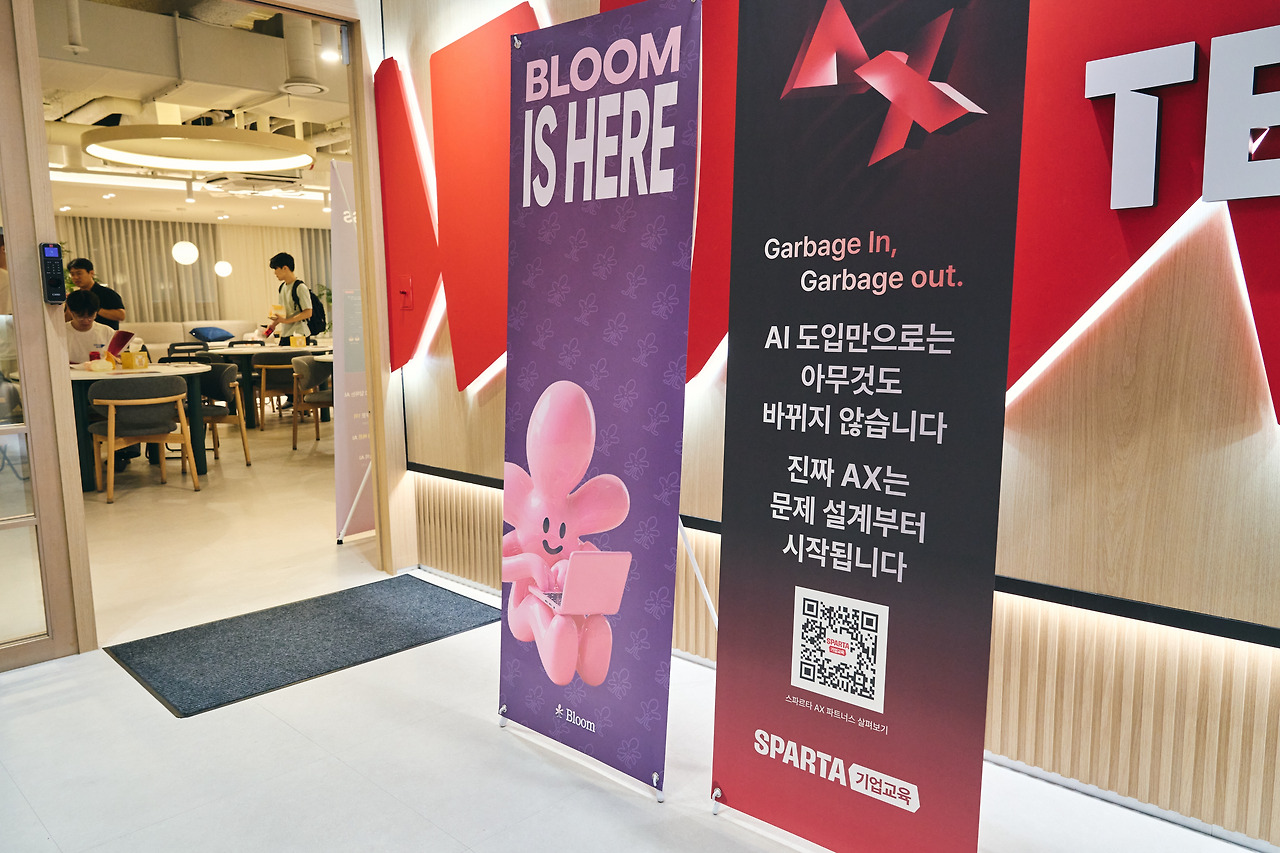
On Tuesday evening, September 15, we filled the Team Sparta office on the third floor of Anam Tower on Teheran-ro and asked one question: where is your company's AI transformation, really. Everyone says they are good at AI, and nobody holds a standard for what good means. That was the starting point. A report Team Sparta built by surveying 330 training decision makers sat on every desk. On stage we had the co-founder of LilysAI, used by 1.3 million people, and the consultant who built that report. The last hour was a roundtable, six to a table, where people put their own company's stuck points on the table.



Nobody had a standard for what good at AI means
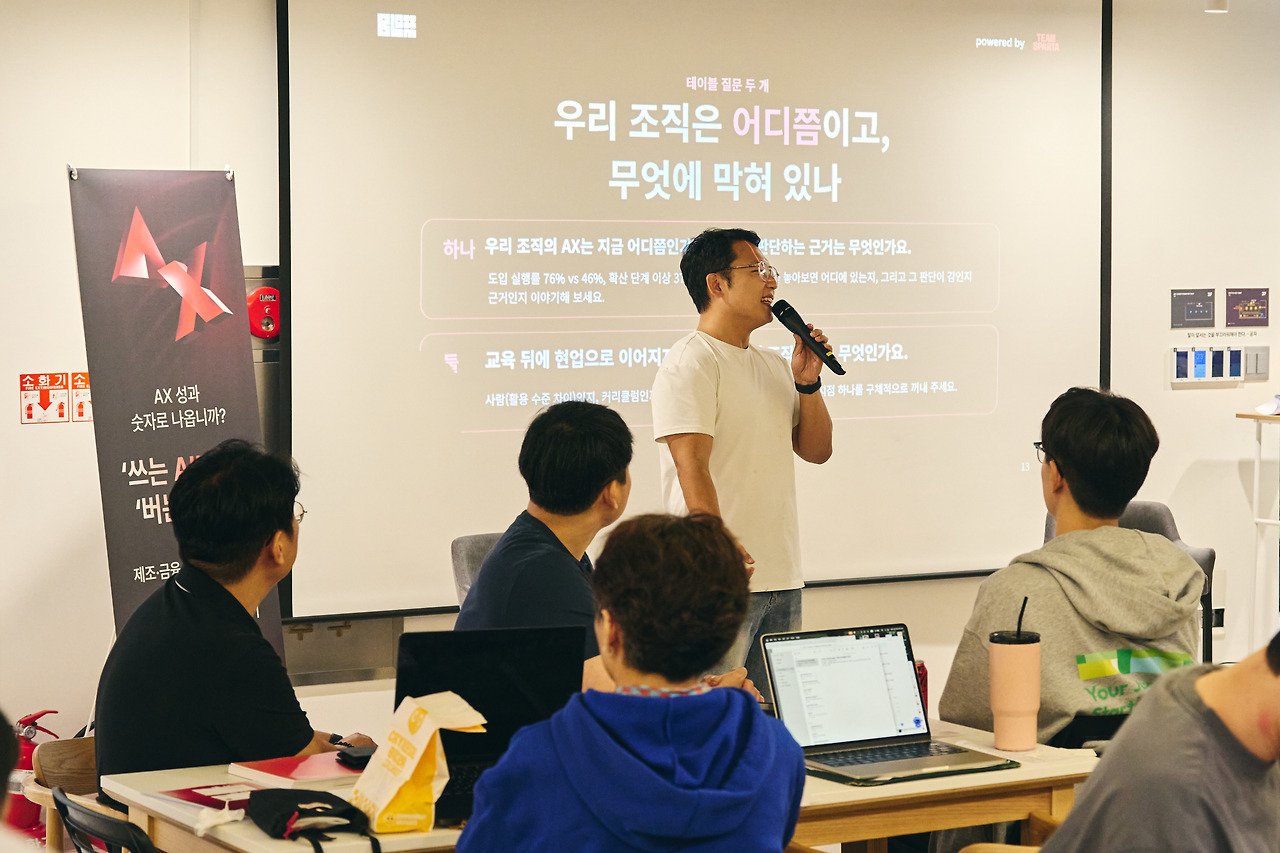
The first thing Junshu said when he picked up the mic was this. Everyone claims to be good at AI these days, and he had yet to meet anyone who could say what good means against a standard. So let's build that standard here tonight.
Then he asked for hands. People running an AX adoption project at their company, the ones who would call themselves the AX lead, went up all over the room. When he asked who works in HR, ran the training, and still feels the business can't use it, almost nobody moved. That gap between the two questions followed me around all evening. Close to half the room was at Bloom for the first time.
A very good knife came out, so we are cutting hair with it
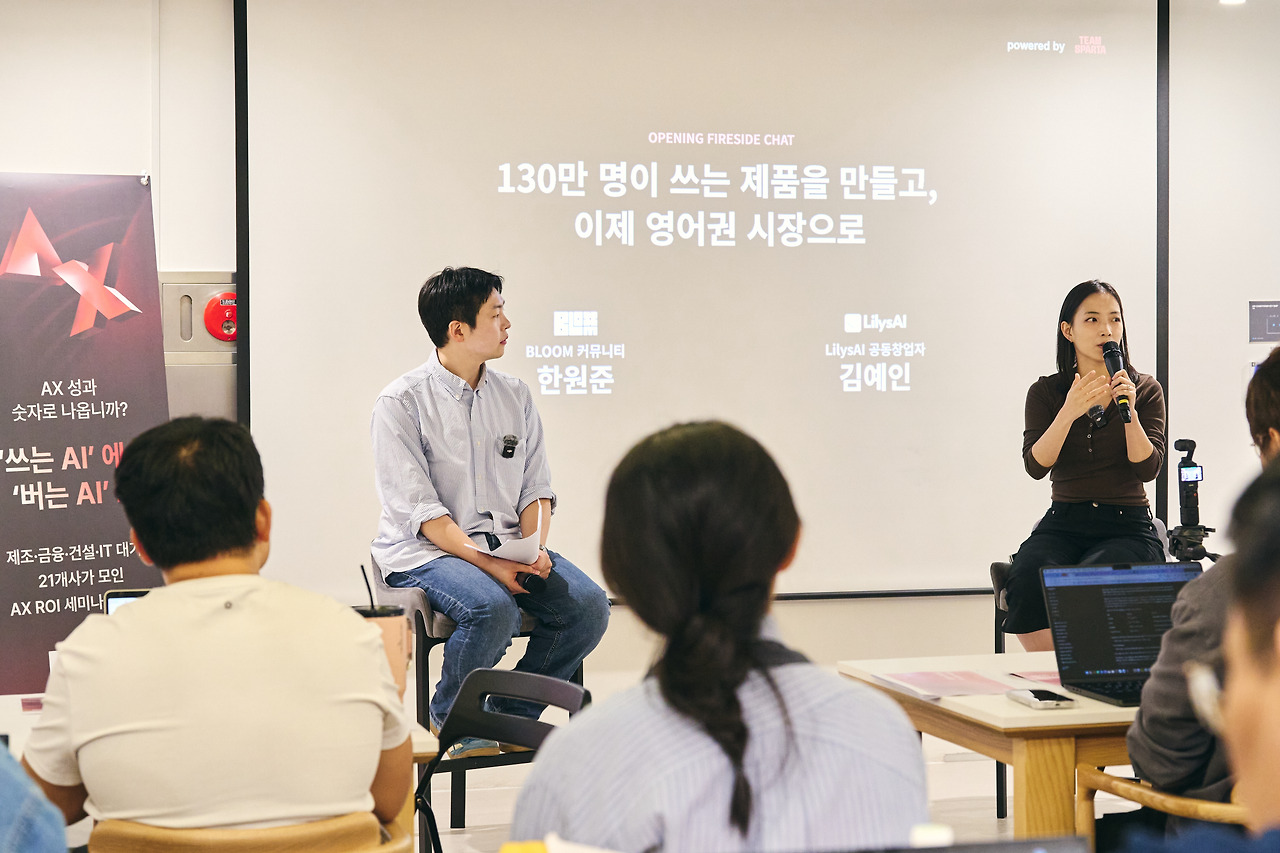
I ran the opening fireside. LilysAI went viral from its very first release, so I had wanted to meet the team for a while, and when I went looking for someone who could make AX feel concrete, nobody else really came to mind. When I asked who knew the product, a lot of hands went up.
LilysAI helps people who have to read a great deal understand it faster. Throw in YouTube videos, PDF papers, web articles, whatever, and it summarizes and answers questions. The product is three years old, and the one million figure I had seen in a recent article got corrected on the spot to 1.3 million. I started by asking what it felt like the first time she saw that number.
I was happy. But a number like 1.3 million users is mostly for talking to the outside. Our internal targets are retention and the paid metrics, so I was happy for a moment and then went back to work.
The health metric she actually watches is retention, then paid conversion and paid retention. She doesn't remember retention ever falling off a cliff, but she did bring up a new product. Readray, aimed at North America, where the share of people who come back a week later is 70%. Much higher than LilysAI, which surprised me a little too.
The reason she gave wasn't intelligence. It was usability. A lot of products today are so impressed by how smart the model is that they lose track of access and usability while they're busy being impressed.
An incredibly good knife came out, and because the knife is so good we are cutting hair with it and fruit with it. But hair is much easier to cut with scissors.
AI has reached about 1% of daily life, she said. A world is coming where AI is in your chair and your desk, and we're at the 1% mark. For the problem of reading, the best experience is information augmented right in front of your eyes, like Iron Man's HUD or the Kingsman glasses, so Readray was built to follow along while you read and layer research on top without being asked. Everything you need for the paper in front of you, laid out in front of you, would be hard to refuse, was the bet, and that's why retention went up.
Yein herself uses Claude as her main tool but Gemini on her phone and in Chrome, for one reason: she can summon it instantly. Pasting material into Claude or ChatGPT and saying do this, do that, do it again is cutting hair with a knife, she said. When you're reading, instant augmentation beats chat, and access and proactive suggestion are still overlooked behind the astonishing intelligence, which is where she thinks a lot of the future sits.
Danggeun is at 270 billion won while Grammarly is at 1 trillion and Canva at 4
Only a handful of people knew Readray. So I started with why build a new product when the existing one is working.
LilysAI is focused on coming into the service, uploading material and working on it. Beyond reading and understanding, you process it, turn it into quizzes, do all sorts of things. Readray narrows down to one flow and only one: getting the material in front of you into your head by whatever means. When I asked why narrow it that far, the answer turned out to be about a dream.
My co-founder Hyunsoo and I dream of building a product loved globally. We started the company because we are people who want to build software used all over the world, like Notion or Canva or Grammarly.
The numbers she gave stuck with me. Danggeun, called the most successful startup in Korea, has annual revenue of 270 billion won. Grammarly built 1 trillion on grammar correction alone, and Canva is past 4 trillion. To build a product like that, she realized, you have to get far sharper than they were.
Realizing it took a year. She fought hard to take LilysAI global and got a little traction in Japan and a little in Northeast Asia like Taiwan, and nothing at all in the English-speaking world. In Korea the path from launch to growth had been relatively smooth, but global was like learning to walk again, where the same action lands differently at every step. Only after a year of digging did the conclusion form that Readray had to be built new.
In Korea people are scared of a button with no name on it
When I asked whether failing to break into the US was a product problem or a marketing problem, the answer was both. But GTM and product are one body in the end, and that was when it became clear the product had to change.
North American UI is far more extremely simple. In Korea a button needs a label or people won't press it, while in North America a label on every button reads as too much text and people dislike it. In Korea, a button with no name is frightening, because you don't know what happens when you press it, so you don't. Telling people they can do all sorts of things once they drop material in doesn't land. You have to sharpen it down to: right where you're reading that paper, I'll augment it like a HUD.
I heard this as the difference between the super app and the niche. Asia wants many functions in one app, the US wants narrow and deep. I also learned for the first time that night that what people call an Asian sensibility isn't design, it touches UX.
I had seen the phrase AI lens in an article and pictured hardware like a contact lens. It turned out to be a Chrome extension, with a desktop app coming. Open a paper and it detects it and offers to analyze. It has shipped, but as a closed beta, blocked for Korean users and filtered to North American users only.
I also asked whether that many people really read papers, since by Korean standards it looks like a small market of PhDs and research institutes. Yein said Jenni AI, aimed only at researchers, is at annual revenue of 20 to 30 billion won or more as far as she knows, and she sees it as a large market the same way Grammarly built 1 trillion on grammar alone. Readray has three kinds of customers, researchers, investors, and company leaders, all people who have to read dozens of papers and reports and videos a day and make good decisions. The region covers the US, Canada, Australia, the UK and Europe, treated as one English-speaking set.
YouTube added a summary button and retention did not move
I asked whether each model release like GPT 5 or Opus 4.5 felt like a threat or a lever. There hasn't been a moment of crisis yet, she said. The last year was spent landing global, and growth kept going.
People worry a lot for us. YouTube can summarize now, there is a summary button, what will you do. But there has not yet been a moment when our retention or churn moved because of it.
The reason was who the customer is. A LilysAI customer watches an enormous amount of investing content on YouTube in order to make an investment decision, and five bullet points will never get you to a decision. The need is to absorb the material completely and only faster, and she feels not many products have properly solved that.
So LilysAI summaries were built in layers to give the confidence that nothing important is missed while the time drops to a tenth. A product that goes ta-da, look at this, gets early traffic and then everyone leaves, while a product that solves the real problem all the way through gets recognized eventually, she believes. One general purpose AI doesn't solve this kind of detail for you.
She added that ChatGPT and Claude also get told they're finished every time a competitor ships something. It's an insanely fast market, so keeping product development speed very high matters, which is why the thing she actually wrestled with longest wasn't the model. It was global marketing.
On Reddit the first question is who are you
The story of moving what worked in Korea and watching it fail was one I wanted to hear all the way through.
The first growth in Korea came through communities. She went into open KakaoTalk rooms and Discord servers like Bloom, made notes with LilysAI summarizing genuinely good material those communities would like, and handed them out. The material was good, so people naturally came in wondering how it was made, and influencers inside those communities introduced it on their own, and it grew by itself.
We tried to reproduce it in North America, but filtering on Reddit is extremely strict and anything you do gets called an ad. Korea is small so people help each other and look at you with an open mind. In North America there is a lot of, uh, who are you, and it did not work well.
US communities are far more closed than expected and suspect an ad or a phishing attempt first. Nobody clicks an unknown link. I asked if there was anything she'd do differently going back, and there was nothing she regrets. What works now is social marketing with micro influencers and DMs on X, and it's working so well she's wondering whether this is the answer.
Short form is the biggest axis of that. She doesn't make them herself but casts influencers with the right chemistry, an influencer doing a PhD, or a lifestyle influencer. Someone satisfied with the product spreads it to friends, and this is where product and marketing connect, because the wow moment of the product has to fit in a short video.
Readray is Read plus Ray, as in a beam of light, and there's a moment where a beam sweeps across a PDF or a YouTube screen and scans it. Putting that moment in the video is what produces the what is that reaction. English speakers hear Ray as a beam immediately, though I wondered whether it would stick for someone whose first language isn't English. Built for North America from the start came through in the name itself.
We took no investment, so we got good at cost control
I asked whether AI costs are a burden in a period when prices fall and then rise again, and the answer, unexpectedly, started with investment.
We have not taken investment so far. We started the company thinking we would raise if there were a reason, but we passed breakeven within a year and have been profitable since, so we did not raise. Because of that I think we managed costs extremely well from the beginning.
Three years in, the company is still growing while profitable, and because it all comes out of their own pockets they grew while checking every month what goes out and whether anything is leaking for nothing. Model costs were much higher at the start, but there was a strong belief prices would fall fast, so they added features aggressively on that assumption. Prices fell even faster than expected.
The other axis of the cost question was willingness to pay. AI doesn't assist a person, it goes as far as replacing the work the person was doing, so someone who paid ten thousand won for legacy SaaS now pays a hundred thousand, two hundred thousand, more. If the value to the user is right, the cost structure isn't the thing to worry about. Recently they connected company spending records and API usage to AI and reviewed all unnecessary spending, cutting about 30 million won a month within days. An AI product doesn't fail to survive because of cost, in her view. If it failed, it didn't deliver enough value.
For the record, the team is five people. Staying at five while profitable is the picture every founder in that room dreams about.
People only decide, AI does all the doing
How five people build a product was the part I most wanted to hear that night.
The answer was authority. One person holds A to Z and runs with it. A front end engineer doubles as the planner and thinks about everything from product planning to GTM, and Claude Code Max is used by marketers as well as engineers, with each engineer running three at a time. Using it at full power matters, she said, and the evidence she pointed to was the US. Teams of twenty producing tens to hundreds of billions in revenue are appearing there, all of them teams that pushed productivity to the limit with AI. So everything starts with AI drafting, and what's left in human hands is only the decision.
It didn't start out that way, she said, and brought up the early days.
In the AI era you can run so many things at once that one person could be running a hundred in parallel, but at first we could only run one or two. I looked at why, and the problem was finding the work.
Looking again at why they couldn't find the work, it turned out nobody knew what problems the product and the team actually had. The remedy Yein came up with surprised me a little: homework. Every team member finds twenty new statistics a week and posts them in Slack. Twenty new facts produce twenty new things to do.
Even the digging for numbers goes to AI rather than people. Bring me these numbers, and AI brings them, and the person moves from there to this is a problem, let's do this. Deciding work from statistics also made the pointless work disappear, she said, and now there's even a guideline that everyone's Claude Code always has twenty or more threads running with five of them on statistical analysis.
I heard this as something you can lift straight into a company of any size. Most teams could run a hundred threads if they had the tokens and don't get the efficiency because they don't know what to hand over. It came out of the team thinking hard about what more to give, on the view that AI runs so fast that people have to run alongside it.
Anything I touch in a browser, I have tried handing over
I asked personally how she pushed to full power like that, and the answer was almost disappointingly simple. Whatever work she has to do, she tries handing it over first, whether or not it works.
Saying she felt awkward promoting another product, the example she gave was the AI browser Aside. Moving off Chrome felt like a burden but she moved anyway, and after an uncomfortable start she now hands Aside everything she touches in a browser. Email drafts all get written, and managing influencers in Discord gets handed over with a go figure it out.
I had heard that people who are good at AI use it the way you use an assistant. I hand over all my email too, but listening to her, the point was to hand over scheduling and Google Calendar as well. People who have worked with a personal assistant are the ones who run AI well, because they've handed everything over. The gap is between people who pushed past do I really hand this over, it's faster if I do it myself, and people who didn't.
When I asked whether handing something to AI had ever left her with more work, the answer was that only two things are left she doesn't hand over, and everything except those two gets handed over. One is making content and writing. No matter how much she tried, it didn't work. Writing something people will actually read still comes out average, so ideation is shared, but writing that goes to users she does herself. Marketing copy and assets are the same. AI tends to land near the average, so it doesn't write copy with taste.
The second is communicating closely with users. We are a team that thinks talking to users matters enormously, so we do a lot of interviews and we still handle all customer support ourselves. AI could do it, but I think it matters that I feel and keep that sense.
Organizing what came out of those conversations can go to AI, but understanding the customer deeply matters enough that it takes the most time. Keeping only the work that sits next to a person and handing the rest to AI sounded a little bleak, but there was no arguing that it's the better way to use it.
Past the ta-da, you have to do a lot of unglamorous work
At the end I asked for advice for people trying to build AI into a product and people who want employees to use AI more. Saying she wasn't in a position to advise, she gave two things from experience, and the first was this.
Products that go ah, this is cool, ta-da, there are so many of them and they can go viral, but in the end they become products nobody loves.
For someone building a product, the point was that you have to keep asking why users behave the way they do and what they actually want, and do a lot of genuinely unglamorous work before something usable comes out. On social media only the ta-da, isn't this cool looks meaningful, while real customers feel and are moved by a single small difference in usability, she said. The second was aimed at people using AI: this is the moment for volume rather than quality. Raising volume by tens of times and then thinking about quality is the way that actually works. What she wants to prove over the next year is that English-speaking customers grow larger than Korean ones.
Two questions came from the floor. On how she chose a domain given how expensive they are, the answer was that it's about 200,000 won a year, which is cheap. The second was about resistance to AI among highly educated users like investors and researchers, and whether lowering that resistance was the big lever or the product simply won them over. There was resistance early, she said, because many people find it extremely hard to try an unverified product. But rather than that lens, she focused on finding people in pain right in front of her.
If you are a first year PhD student and you understand nothing about this research and you have ten papers to read, you do not have the spare capacity to think about whether you have a problem with AI.
Investors are the same. Watching YouTube is a pleasant activity, but for someone with tens of millions of won riding on it, it becomes an urgent problem. For leaders, studying other companies' AX cases isn't optional either. As Junshu said, it was a deeply fundamental answer. Find the people who feel the pain.
We turned what we used to say by feel into numbers
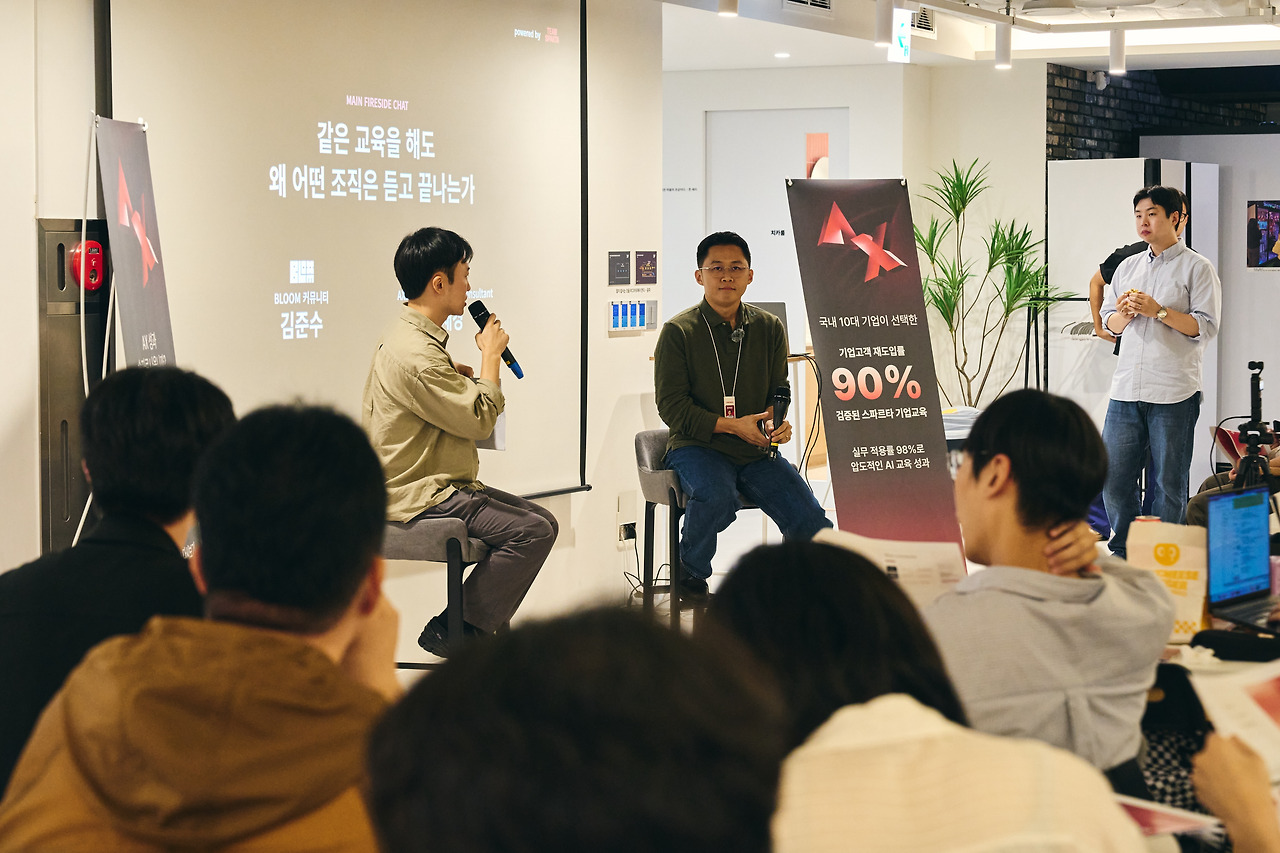
Junshu ran the main fireside. The report on every desk was the 2026 Corporate AX Benchmark Report from Team Sparta's corporate training team, and Junshu valued that it offers a numeric standard for judging whether you're doing AX well. The two most interesting numbers: 97% said AI training is necessary, and 82% of the people who actually received it said they can't really use it at work.
It felt a bit like studying English to me. Everyone knows they should study English, and then you put them through a course and say okay, go speak English now, and they say I can't.
LinkedIn overflows with reports and the usual outcome is saving one to read later and never reading it, so we decided to read this one together with the person who made it. Jaekyung Hwang leads the consulting part of the AX training team in Team Sparta's AX business division. By career he's a tenth year B2B salesperson who started selling air conditioners to construction firms at LG Electronics B2B, passed briefly through overseas sales, sold at the Apple Korea business team, and has been at Team Sparta for two years and ten months.
Junshu's first question was fairly direct. Was this report made as a lead magnet, or to organize the difficulties felt in the field?
When you run a lot of training you end up telling customers things by feel a lot. How are other companies doing it, what are other companies struggling with, what are they doing well. I was saying it by feel to each customer, and I wanted quantitative data behind it.
What AX leads are most curious about is always other companies, he said. The hope was that it would become background knowledge for designing training or planning company-wide AX, and something usable in a report, and yes, he added, it was also made to bring customers in and give us something to talk about together. I found that honesty is what made the rest believable.
The number Jaekyung stared at longest was also 82%. Personally it made him wonder what all the training they'd run amounted to. But the number he considered more important sat next to it. When a capability diagnostic is run and the curriculum is designed well, training succeeds 32% of the time, and in the training industry one in three coming back with high satisfaction is a high number, so that's where he saw how much diagnosis and design matter.
The report's sample is 100 people at large enterprises, 106 at mid-sized firms and 124 at small firms, 330 in total. 108 HRD staff, 106 executives, 74 C-level and 42 training planners, with manufacturing the largest sector at 45%. The adoption execution rate is 56% overall, and only 22% have actually settled at the diffusion stage or beyond.
Everyone within ten meters uses AI
Junshu pointed at a number: half of companies said they were level with or ahead of competitors, and 29% of those hadn't even started adoption. Where does that gap come from?
Jaekyung didn't think anyone was lying. The AI you see in the field and the AI you see from a desk at head office are simply different, he said. For one thing, the comparison isn't big tech or IT companies, it's a friend. You ask whether it's been adopted at their company, hear not yet, and conclude that you're ahead. And no distinction gets drawn between using and adopting. If the person next to you writes a report with ChatGPT, that counts as ahead, when whether the company adopted it and applied it to work is a completely different story.
The people doing planning or AX from a desk, everyone within about a ten meter radius in front of them uses AI. So when they look around and see people using it, they are using it, but whether the company is using it well came out a little lower.
So I asked what a company should look at to measure its own position, something a practitioner could check tomorrow. Can you list five outputs you produced with AI in the past week. Can you name a person on another team, not the team you lead, who uses AI well. Has any work actually disappeared because of AI. Junshu welcomed how concrete it was. Running roundtables, the most common worry is how to measure AI, and he once told an HR person that he organizes meeting notes with AI and was asked whether that wasn't a waste of tokens. Our company has unlimited tokens and he'd been using it freely, so it struck him how differently people see this.
There is a test for whether you use AI well
Team Sparta built a separate diagnostic that measures whether you use AI well. Junshu asked whether it was the which of the following is not a Claude model, pick between Astra and Codex kind.
By Jaekyung's account, there was real demand among HRD staff to diagnose capability, because there was no quantitative data on whether people use AI well. Tests exist on the market, but they ask you to pick the correct description of prompt engineering, which is closer to B2C, and for B2B the judgment was that you have to look at whether the capability to use it well is there, not tool trivia.
So they built it on four axes: prompt engineering, data analysis, ethics and security, and workflow. Twenty multiple choice and two open questions, and the open ones give you a persona. You're an HR manager, in this situation you need to pull this data, how would you write the prompt. It isn't a literacy quiz, it asks whether this person and this organization have the capability to use AI well, and whether they have it after training. No company uses it for new graduate hiring yet, but some have rolled it out company-wide, and one financial firm adopted it to add an AI item to promotion points.
You write the report with AI and the template stays the same
I asked what the 82% who can't use it after training actually looks like in the field.
The biggest weakness is that people cannot carry the outputs from the training back inside.
Whether it's a skill built during training or an MD file organizing it, it stays in a personal folder, he said. What's missing is distributing it to the team and making the organization use it, and what blocks that is templates and approval lines. People learned AI and the report template and the approval chain are unchanged, so nothing changes, and when you write the report with AI and then have to transcribe it again by hand, it becomes, ah, if it's going to be like this I'll just do it the old way without AI.
Junshu said that ah, if it's going to be like this is the line he relates to most. That's how people end up doing it themselves again.
Work piles onto the person quietly using it well
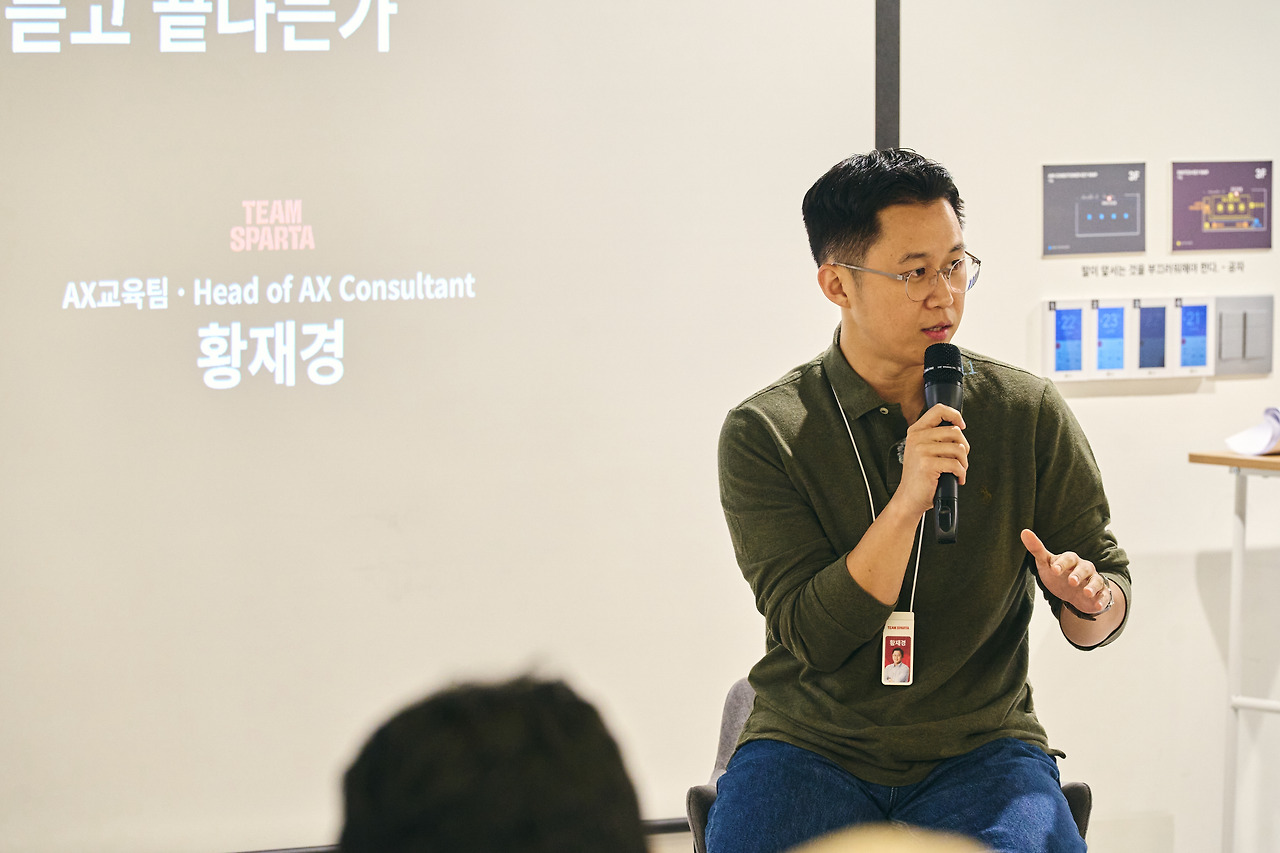
The report says what blocks AX isn't technology but people. Regardless of size or sector, the number one barrier was the gap in AI skill between employees, mentioned by 55%. I asked what that spread actually does inside an organization.
When I say AI ability differs, in the bluntest terms I often thought during consulting that meetings inside the company break down quite a bit.
The time put into a meeting differs to begin with, he said. One person prepares in thirty minutes with AI and another spends from Monday doing it the old way, so the grain of the opinions and the hours behind them differ, and the meeting itself changes. Then work piles asymmetrically onto the person quietly using AI well. You're good at AI, so do it well with AI, and work that should be spread evenly goes to one person.
The same thing happens on the executive side. Because of the skill gap they either fail to support it properly, or they support it and then treat it as a magic wand. It all worked in the YouTube video I watched, and the best you bring me is a translated business email, he said people hear. The most important meetings in the company break first, and reporting lines and outputs break with them, which he's seen with customers several times.
Junshu added something from an early roundtable, where a company gave an executive tokens and asked for a video edited with AI, and since the executive couldn't use it at all, he edited it by hand and submitted it as if AI had done it. Not a joke, it actually happens.
Set the process to the top and the training to the bottom
If there are people who use it well and people who don't, where should a company set the bar, Junshu asked. At the average? Jaekyung said it wasn't the right answer but split it into the two lenses he uses in consulting, how to change the process and how to run training.
The process is much easier to set at the top end. Pick the roughly 15% who are champions or ambassadors and encourage them to build the process that fits your company best. That is the most effective and the fastest. Training has to be set at the bottom. If you set it at the top, and there are more people at the bottom, they give up an hour in.
Boiled down to one line: process to the top, training to the bottom.
I also asked why the people who won't use it no matter what refuse to. I'd assumed it was either inertia or a sector that genuinely doesn't need AI, and the answer was neither.
What I feel is that they do not use it because there is no loss in not using it. It is not that they have no time. It is not actually difficult either. But nothing much changes for this person. No more benefit, and no penalty. If anything there is more risk.
Using AI seems to create more work, saying you used AI raises expectations, and doing it the way you always have seems to finish faster, so reason it out and there's no loss in not using it and therefore no reason to. That line stayed with me long after the event ended.
The size gap is money and the sector gap is data
The adoption execution rate is 76% at large enterprises, 50% at mid-sized and 46% at small firms. By sector, IT is 78% and manufacturing 44%, a full 34 point gap. I asked whether the difference comes down to the scale to pay for tokens.
The size gap is money, he said. The share spending over 50 million won a month on AI is 41% at large enterprises and 9% at small firms, and over 300 million a year is 28% versus 3%. The volume of tokens you can pay for and the number of AI accounts is the largest gap between large and small. But the sector gap wasn't money. IT and manufacturing are furthest apart, and that's a data difference. IT already works with digital data organized in Excel and CSV, and going to train at a fintech or IT company you find the data well organized, while in manufacturing the data may be digital and has often never once been opened.
I went into a steel mill once. They said we had to pull data off the machines, and they had me put on a helmet and line up and follow them. And they brush the dust off you. You plug a USB in here and the data comes out.
When he asked how they'd been looking at data until then, they'd been processing it so the results came out well and sending it up to head office. The gap between IT and manufacturing isn't money or ability to pay, it's the data source and how much that data gets used. Junshu added that he once asked for data in a meeting and was handed a bundle of USB sticks, this one is 2025, this one is 2026. That was when he saw why manufacturing AI is hard.
The report shows different sectors stuck at different points. In IT, manufacturing and healthcare the skill gap between employees is the top barrier, while in finance and retail the absence of a tailored curriculum rises to number one. It means training content fitted to their sector is rare on the market, and in retail a full 88% say applying training to real work is difficult. In manufacturing there's also a figure where the sense of crisis is 68% while executive involvement is 12%.
They ask what we will build, not what we will learn
Even at the most advanced large enterprises, only 37% are past the diffusion stage. Nobody has finished, so I asked what the companies furthest ahead do differently.
Rather than focusing on what to learn, they think a bit more about what they can produce. Not teach us about Claude Code, but we want training where we use Claude Code to build a dashboard from this data of ours.
When a request comes in like that, he feels they're ahead. Another sign is treating training as accumulation rather than a program, where the materials from cohort one become teaching aids for cohort two and the outputs of cohort two help cohort three, and one company is on its sixteenth cohort and still improving. And advanced companies now think about how to use tokens economically. They handed AI out freely, saw the cost, and now think ahead about efficient use and split training by level. Large or small, the needs of the companies out front were that different.
The company with both urgency and budget is the most dangerous
Junshu said the stories about companies that fail are more interesting and moved there. Success in applying training to real work splits by how the training was designed: one curriculum for everyone is 11%, designed by job function is 18%, and designed by level after a capability diagnostic is 32%. If the best is 32%, that's one in three, so what happened to the other two?
Jaekyung said that was exactly right. When you diagnose capability, design well and move into training, one in three produces results, and that's accurate. For a training company, diagnosing, designing and training is the entrance. Paving the path at the entrance and pointing out that this way is easier is what they can do, and running that path all the way to the exit is one in three. The other two, he said, hit two problems.
One is executive risk. They either don't support it, or they support it and then make unreasonable demands. I gave you this, so bring me that.
The most dangerous, we think, is a company with both urgency and budget. With both, they want a magic wand. I am pouring in budget and our sense of crisis is this big, so bring me more and better, faster.
Companies like that can't endure the path from diagnosis through design to training. The other problem is companies that can't picture what waits at the exit. You need a picture of the finish line, and there's a fair amount of HR that says let's just run the training and see what we want, he said. Good training is hard to build from there. Team Sparta can design as far as the entrance, and the exit has to be pulled by the company's environment and systems, was how Jaekyung put it.
The curriculum is the last thing we look at
I asked what Team Sparta looks at most when designing training, given they train several of Korea's ten largest companies, and the answer was unexpected.
The curriculum is the last thing we look at. The first thing is the company's environment.
It might be the IT environment, or something particular to that industry. Some run an LLM developed on premise internally and some take an external API, so they look at that first, and then at distribution. Run the diagnostic and you see whether there are more level ones or level twos, and only after deciding what distribution to look at to lift these people to level three or champion does the curriculum come in.
There are also companies where no amount of good design will work, he said. It shows less at the moment you walk in than as you talk. No understanding of their environment, told to do it from above, no concrete blueprint, no clear theme for AX, has to train quickly, budget has landed, results have to come fast, outputs unknown, just do it with us.
There were also cases he read wrong. Executive training at a large holding company, where executive training is usually insight lectures or mindset training, but this one set out laptops and wanted to start from login and prompts and end at vibe coding. Claude Code had only just arrived and they wanted to do that.
I tried to stop it. Absolutely not. The moment that black screen comes up for executives, I said it just will not work in a CLI window, and instead the feedback was that the process was excellent.
Companies that share their environment honestly do well, he said. The ones that say this works, this doesn't, and here's what we need. In practitioner training at a manufacturing company where the data differs by process, someone vibe coded an agent that collects and unifies eight kinds of data from eight processes. Seeing that, you know this company understands where its problems are and how to prepare its data, that it's designing its ontology well. Junshu added that he'd heard executives are actually good at AI. Delegating to an assistant is a habit, and handing the same thing to AI pulls out that much.
They do not lack the tool, they do not know where to use it
Plenty of companies hand tools to employees and assume they'll figure it out, so I asked why that doesn't work. The report shows ChatGPT and Gemini adoption above 85%, so the tools are already all there.
I think these people do not so much not know the tool as not know what to use in their own work.
In sales there's a workflow from A to Z, and you have to show them that C or D can be replaced with AI, he said. Without that sense, they don't know where or in what context to put AI. From an executive or buyer's view it seems like they gave it out so people will figure it out, but that figuring it out is hard. Analyzing your own work and breaking it into pieces systematically is difficult, which is why he insisted the capability diagnostic include a workflow axis.
Juniors came up too. A senior has done the work for five or ten years and knows what to feed AI in what order to get the result they want, and even if they're bad with the tool their domain knowledge is deep, so a little guidance produces good results. A junior doesn't know the work itself, so they don't know what to feed it, and for juniors they use guided projects. You're in marketing, there's no budget, and the ad banner launching tomorrow has to go up in the messenger today. Practice what prompt produces the output. It's designed to lift a shallow domain to a comparable result.
Report that you cut four hours to thirty minutes and a follow-up question comes
A lot of people came who have to report AI adoption results upward. Some places used to say they'd measure token counts, which makes no sense now, and every company has a different standard for whether to look at time saved or work efficiency.
Time saved is very good for the first report, he said. The problem is the second one, where if you go with time saved again, executives have a follow-up question in common. What did you do with the time left over, and what more could you do with the time you cut.
Not simply that something taking four hours now takes thirty minutes, but that work writing three reports that took four hours now takes five minutes, and we automated ten of them. Going that way gives you reporting material that blocks the question itself.
So his advice for the second and third reports was to build the slides around who used AI, on what work, and how that work was converted into something else.
Name five things you did with AI last week
The answer to what one thing you'd do tomorrow was practical too. Practical questions show the bare face of AI use best, he said.
Ask two or three team members around you to name five things they did with AI in the past week. That alone roughly gets you there. Five is not easy. Doing it with AI at all.
If there's room, ask one more: what work did you eliminate with AI. Not reduced, eliminated. When I asked what one question people should ask each other at the roundtable, he said to ask about what isn't working rather than what is, because that's where conversation flows. Ask whether there's a rule or a situation at their company that blocks AI use. We're told to use only the internal LLM, or prompts wear out if you use ten of them, and small talk starts there. What's blocking me at my company right now, and why is it hard for my company to grow explosively.
Three questions came from the floor. The first came with a method attached. Like being told to write out your work process, this person kept asking AI how it works and built a canonical version and kept updating it, and wanted more tips like that. Jaekyung laughed that if he knew, he'd be using AI far better himself, but said that if organizing a workflow right away is hard, focusing on one thing and asking about that work repeatedly is good. Then he added one thing.
If the data is not organized, AI is honestly just a very simple model that tells you about King Sejong and the MacBook, so the question is how you can train it on the data you have.
In sales that means revenue data and customer data, calls and emails, and whether the CRM you use connects over MCP or can be pulled by API. Turn unstructured into structured and structure it so AI can learn it, he said, is one of the ways to use it well.
Someone pushed back and said they are skeptical of training
The second question was an objection. Someone working in AI solutions said they lean negative on training, especially AX training. They agree with training that raises literacy, but are skeptical that training reduces people's work. What people want is for someone to build the agent that solves the problem they have, and rather than teaching people to build tools, isn't it best for someone to build the tool that solves my difficulty and just tell me how to use it.
If you were handed the job of summarizing YouTube or papers, the example went, you don't build the tool, you use something like LilysAI and hand the result straight on. I think that question is what kept the session from ending as an ad.
Jaekyung accepted that the approach is very good as process design set to the top end. A company has several problems that don't resolve cleanly, and the 10 to 15% of champions who use it well building a process and spreading it is genuinely necessary and can matter more than training, he said. One thing catches, though.
AI moves pretty fast. There is no guarantee that the agent or skill those people built lasts forever. So in the end I think the people at the bottom need to be able to adjust the agents and skills they receive a little to fit their own work.
Digital literacy as UNESCO defines it isn't reading and writing, it extends to using, integrating, modifying and managing, he said. Building a process and distributing it matters enormously, but modifying what you received at a very small scale to fit yourself requires literacy training at the bottom end. It might also be a difference in how far you take the word literacy, he added.
Development was 15%, defining the problem and the data was 85%
The third question took a company-wide view. There's a lot of talk that you should redesign work assuming AI rather than attaching AI to the existing process, and the question was whether that change is actually happening inside Team Sparta, with detail if so.
Team Sparta has a separate organization for AX and spends a lot of time redesigning work, he said. For the training team alone, building and managing training, meeting customers, booking instructors and organizing labor costs and tax invoices had been split up very fragmentedly, and it would have been good to have a SaaS that unified this, except there was no such SaaS in the world.
No CRM fit and nobody could build it for them, so they decided to build it themselves, and when they defined the work by part from the start, organized how the parts connect and rebuilt the workflow, Claude assembled the system faster than expected once trained on that. Company-wide it extended to finance management, the hiring system, and document automation connected to Google Workspace.
The actual development time was under about fifteen percent, and eighty five percent went to defining the problem and gathering the data.
The point was that the core is the step before the tool, looking at the whole of the work end to end again. To build company-wide AX, building the data and organizing it into a form AI understands is what matters, and AI is very good at the rest.

Only 3.6% fed the diagnostic results into training design
From the second report delivered by QR, the 2026 AX Training Trend Report, I picked up more numbers. Same 330 respondents. 56.3% of organizations are executing AI adoption, and 54.5% feel their company is behind the pace of Korean companies overall. 74.6% say executives are interested in AX, while only 15.8% have executives driving it as a top priority themselves. The trigger for feeling AX was needed was AI news and content at 40.6%, followed by executive instruction at 22.7% and competitor cases at 17.9%. As difficulties, 54.8% said employee AI levels vary, while no curriculum fitted to our job and industry and no application after training each came in at 50.9%.
Why Jaekyung led with the diagnostic is in this report too. 51.5% of organizations feel a capability diagnostic is needed but do not know how, and only 3.6% actually fed diagnostic results into training design. On measuring results, 29.7% look at productivity and time saved, 28.8% at frequency of tool use, and 20.3% want to measure and do not know how. 61.5% intend to finish company-wide AX by 2027, and the largest group, 27%, has a plan but no budget allocated.
Demand is shifting too. Among inquiries to Team Sparta, common job training fell from 96% in the first half of 2025 to 51% in the first half of 2026, while job-specific rose from 4% to 41%. The number of training types requested per inquiry rose from 1.24 to 1.89. It means please give us AI training has become please design common, job-specific and leadership together.
In a prompt challenge with 262 HRD staff, the basics of specifying the task and the output format were solid at 93% and 85%, while breaking work into steps was weakest at 42.4 points and only 37% asked for verification of the result. Not do it all for me, but split it, assign it and verify, is the report's conclusion.
The person on the most expensive plan was the table lead
The last hour or so we sat six to a table. The table lead was set as whoever subscribed to the most expensive AI plan, and there were two questions. Where is our organization's AX and on what evidence. What is the wall between training and real work. At the end six table leads came up front and relayed what had come out.
The first table's lead was a solo founder four months into their company. A Team Sparta training team member at the same table said with confidence that the company has reached the cost reduction stage with real outputs and concrete numbers. A manufacturing enterprise engineer was getting results collecting field data including overseas plants in one place and processing and training on it in an on-premise environment, and a solo business owner who trains corporate communication had recently vibe coded a website for a doctor client and said that as a non-developer the coding works to a surprising degree while AI is still quite hard for everything else.
The table lead's own story was candid. They started the company after watching someone's lecture about building a company that runs AI agents like employees, and doing it themselves was different. Coming from engineering, they're confident they can take development all the way to a product, but a business owner isn't a builder, they have to revise strategy themselves and do sales and marketing too, and running agents like employees in that territory is still hard, a limit they said they feel a lot lately.
The second lead was a PO leading an AX TF at a service company. It began boldly, helping non-developers use AI, but because the business is busy, learning AI takes more time and the reaction was that work doubles, so adoption fell short of expectations. They came to think about lowering that hurdle. The answers at the table went two ways. Mature organizations had such variance in the skills each person built that they were reaching the stage of managing them as one, and one organization ran a hackathon every two months on the CEO's will and attached extra training for people who struggle to keep up.
Third was a new developer. The company shares one thing built by the AX team rather than individuals building their own, which was good as process, but it's an established company and suggesting something new is hard. Other team members use AI well for parts of their work and find it hard to see the whole of their work as a process. The conclusion landed on the more a company has accumulated over a long time, the harder AX is to tear through, with approval from above the biggest wall. A founder at the same table said a new company finds it easy to raise productivity with AX while an organization with a lot accumulated needs more thought about how.
The fourth lead was an MLOps engineer at a game company. A CEO, a CEO who lectures, a content marketer, a PM and an engineer at one table, with completely different interests. The CEO wanted the effect of several employees, the content marketer was thinking about how to fold AI's uncanny valley into content, and the PM about how to share prototypes.
The bottleneck in the AX an engineer uses is people in the end. AI is so fast and so smart, and I am slow and stupid.
Fifth was someone at the Korean arm of a Japanese IT company, who became the table lead while mentioning that most employees are on enterprise plans and pay substantial token costs every month. That company's AX has the development team out front and the approach just beginning to spread to other departments. The way of working is shifting toward one senior handling full stack, and because of that work concentrates on one person, so a key person running four or five projects alone can't take on onboarding for other departments. Individual productivity rose, and using it at team scale means redesigning the org structure first, was the table's conclusion.
Last was the sole AI specialist running AX at a long-established animation IP company, with a patent attorney and two interns at the same table. In any organization the individual variance is enormous and attitudes and will toward AI differ, so AX is still a long way off, was the shared sense.
At content companies many people worry about why they have to do this and whether their IP will all be taken, and since the report's sectors didn't include content, they were curious whether there are cases where AX is blocked by practitioners afraid for the security of their IP and resources. The patent attorney relayed stories of knowledge workers worrying that things like Astra will take all their work, and the interns felt that how capability is recognized inside a company is changing. One person said the company tells them to use Claude or GPT freely but there's no training, and that night was the first time they learned Claude Code exists.
There is no loss in not using it, and that line stays
Junshu said something in closing. After a roundtable there's always a lot of off the record conversation and always people saying they wanted more. So Bloom continues this roundtable in Gangnam under the name Mixer, in groups of four to six. We keep thinking about what can only be made offline.
On the way home I kept thinking about how the two firesides end up in the same place. Yein's five people could run a hundred things at once and were running one or two, and the reason was they couldn't find the work. The company of several hundred that Jaekyung sees was stuck not for lack of tools but because people didn't know where in their own work to use them. Five people or a thousand, it jams in the same spot. Yein solved it with homework, twenty statistics a week. Jaekyung solved it by writing the workflow from A to Z and finding the C and the D.
And the line about not using it because there's no loss stays. Our company has unlimited tokens and I hand over everything starting with email, so it was the first time I'd heard the arithmetic of someone who doesn't use it stated that clearly. Whether what changes that arithmetic is training, or process, or the approval line, I still don't know. What I do know is that next week I'm going to ask two or three people on my team to name five things they did with AI last week.

Keep reading
Join Bloom
Bloom builds offline rooms where people and technology meet. We run them in Seoul, and now beyond it.
- 💬 Discord community, where events are announced first
- ▶️ YouTube, full talks from past events
- 📸 Instagram, photos from our events
- 🎟️ Upcoming events