The AI-Era Moat = Domain Experience

Over the past few days, two stories have been making the rounds among people who work in software. One was about an American developer who used Claude Opus 5.5 to rebuild seven Adobe apps, Photoshop among them, and release them for free. Even he calls it rough enough to be an alpha, and he rebuilt the apps from watching how they behave instead of copying the code, but it was enough to show how far the cost of making a believable substitute has fallen.
The other was REA, an open-source project that hands reverse engineering, taking a finished program apart to figure out how it works, to AI agents. Work that used to tie up skilled experts for weeks is now done by an agent driving the existing analysis tools.
Watching that, I figured that since software would all end up cloned through reverse engineering, the answer had to be on the content side, and that idea fell apart within a day. At Bloom Mixer on Friday afternoon, someone said that if you paste in a link to a video from a channel that's doing well and just ask for a different topic, the format comes out almost exactly the same. When they tried handing off the editing too, the AI skipped spending tokens and built its own editing tool to use. I'd thought content was next after software, and content was already on the same road.
In an age where anyone can make or copy anything with AI, what's the moat that keeps competitors from crossing over easily? In conversations with the people I met that week, the answer kept circling back to the same place: problems only someone who's been in the field knows, and data only that person has.
The problem wasn't a moat around ideas. It was having none.
A friend who runs a startup said he spent all of lunch that day talking about exactly this with the developers on his team. His team had agreed that each member would bring one new idea beyond their current service, and in the end nobody brought one. He summed it up: “We really have no ideas.”
I've thought something similar for a long time. People say ideas have no moat in the AI era, but the way I see it, the trouble is that there aren't any ideas to begin with. If everyone had the same ideas, whoever built cheapest would have taken the whole market. Silicon Valley keeps winning anyway because it has the ideas, the planning, and a sense for what to build before anyone else. We always say, “Ah, I should've built that,” but we never actually build it first.
The developers on his team said they've been having a reality check lately, watching people take someone else's program apart with AI and rebuild it in no time. It felt like the service they're building could be rebuilt just as fast. He passed on where his team landed that day like this.
Building software with AI is honestly hopeless. It's better for someone with domain knowledge to build it themselves.
In other words, the person who knows a job best building their own tools with AI beats a company that builds and sells software. His team also had a colleague who used to run market-size numbers with AI and say it only came to this much, and that colleague has completely changed their mind since. A 15% operating margin already makes for a really good company, but because software costs little beyond salaries and servers, people figure it should keep 70%, and that math itself no longer holds up.
Bringing it to the field turned up a different problem
His current idea didn't come from behind a desk either. By chance he met some people in the field and heard about a problem they had. It wasn't hard. He went home, built something that day and showed them, and they paid for it on the spot. Since then, whenever he has time, he goes knocking on the doors of people like that, and one in ten will tell him their story.
At Friday's Mixer, which he came to as well, he told one more story. He took what he'd built out to the field and asked people to try it, and got back a completely different request: that's not the real problem, solve this instead. The problem a builder guesses at from a desk and the problem someone in the field runs into every day were that far apart.
So these days he gets stuck on planning, not development. Between handling planning and design and doing sales too, development finishes in a few hours and planning can't keep up. Not being from that industry, he has to hear their pain points directly before he can decide what to build next, and on days that runs late, he becomes the bottleneck for the whole team. Still, he said the final polish is better left to a developer. At first it looked fine for him to do it himself, but the finish was clearly different once a developer had refined it.
There was a gap on the other side too. When he looked into competing products, several built by people from that industry had appeared within a month or two, and they had every feature you'd need but looked painfully AI-made and were awkward to use. Between knowing a problem precisely and building a good product that solves it, there's still a clear gap.
The dentist canceled the subscriptions
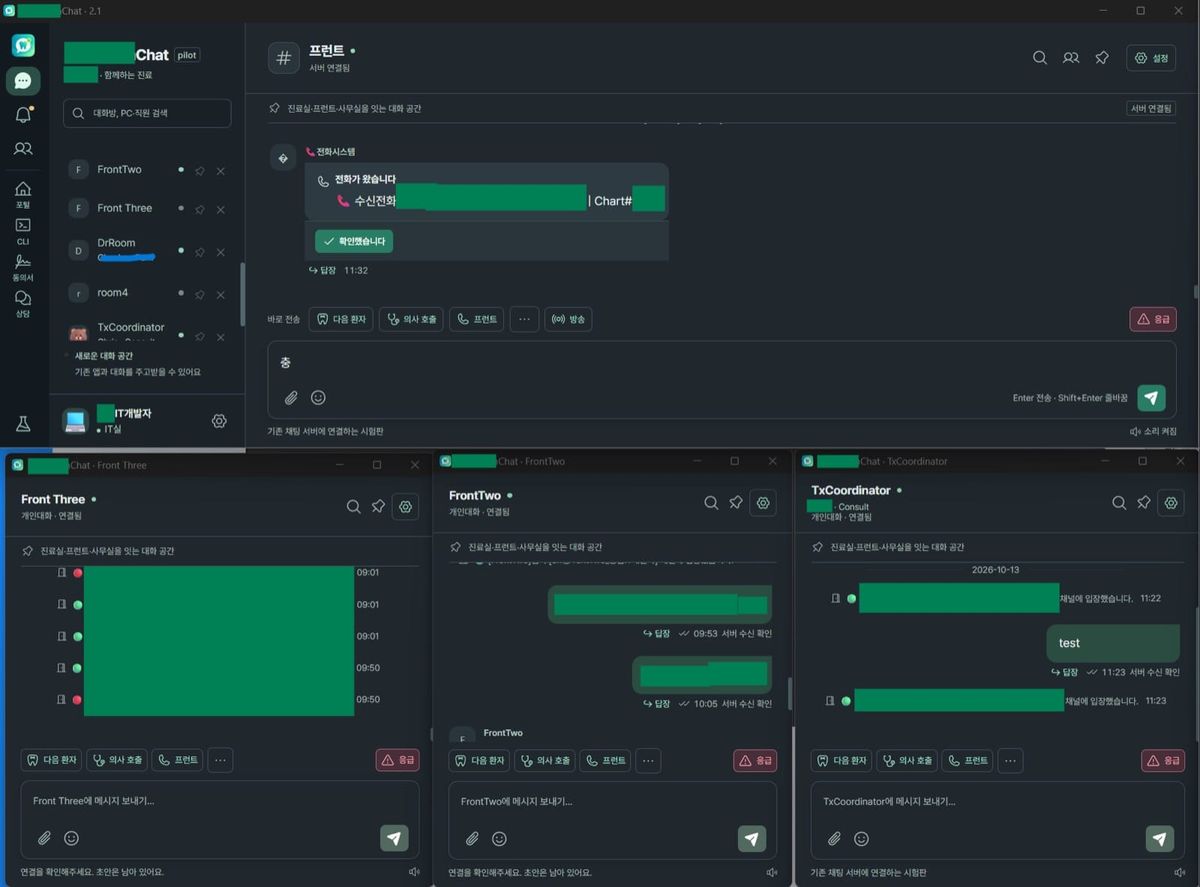
A post from someone who crossed that gap alone happened to go viral that same week: AX at a Neighborhood Dental Clinic, posted on Arca Live. It's the story of a neighborhood dentist with a biology background who put Claude and Codex to work like teammates with assigned roles, until the clinic was running everything in-house, from answering the phone to cross-checking insurance paperwork, management reports and an internal messenger. Along the way the clinic cut, one by one, the subscriptions it paid for every month, like call recording, document recognition and appointment texts, and dropped its accounting service and ad agency too.
Developers who read it said this was someone really good at AI, but to me it was something a dentist could build and an AI expert couldn't. When I brought it up at Friday's Mixer, someone said that above all, the dentist is a person who can define the problem.
Someone I met at the lunch Mixer said the same thing. Only the person who knows where problems actually keep piling up can automate them, which is why there's a gap between AI experts and practitioners. That person also wanted to automate the daily repetitive work that annoyed them, and the goal was to make the company's back office something one person could run. The conversation even got to the idea that a system built that way could be sold on its own.
The dentist's own takeaway in the post said as much. Non-specialists can build things like this, but the dentist, who knows dental work best, has to know what to have it do. The dentist wrote that AI takes over the work people disliked more than it replaces people. Staff only need to look at what AI has flagged for review, people still make the judgment calls, and AI is trusted only with reading, organizing and suggesting.
There was also a passage about how spending heavily on ads creates a structure where you have to get more out of each patient to cover it, which leads to recommending treatment that isn't needed. The dentist wrote that cutting ad spending thanks to AI brought the clinic closer to being one that can tell patients they don't need a treatment. The dentist expects AI to handle all the paperwork involving numbers eventually, but noted that the hands-on work inside a patient's mouth is still beyond it, and called people a bigger bottleneck than technology. With many older patients, the clinic still sometimes has to take paper charts.
The dentist predicts that within two years anyone with an idea will be building things like this, and plans to release most of it as open source for other dentists. The post notes that the long write-up was itself written with AI, and it still came close to 300,000 views. What drew those views was less the smooth prose than the stories only that person could tell, like the server rack set up in a back room of the clinic, or the staff member who watched insurance paperwork reconcile itself and asked, “So am I getting fired now?”
The moat is data no one else can make
I asked the same question on a call with an old friend in the US, and as my friend sees it, the moat in the AI era is data no one else can produce, or a thought nobody has had yet.
You need new data or a new idea.
My friend also said they don't know what anyone is basing the claim on that AI will solve everything within a few years. What AI helps with is picking out candidates worth trying faster and in greater numbers, and checking whether those candidates actually hold up still takes time in the real world.
It's not going to run the experiments for you. In the end, people have to do it.
What my friend wants to do next lies there too. When someone has a problem to solve, my friend wants to be the person who looks at that person's data and workflow and makes it possible for AI to take that process over.
What I heard at Friday's Mixer pointed the same way. When a company that makes physical goods takes AX all the way, it reaches a stage where you describe a product and it gets made. Words become the blueprint and the blueprint goes straight into production, but ahead of that sits a huge homework assignment: field data that has to be deliberately collected and organized.
That's why people say Korea's physical AI isn't competitive yet. For physical AI to do real work in a factory, everything on site, factories included, has to be turned into data first, and people say we're nowhere near ready for that. Physical AI will go down a similar road someday, the way software and content did, but even then, the ones left standing will be those who built up their own field data first.
Keep reading
Join Bloom
Bloom builds offline rooms where people and technology meet. We run them in Seoul, and now beyond it.
- 💬 Discord community, where events are announced first
- ▶️ YouTube, full talks from past events
- 📸 Instagram, photos from our events
- 🎟️ Bloom app, upcoming events and Mixers