The Reality of AX from Korea's First FDE Company
One conglomerate ran 4,000 proofs of concept and built 4,000 agents. Ted Hwang of SpaceY on the four generations of Korean AX and the maintenance trap.

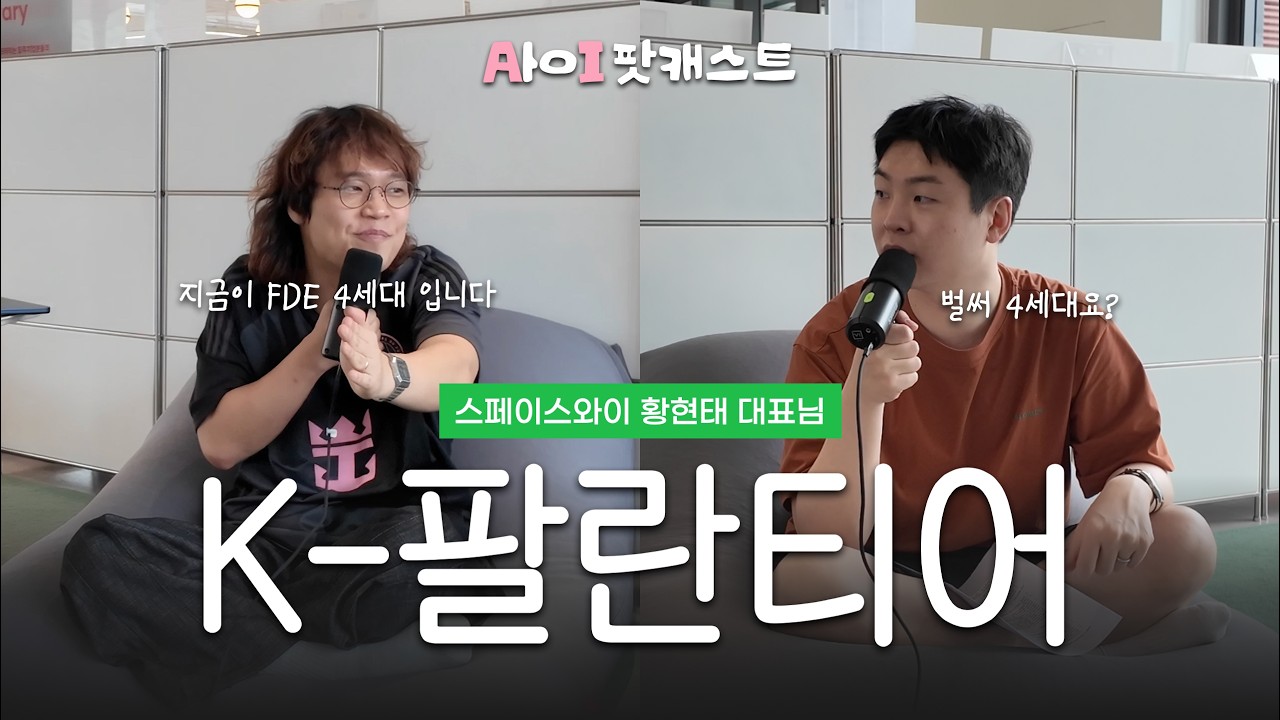
Bloom has finally started a podcast. Our first guest was Ted Hwang, CEO of SpaceY, who has been running and spreading the FDE model in Korea before most people here had a name for it.
He pushed Forward Deployed Engineer into the Korean market while working with LG Electronics and Kiwoom Securities, and SpaceY was recently acquired by Day1 Company, which opens the next chapter. We sat down on a Friday morning and talked for fifty minutes, and this is what came out of it.
SpaceY because he likes SpaceX and Y Combinator
The name came from liking SpaceX and liking Y Combinator, so somebody said let us call it SpaceY. The company started in February 2022, which makes this the fifth year, and the name came first while the product kept getting torn up and rebuilt.
The reason he founded it was a person rather than an idea. He wanted to work with Songhak Nam, his co-founder and CTO, and he wanted to work in that kind of environment. He said twice that he would not have founded anything if his co-founder had said no.
From Middle Eastern gemstones to a Seoul R Real Estate
The methodology in fashion at the time was Alberto Savoia's pretotyping, and he threw ideas at the wall through that frame. He sorted problems by whether the pain was sharp and rare or mild and frequent, and on that basis he considered selling Middle Eastern gemstones, building a social dining platform, and opening a counselling service. After reading Tokyo R Real Estate he got as far as planning a Seoul version.
The sixth or seventh idea out of that pile was DIO, a hiring platform for senior developers. He described the whole detour as the process of finding founder product fit, because however good an idea looks, it has to be something you like and can actually do well.
A mechanical engineering major in a lab that wrote code
His path was not the usual one. He majored in mechanical engineering at Yonsei, but the lab he belonged to worked on knowledge-based design and spent its days writing code. He wrote code from his undergraduate years straight through into a PhD program, and AlphaGo landed right around then.
He told his advisor he wanted to work on AI, and he ended up researching model evaluation and stability with a Dutch researcher who is now at DeepMind. A PhD usually leads to research or a professorship, but he had no particular dream at the time. Military service was part of it, and the lab culture was fun. He pointed out that an engineering lab can cost you more all-nighters than a startup, with the difference that it has an end date.
A senior twenty years older asked him to start a tax company
Around the age of twenty-three a senior from his graduate program proposed starting a company. The senior was twenty years older, and the pitch was that AI could change tax work. He became a co-founder of Hyeoum and spent four or five years there.
Looking back he said he did not play the co-founder role well, that he followed his senior around and that the heavy responsibilities including money all landed on the other man. Even so, his way of working, his mental model for meetings, and his frames all came from that time. He expected to stay longer, but as his head grew he started wanting something of his own.
Our FDE starts by finding the client’s own customers
When asked to define FDE in his own words, the scope turned out wider than expected. A Forward Deployed Engineer is literally an engineer deployed to the front, but the SpaceY definition covers everything from finding the client's own customers, to locating the client's vague problem together, to finding and building the solution, to deploying it inside the client.
The core of it is not the technology. It is one sentence the team has carried since the DIO days.
Betters. The desire to work with someone better than yourself. FDEs have to reach that desire inside the client.
That is why changing a developer's job title does not produce an FDE. Clients are cold, and the moment they start wondering why they bothered, it is over. So how does SpaceY do it?
We just work hungry. We are bad at things too. We make a lot of mistakes. But we work hungry.
The large companies reach out first
The client list runs from LG Electronics to Kiwoom Securities to insurers, with no fixed domain. He laughed and said they are still a hungry startup, so they are omnivorous, but what struck me is that the companies opening the door first are large and supposedly conservative. His explanation was that the FDE position is early enough in Korea that anyone looking for SpaceY right now is an early adopter regardless of industry.
Sales are entirely inbound. Some people find him through YouTube, some through LinkedIn, some just email. We found him the same way. We knew DIO but not the person who built it, until a colleague kept posting his YouTube clips in Slack and saying the insights were good. Watching him pull structured thinking out of his head in real time, I sent a LinkedIn message, he talked with us for nearly an hour, and an event together followed.
I do not really know what the client actually wants
The first thing he asks when a company reaches out is why they came to SpaceY. Most companies that call have more headcount, more scale, and more domain knowledge than SpaceY does, so he wants the real reason they are looking outside at all. It might be a product they need, or it might be a change in the internal weather.
Asked how he figures that out, he said he does not really know. He keeps asking and keeps meeting, and sometimes he only discovers the real answer in the middle of the work. So his method is the plain one, dig for the problem, focus on which problem is the core, and study the domain hard.
The method also shifted within six months. In the first half of the year they would prototype fast and show the client a picture to react to. Now the clients have levelled up and tell him what they want first, so the work is about carving that problem down.
Startups have no enterprise development experience
He brought up the mistakes himself. One is the fumbling that comes from not absorbing a client's domain knowledge fast enough. The other is that startups have almost no experience building enterprise software.
The reasoning behind the second one stayed with me. The generation now working in startups grew up hearing that taking a job at an SI firm would wreck your career, so they have never written code inside a corporate network or an air-gapped environment. That experience was never handed down, and now that they are doing enterprise work, the early months were clumsy.
They are learning it two ways at once, by running into walls and by working alongside a large SI firm at a securities company, which one client suggested outright. At first they did not know enough to ask anything, and now they learn by asking.
He was level about the client relationship as well. The client can make mistakes and SpaceY cannot, which is the shape of the deal, and even so the clients communicate fast and teach them a great deal to keep the project on track. Most clients are at least five years older, so outside of engineering skill he is receiving an enormous amount of help.
Korean AX is already in its fourth generation
Asked why large companies work with SpaceY, the answer came back as a generational history of Korean AX. The first generation put an AX team inside each affiliate to solve problems for the business units. The old IT team could get by solving a few problems a year, but AI does not behave that way.
AI moves so fast that if you really set out to solve things, hundreds of tasks appear, and then the team overloads.
So the second generation moved toward training, on the theory that the business units should acquire the capability themselves. People say the business side just needs to use Claude well, but learning outcomes vary too much for that alone to work. The third generation brought in startups with small headcount, decent revenue, and tight optimization, regardless of domain, to see what the enterprise could learn from them.
The fourth generation, which is where things sit now, argues that the leaders themselves have to become AI native. This field is barely a few years old and it is already on its fourth generation, which tells you the speed of the market on its own.
Build 4,000 agents and maintenance becomes impossible
The diagnosis came from something concrete. He saw a conglomerate that ran four thousand proofs of concept and built four thousand agents. Trace back why that many agents appear and why maintaining them becomes impossible, and you arrive at the absence of a leadership philosophy about being AI native.
His prescription is to lower the number of maintenance points and to staff maintenance as its own role. He cited the maintainer, builder, and sweeper framing that came out of Anthropic, and said most organizations concentrate on prototypers and builders while the design needs weight on the sweeper and maintainer side too.
Organizational design has to travel with a philosophy about what an agent is for.
The philosophy has to be about using the general purpose agents that already exist, not about constantly building new ones.
Power the Agent rather than Build the Agent. Attach one agent per task, a gas risk assessment agent, a freelancer matching agent, a public bidding agent, and he says a disaster follows. He added that this is not somebody else's problem, since he runs a freelancer platform and the host that day builds a public bidding solution. His structure has a universal agent in the middle with tasks managed as specifications, and the reason is that tasks keep changing.
Better models do not remove the need for an FDE
I asked what happens to the FDE role once the business side can click through everything themselves. His first rough thought had been that some work would remain that only people can do, and he corrected himself out loud.
The external force that an enterprise always needs is always there. That is the answer now, I think.
Even an organization with optimized business processes has places it cannot reach on internal motivation alone. Whatever version Opus reaches, the FDE job is to keep finding that gap and filling it.
The trend shifted within six months in practice. In the first half of the year attention sat on work automation, and he said that bringing up work automation now can sound dated. As the clients level up and the models level up, he keeps feeling that SpaceY has to keep changing shape too.
Some companies replaced the AX team with an FDE team
I mentioned an Instagram ad about a company that dissolved its AX department and replaced it with an FDE department, and asked why large companies are announcing plans to train a hundred FDEs. He said there is clearly a branding element. A dispatched developer carries an image in Korea, while an FDE carries more scope and a visible career path, and if you want a hundred applicants for a hundred seats you widen the pool.
He also traced how the role landed in the United States, where the feeling was that engineers could finally be valued properly. In Korea it has been localized, and each company defines the FDE role differently. At a recent policy roundtable on FDEs every company had a different definition. He is not sure they need to converge, because the edge and the differentiation come from exactly that spread.
He wakes at six thirty and starts with what is left over
His day begins between six and six thirty, washing up and reaching straight for his phone. Sleep stopped coming easily after he founded the company, so he wakes early, and he opens the day by checking that nothing large broke overnight. He often falls asleep with the vague feeling that the work is not finished.
He clears the email inbox and turns it into raw material, then commutes to the Orange Planet office in Yeoksam. Sometimes he visits clients, and mostly he checks in with the FDEs and works alongside them. The quality across FDEs has to be even, so he communicates constantly with the core team. Out of a team in the low teens about six are FDEs and the rest are the people who stay in, and he said job titles are blurry enough now that they just call them the ones who go out and the ones who stay.
I have no scale-up experience
Asked about the story behind the Day1 Company acquisition, the first thing he brought up was his team. It was a large decision so he talked it through with them, and they welcomed it enormously, more than he did. He explained why in his own words.
I have a ceiling. I have no scale-up experience. I am someone who builds a good restaurant.
The FDE model is in its emergent phase, which made outside insight all the more valuable, and in a situation that could call for money, scale, and brand, a good offer arrived and brought reinforcements with it. He was clear that if AX, or AX through FDEs, is a mega trend, then this is the moment to move hard. What exactly his role becomes after the two companies merge chemically is still being worked out.
Korea specializes in making 99 percent very fast
I asked how he feels about being called the Palantir of Korea.
Korea is a Palantir country. We are extremely good at producing 99 percent very fast, rather than producing 100 percent.
On that basis he thinks SpaceY and other FDE companies may not scale this up enormously, while boutique FDE companies will appear in large numbers. His reading is that younger people avoid employment because they feel their value is not fully recognized, and the ones capable of being recognized in full will do FDE work outside, himself included.
That is also why founding experience is one of the conditions he weighs heavily when hiring FDEs. Having founded something means carrying the pain of it, and unlike B2C where founding means building a platform immediately, founding in B2B can take this shape, which he sees as another kind of founding culture.
Enterprise and public sector work still needs SI, because building a permanent engineering team for one project is inefficient whether you are a pharmaceutical company or a bank. The lineage broke once because of the belief that an SI job wrecks your career, and picking it back up under the name FDE can create far more value far more efficiently than before.
He wants the city hall website to feel like Toss
His vision for the public sector starts from a generational obligation. If his generation learned engineering and IT on top of the broadband infrastructure Korea built when it was an IT powerhouse, then it has a responsibility to remodel and rebuild the aging public services that now draw ridicule. Companies survive on their own in a market, while the public side is not competitive enough for speed to appear naturally.
The order was already there when he started SpaceY and talked it through with the FDEs. He wants city hall websites to feel like Toss, and since nobody knows their name yet, they would make a name in Seoul first. That is how the enterprise work began.
He brought up the previous generation digitizing the property registry, spending four years crossing the country to set up kiosks and print and label every certificate, and said he would like to do something like that once. He does not know whether he will be able to, but if the capability is there he really wants to.
One goal for the rest of the year, the renewal rate
Asked what would make the rest of the year feel worthwhile, he said there is exactly one KPI. Keep the renewal rate on the current projects between 90 and 100 percent. He would also like to be able to take on everything that comes in, which requires both capability and a larger team.
Since quality matters more the larger the enterprise, he has set the rule of not taking work they cannot carry, and he keeps one person on one thing in mind.
The speed of building is both the strength and the trap
The line about being a country that makes 99 percent very fast stayed with me. That speed is an advantage now, and the same speed produced four thousand agents.
The next step in AX looks less like a faster way to build and more like deciding what not to build. The fourth generation diagnosis that leaders have to become AI native and the proposal to put a general purpose agent in the middle both point at the same place.
We agreed to talk again in three or six months about what has changed at SpaceY.
Keep reading
Join Bloom
Bloom builds offline rooms where people and technology meet. We run them in Seoul, and now beyond it.
- 💬 Discord community, where events are announced first
- ▶️ YouTube, full talks from past events
- 📸 Instagram, photos from our events
- 🎟️ Upcoming events