How a Builder Spending $1,800 a Month on AI Stays Alive
Four months with no investment and no government funding. Jeongmin Lee on why companies hand one person only training, events, and advertising.

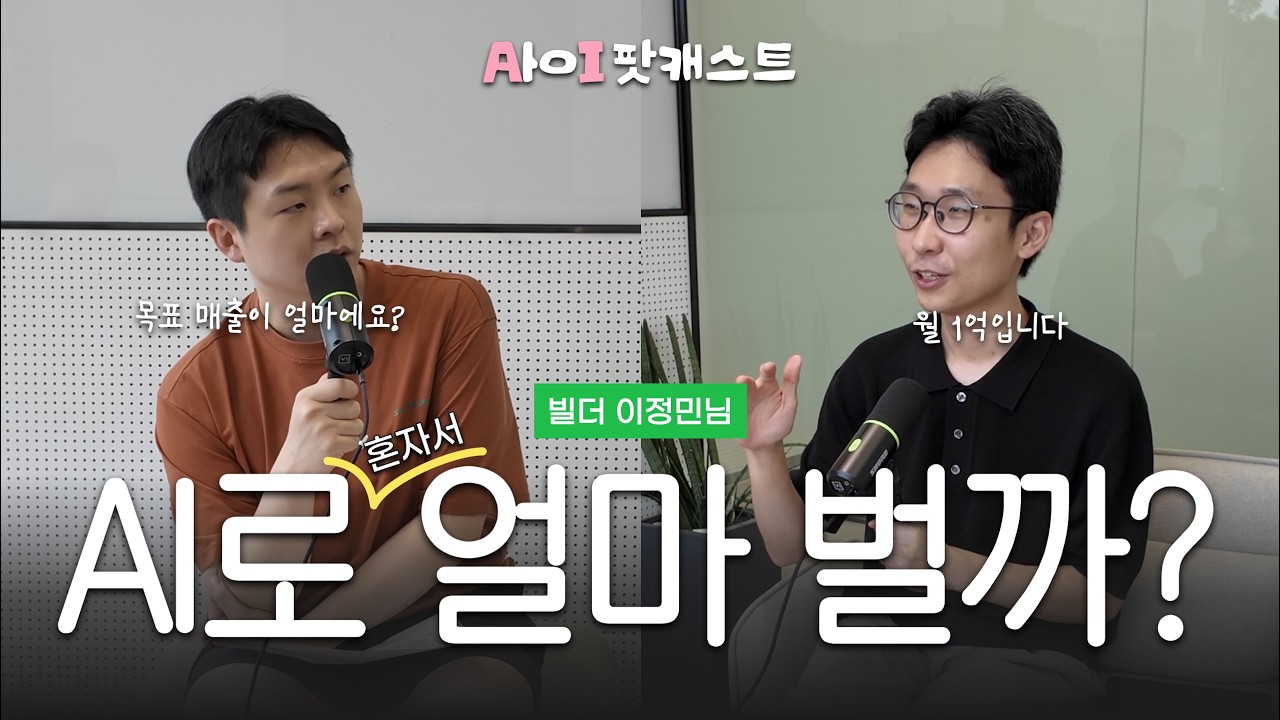
Building with AI got easy. Winning the work did not. We invited Jeongmin Lee onto the Bloom podcast, a builder who has been working alone since May of this year without investment and without government funding.
He studied biomedical engineering, founded a company as a student, interned at an investment firm, served as CSO at a startup, and now runs a sole proprietorship taking on B2B work. Over fifty minutes we asked him where the third AI wave turned, what it means to say the fourth boom arrives when companies use people as an API, and how one person earns trust in a B2B market.
He attached a qualifier to his own introduction. The original goal was to find out whether one person can run a B2B business, and having tried it he now knows how large the constraints on one person are, so he is careful about being called a solo builder. He has started thinking he might just say builder and leave open the possibility that someone else is behind him.
He did not much like programming
He wrote code during his biomedical engineering degree for things like medical image analysis, but he did not much like programming at the time, and he laughed about how he ended up living this way. He said that in the old days he could not have claimed to build software, since he was doing modelling and writing training code at best. Now he builds web applications himself and delivers them to clients.
The standard track for that major is graduate school, with most people continuing in research or joining a pharmaceutical, chemical, or electronics company as a researcher. He skipped that track and founded a company as a student.
He thought founding a company was the ultimate credential
Looking back he admits he wonders now and then why he did it. Through the 2016 and 2017 cohorts engineering students barely entered competitions, and grade management and the graduation project mattered far more, and then he suddenly threw himself into competitions, from advertising contests to volunteer programs. He described his own aim at the time as broad and shallow.
Somewhere in that circuit he decided that founding a company might be the ultimate credential. In 2018 he was accepted, almost by accident, into the Naver D2SF student founder competition, which came with office space near Gangnam Station and a stipend. It was private support with no equity involved, closer to a base model than an accelerator, and the product was digital healthcare that detected schizophrenia through a mobile device.
He went to an investment firm once he saw he had no expertise
The lesson from the first company was that he had far less expertise than he thought. He spent his alternative military service turning over what expertise a founder actually needs, and since founding means raising money he decided he should understand the investment ecosystem, so he applied to Bluepoint Partners as an intern and got in.
The role supported the investment team and lasted about six months. The firm gives interns real opportunities, and he took a portfolio company to the investment committee, which is rare for an intern. That deal was dropped, but he connected another company and that one closed a round. He was not trying to build a career as an investor. He took the role because understanding how funding works would help whenever he jumped back into founding.
They pivoted the day after ChatGPT launched
Next came Smoretalk, where he spent four years including the pre-founding period, with a mission of solving mental health problems with AI. It started in 2022, before ChatGPT existed.
When ChatGPT arrived, what the team felt was not opportunity but danger. They worried it would do all of this, the fear set in, and they pivoted that same day toward images. He remembers the date exactly because the pivot happened on December 1 Korean time. Smoretalk now works on media AI for advertising, and he left at that point.
ChatGPT, Manus, and Opus 4.5
Asked whether today's AI performance arrived early or late, he said it arrived at the expected speed, and since that expectation already reflected enormous ambition, it means it really did arrive fast. It is fast, and the completeness is frightening, and the gap in how well people understand that is very wide right now.
Asked to name the moments that added momentum, he traced the turning points of the third AI wave. After the ChatGPT launch came Manus. The ad showing an agent running Instagram on its own was a shock, and it made him wonder whether it had already arrived. Claude Code was still a tool for the people who used it, and the one that landed hardest for him personally was the Opus 4.5 release.
Up to that point I said we were still at the stage of delegating rather than being replaced, and from 4.5 it feels like something serious has happened.
Non-developers started using these tools in earnest from January, and even heavy users were shaken from then on. News about Claude Code spread, share prices moved with it, and FOMO came around again.
Next comes the point where companies use people as an API
Asked how the fourth boom arrives, he said it has probably started. It might take the form of personal assistant services, but the marker is the point where a company genuinely handing work to AI becomes a common value. He means an era where handing over a task end to end is taken for granted at ordinary companies rather than early adopters.
From the point where a person becomes an API that uses a Claude or a GPT. Companies now treating humans as an API.
His reasoning was corporate arithmetic, in that a company that saw no utility would skip the cost optimization question and simply give up, and right now, with Chinese open source models performing well and pricing low, companies have started optimizing for both performance and cost on that basis. Companies never do anything unnecessary, so the fact that they are doing it means they need it, which is how AI infrastructure became a fundamental corporate asset. Socially, he expects the larger effect to show up as less hiring.
He picked B2B because it is the hardest place for one person
The hypothesis he set when he went out alone was how far one person and AI can grow together. He wanted to see how much one person can actually earn and how much influence one person can exert.
His read is that one person can earn more with a consumer app than with B2B, and that none of that knowledge travels into the B2B world. It becomes a topic at the B2C level while staying abstract for the people running companies. So he wanted to make his name known properly to senior people at Korean companies.
The reason was proof. Meeting senior people and carrying an actual project through means one proven engagement on the record, and he believes it is people at that level in those organizations who move society. His calculation was that reaching the level of a person with business influence rather than an entertainer opens up more later.
The fact that this is the hardest area for an individual to enter was itself the reason he chose it. Young people rarely get to that level, and doing it with AI makes it a case of achieving something that would have been impossible without AI. He is treating himself as a test bed and validating the hypothesis under the hardest conditions available.
Asked for a check-in four months in, he said revenue for this month and next has climbed a good deal, and held back the specific number for now. Instead he summarized it this way.
I thought I would starve and I did not starve. Coming out here was right. And honestly I am making decent money.
Companies hand one person training, events, and advertising
Even so, he thinks the areas open to one person are fixed. What a company can officially trust one person with is training, events, and advertising. Advertising runs on a personal channel so a company cannot do it in house, and events and lectures could be absorbed internally but carry less risk when handed to someone with reach.
Projects are genuinely hard. Without serious trust they do not happen.
Training matters to him for the same reason. Advertising cannot lead to a further project, while training and events come with participants and continued conversation, which creates points where trust can form, so he uses them as the first gate toward a company.
The number of applicants per contract posting is beyond imagining
He thinks somebody starting today would struggle to win the same work with ordinary effort. Most people end up on a contracting marketplace, which asks them to upload a portfolio, and with the development market this soft, the number of applicants per posting is beyond imagining. Developers who already did contract work and newcomers are crowding the same listing, so getting selected at all is unlikely, and clearing that bar takes a portfolio that is nothing short of remarkable.
The reason work comes to him has nothing to do with skill. It comes from the network and the media presence he has accumulated, which means the same market has two completely different entrances. One side applies to a posting and competes. The other side answers inbound. AI narrowed the gap in ability to build, and in exchange the gap in front of that got sharper.
No investment and no government funding
He has taken no investment and has never once applied for government funding. The goal was to survive and earn on private money alone, and he is relieved that the earning started sooner than expected.
The reason is that only this way can he run the play he actually wants. He wants to build one piece of software with impact, and he is learning clearly that building it with near-term revenue in mind makes that impossible. So the plan is to expand the features entirely for free, and since calling something free makes people feel no scarcity and skip it, how to tell people about it becomes its own problem. He is drawing a picture where at some point the thing you are using turns out to be his.
The field barely matters as long as it works in the market, and right now he is operating entirely for revenue.
He decided software alone would fail
Asked why he studies overseas cases so closely, the conclusion came first. AI builds software too well, so he decided software by itself would fail, and that neither a company nor an individual can grow on software alone. From that point he started thinking about sales far more, and he thinks about selling before he thinks about building.
His reason for choosing YouTube as the channel also came from abroad. Watching Riley Brown and other creators, he saw that developers were gaining influence by doing YouTube well rather than by selling courses on a learning platform, and that AI companies were reaching out to them first because of it. Training is closed by nature and hard to spread widely, though it builds one-to-one relationships with companies, and depending on it alone is the same as being employed, so public reach has to rise alongside it.
The real reason Koreans do not start a YouTube channel
He brought up his sister's reply when someone said YouTube is a red ocean. Do you know any YouTubers, no, then it is a blue ocean. So I asked what he thinks actually stops people.
Not the equipment and not being late, but simply being unable to stand having their face out there. People with day jobs have far more in the way, from declaring outside work to how they will be seen as employees.
Koreans carry a lot of embarrassment. And at the same time they want to do so many things.
So he sees YouTube as a place where the embarrassment is still larger, which makes it a good market to enter. Once everyone is doing it, regret will outgrow the embarrassment and the competition will get much heavier.
The real risk for a solo builder is loneliness
Working alone seemed hard on the mind, so I asked how he handles having a discussion partner. He thinks a lot on his own, talks with AI, and occasionally talks with other builders working nearby, and his default is to do something rather than spend the time worrying.
The risk he named for solo builders is that this is not easy for people who draw energy from other people. He said it surprised him to go from talking constantly to barely talking at all, and that a genuinely hollow stretch arrived at one point. He added that it is probably better to have something that answers the human emptiness and the loneliness.
Tokens themselves are turning into money
Naming tokens as the trend he is watching, he pointed out that the word is the same one Web3 used, and said he lives with the sense that this side is the Web3 that actually helps the world.
The event he cited was Stripe acquiring OpenRouter. Payments and AI are completely different areas, and the moment you define AI tokens as currency it lines up. In that case investing in tokens or paying salaries in tokens becomes unrealistic today but not impossible. The volatility is the catch, and just as Web3 had value when it was stable and frightens people now that it is not, token costs could drop sharply or spike.
Thinking of the film where time is currency, he pointed out a difference. That film has one currency, while tokens come from several models, which creates exchange rates. Just as manufacturing left the United States for China over labor costs, the exchange gap between Chinese and American models could create differences in what you can afford to do.
Personal AI assistants interest him as well, and when I asked how far something has to go before it counts as one, the answer was that most people have never had an assistant and do not even know what to delegate. People who handle assistants well hand over everything from scheduling to all their work and sometimes household matters, and reaching that level is the bar.
One plan until the end of the year, belong nowhere
His plan for the rest of the year is exactly one item. Until the end of the year, belong nowhere and stay as one person.
He also named the trade-off, that without a target he stops thinking about running toward one. Handling what is in front of him is going well and building trust, and with no short-term plan he is not heading anywhere in particular. So he is trying to hold onto the original intention of building software everyone uses, and to allocate his time against it.
Is it hard to survive without personal branding
I asked what he makes of the extreme claim that life is hard now without personal branding. The answer was that it depends on how you want to live. Someone who wants to run their own business and already has the network can do well without announcing anything, and someone with no network at all has to create something, at which point channels matter a great deal.
By that reading now is no different from before, since a name card served as branding for people inside an organization and everyone else had to build their own. The difference is that when hiring was strong, building a network through a company was easy, and now there are cases with no affiliation and nobody to build it for you. In exchange the barrier dropped, editing got easy, and even content planning can happen with AI, and since digital reaches everyone and somebody is watching YouTube at this very moment, working there scales naturally.
Do it instead of hesitating
Asked for a closing thought, he said this is an era where you should simply act on an idea. The evidence came out of his wallet, since replacing the MacBook he bought when he quit would now cost two million won more because memory prices rose. He keeps a list called 2026 sunk costs with more than a dozen entries he would not have lost money on if he had bought them then, from AI subscription plans that jumped in price to hardware to travel.
Do not hesitate. The era moves too fast. Optimization is not the point any more. Doing it first turns out to be the cheapest.
The same goes for action, because somebody is already doing it while you hesitate, so do it now if you are going to do it at all. It is not easy and the competition is heavy, and in that case the choice is either joining a good company and being genuinely satisfied with that life or doing this properly. From the moment dissatisfaction shows up, it splits on whether you acted, because if you did the thought was worth having and if you did not it only eats at you.
Asked about his AI subscription costs, the software he built totals 1,800 dollars a month, and he corrected it twice, saying that is at list price and several reasons mean he does not actually spend that much. He receives discounts as well, so the real outlay is lower.
We agreed to meet again when he hits 100 million won a month
We closed on the next appointment. He has not hit 100 million won a month yet, so we meet again once he does, and beyond the money the number is symbolic because it marks the point where his hypothesis approaches proof.
There are already plenty of people who can build. The question is no longer what you can build but who knows you before you build it.
Keep reading
Join Bloom
Bloom builds offline rooms where people and technology meet. We run them in Seoul, and now beyond it.
- 💬 Discord community, where events are announced first
- ▶️ YouTube, full talks from past events
- 📸 Instagram, photos from our events
- 🎟️ Upcoming events