Claude Blue Is Spreading Across Silicon Valley
A senior AI engineer at Meta and a founder in the Valley, on the same day. This is where the name Bloom came from.

"Claude Blue" is a term I coined. It refers to the AI depression that is actually spreading through Silicon Valley right now.
A conversation with a senior AI engineer at Meta, and with a founder building in Silicon Valley.
In 2025, AI hit the coding world hard. Back then there were two camps. One said we should hand coding over to AI entirely. The other said humans had to review everything. By March 2026, that debate is effectively over. AI now produces code at a volume beyond what humans can review. The transition arrived whether we were ready or not.
I personally expected this wave to reach office workers in 2026. Coding had set the precedent, so I assumed the same shock would hit non-developer roles that live in documents and data analysis. But when I actually asked around fifteen people across different jobs in the US and Korea, not one of them said they were feeling an AI-driven bottleneck. Everyone said it was still manageable. Humans were still in control.
We had our own back-and-forth about this inside the company. Everyone agreed AI would fundamentally change office work. The disagreement was about timing. I was in the "too early" camp. Embarrassing to admit, but I had not personally felt any AI-induced bottleneck at work, and neither had anyone around me. One colleague disagreed. He said the shift had already started, that people were losing context in AI-generated documents and decisions, and that this was not anyone's personal failure but a growing pain of the era.
Then today I got on a video call with a college senior of mine who works as a senior AI engineer at Meta. It landed hard. On the frontier, in Silicon Valley, this was already reality, and hearing the specific use cases made it real. Within weeks, or a few months at most, office work will be forced into AI-native shape too. Nobody will write documents by hand or visit websites one by one to take notes. People will sit in a terminal and direct agents, whether that's Claude Code or something else. And office work will hit the same transitional damage the coding world already hit.
What struck me most was that even this senior, sitting at the very frontier as a Meta AI engineer, was going through a severe reckoning because of how fast AI is advancing. He said he felt a strong pull to build founder instincts and start something himself. This is someone who had followed startups with interest but never imagined founding one. Now even his side projects come less from curiosity than from a sense that at some point he will have to run his own business.
That same day I had coffee with a friend my age who runs a startup in Silicon Valley, and I heard almost the same thing in almost the same tone. A senior engineer at big tech and a startup founder, sitting in completely different positions, feeling the same existential unease and the same inability to stop.
Here is what came out of both conversations, organized by theme.
1. AI-native daily life at Meta: working only with agents
He uses Claude Code at work and OpenAI's Codex at home. The reason is simple. At work the only options are Claude Code and Gemini, and Claude is far better at coding, so he uses Claude. At home he does personal projects that need image generation, which Claude Code does not support, and more importantly Codex Pro gives him effectively unlimited tokens for $200 a month. Claude Code Max is also $200, but past a certain point it costs extra. He burns about $2,000 in tokens a month at work. Nobody covers that out of pocket.
His setup was the interesting part. He built a VS Code extension that pipes every AI conversation into Obsidian, so a knowledge graph grows on its own as he works. Every conversation becomes a document, and each new document links itself to the existing ones. Obsidian used to be a tool you fed by hand, writing and linking notes yourself. Now that AI conversations are the raw material, the barrier to entry has dropped enormously. Meta has about 70,000 employees, and more than 10,000 of them are in the internal Obsidian group.
What surprised me more was that every productivity tool at Meta is wired up to be reachable by an agent. Google Drive, Google Docs, spreadsheets, email, Jira, Confluence, wiki, whiteboards. All connected. He put it this way.
"I work only with agents, and the output piles up in whichever tool I want it in."
He doesn't open the spreadsheet. He doesn't open Jira. He stays inside the terminal and the databases fill themselves.
One example shows how mature this is. In January, doing his first year-end review since joining, he asked the internal AI review tool to summarize everything he had done since he started. It pulled every report and document he had written and produced a long, organized list. All he had to add was his own commentary, and self-review was done.
2. "The infrastructure is completely wrecked": the reality of the AI code crisis
Using AI at Meta has not only made things easier. His workflow shows both sides clearly.
When he gets a new task, he opens two agents at once. One is an execution agent: he throws the goal at it and says go. He often doesn't yet know exactly what the task is. He just points it at the target and lets it run. The other is a learning agent that explains the task back to him. The execution agent runs for a day or two and produces close to ten thousand lines of code. Meanwhile he uses the learning agent to understand the domain, then analyzes the generated code with yet another agent. Most of what he finds is minor revisions, and an agent applies those too.
The problem is that this speed outpaces people. He was blunt about it.
"Meta's infrastructure is completely wrecked right now."
Too many people push code without reading it. Committing AI-generated code without proper review is creating serious stability problems. This is the transitional damage of the vibe-coding era.
He expects the same thing in non-developer functions. Take a hundred-person non-software company. First, three people using agents will build a company that does the same work, undercut the price, and kill the incumbent. Then, inside those three people, a crisis will emerge because they cannot keep up with what their agents produce. The ones who cannot keep up will die too, and the survivors will be the companies where three people can actually orchestrate agents.
3. From vibe coding to agent orchestration
He says people in Silicon Valley barely use the phrase "vibe coding" anymore. The term that has replaced it is "agent orchestration." Vibe coding is throwing a rough request at a model: build me a game. What people do now is far more structured. If it's a game, they write an extremely detailed spec: genre, how characters grow, how enemy levels scale. Then they find the common patterns across repeated requests and turn those into shared specs, skills, or tools. How well you feed those to your agents determines the quality of what comes out.
Being good at getting what you want out of AI has become the skill itself. To unpack his point: what remains human is the beginning and the end. Knowing by instinct what should be built, and judging whether what came back is right. Only people do those two. Beyond that, the people who succeed are the ones who can say precisely which part is wrong and how. At company scale this gets much harder. You break a large task into pieces, then decide which pieces AI can verify on its own, which pieces a human must see, and which pieces AI can carry forward to the next stage unattended. Agents cost tokens, so optimizing the split between human and agent resources becomes the core competency.
4. Non-developers are not exempt
Using AI at Meta is not an engineering story. Program managers, HR, sales, effectively every function is running on it.
At his kid's birthday party he met an Indian dad who works on a team that manages sales data at Apple. That dad had moved his entire team onto agent-based workflows. The team does data science, turning managed data into insights that support executive decisions, and all of it now runs through agents. That freed people up, and they used the slack to widen what the team covers.
On Meta's internal Facebook, non-engineers from HR and People teams post things like "I'm not an engineer but I built this program, seems decent, give it a try." The HR team built an agent that pulls data from every software tool each engineer touches, and used it to create their own scoring system for evaluating people.
The same goes for people in sales, who spend their days in meetings. They drop key messages into a spreadsheet and slides generate themselves. My senior said he doesn't hand-craft decks anymore either. You throw in the paragraphs and charts you want, say build it, then iterate. Make this table bigger. Move this chart. A few rounds and you have something solid.
"I don't think there's anyone at Meta right now who isn't using AI."
5. "Wow, this is going to replace me": a reckoning at the frontier
He has a PhD in physics and engineering, and he spent years at a major Korean conglomerate and then at Meta, building deep expertise over decades. So when he feels shaken, it carries weight.
"When I write things up, I have my own structure. My own way of visualizing data. That was my edge. But when I ask AI to organize something, it writes beautifully. Polished prose just comes out."
Years, decades, of accumulated know-how. Matched in seconds.
He could even pinpoint when it turned. Until early February he was still in the excitement phase. Every new AI feature dropped and he'd think, this is amazing. Then Claude Code with Opus 4.6 came out. Then Codex 5.4. And the mood flipped completely.
"I think that 0.1 difference was exactly the line where I started feeling real fear."
He had been using the mid-January model more seriously starting in February. Within weeks he went from excitement to "wait, I don't have much time left."
He described his own psychology honestly. Denial. Frustration. Anger. And then, just in the last few days, a slow acceptance beginning to creep in. What scared him was how fast the cycle moved. What used to take months of processing was happening in weeks.
"It used to be that you'd have to use a new technology for a while before you could even judge it. Now you watch two hours of YouTube, try it once, and go, oh, this is going to replace me. I'm done. And that happens in a single day."
The thing he has always been proudest of is his ability to learn. He said he'd put his learning speed up against anyone. But even he is losing to what agents can produce.
6. The base model war is over
The conversation drifted naturally to the structural changes in the AI industry. His view was clear. The base model fight is winding down. It has basically already been decided.
The companies that can produce base models good enough to replace human-level productivity? Four or five. Claude from Anthropic. GPT from OpenAI. Gemini from Google. Grok from xAI. Maybe Meta if you count them. Sure, people play around with Chinese models like DeepSeek or Kimi. But when it comes to actually replacing human work at production level, it's those four or five.
What matters is that only those companies get to build the agent orchestration layer. They own the base models, so they can build the communication structure between agents and the value-creation layers across verticals without worrying about margins. Meanwhile a company like Perplexity, which wraps someone else's model, has a ceiling. The moment Google folds more AI into search, that company is in trouble.
Meta's strategy is a little different from the other big tech players. Meta builds AI for its users to consume. Instagram users scrolling high-resolution video need the model to be powerful and cheap. That is a different game from Claude or GPT, which are B2B productivity tools. So inside Meta nobody hesitates to pull in outside AI tools.
"Our AI is built for customers to use, not for us to use."
7. Organizations that don't change get eaten alive
He worked at a major Korean conglomerate before Meta. Same job title, AI engineer, completely different life. The biggest difference, in his words, was how many layers of permission you need before you can do anything.
At the Korean company, if you want to do something you ask your boss. Your boss asks their boss. If it gets approved you draft a contract. Once the contract clears you start preparing. Then you report on the preparation. At Meta you just build it. You ship it, tag the relevant people, and say, I did this, we good? One person approves and it's live.
That's partly a Korean versus American culture thing. But more fundamentally it's manufacturing-era corporate culture versus software startup culture. Korean conglomerate culture plus security culture on one side. Meta's software culture plus startup culture plus American culture on the other. That combination makes the daily lives of two people doing the same job look completely different.
He was blunt about organizations that haven't adopted AI.
"If they're not using it now, there's a reason. And they're going to keep not using it."
Behind the surface excuse of security concerns sits a structure of vested interests. There's a subsidiary that builds in-house AI tools. That relationship already exists. If someone says let's use Claude Code instead, that arrangement is threatened. The people at the top won't accept it.
He gave an analogy I thought was perfect. A game company that hired heavily into AI and poured money into it. But the core business model, selling expensive in-game items, never changed. AI features got shoved into corners nobody used. The success formula that got them there was too strong to abandon. So they didn't.
"Eventually, companies like yours are going to eat those conglomerates alive."
He also reflected on his own move to Meta.
"I timed it really well. If I'd stayed at the Korean company, I'd still be unable to use AI properly."
Back there, he was copy-pasting code into an internal chatbot window. Compared to writing directly with a code agent, the productivity gap is about five times.
"What took three months at the conglomerate, I can do in a week now."
8. The next generation's only weapon: entrepreneurship
The conversation shifted to his kids. He has a young child. He figures the next five years will bring massive upheaval, and by the time his kid reaches middle school the dust will have settled. The world will already be rearranged, so his kid will be able to see concrete examples of what the future looks like and plan accordingly. In that sense he thinks his child was born at a good time.
But there's a condition.
"The next generation has to be entrepreneurial. Kids who don't develop that ownership mindset won't find a place."
So he tries hard not to crush his kid's spirit. Scold too much and the kid loses confidence. A kid who loses confidence becomes a test-taker. And a test-taker in the next generation is a dead end. Building self-confidence, letting the kid develop a founder's instinct on their own, is his entire parenting philosophy right now.
He also said the next five years will be chaotic. People in jobs with high AI-displacement scores need to do something, anything, now.
"This year is a really big deal. It's an incredibly important year."
9. Silicon Valley's two faces: depression and big dreams
By coincidence, I had coffee that same day with a friend my age who is building a startup in the Valley. A Stanford MBA who launched in San Francisco in 2024, he has built and killed over forty products and he's still going. He was in Korea briefly for a trip, so we met up. And he said something strikingly similar to what my Meta senior had told me hours earlier.
"Silicon Valley is actually really depressed right now. It's so bad that I sometimes want to leave just because of the depression."
He said there's even a phrase going around: Claude depression. People feel too viscerally that human jobs and roles will all disappear at some point. Meta recently laying off 16,000 developers and freezing all new-grad hiring is not abstract news to them. It's happening next door.
His company's vision was to give everyone development power. Narrow the gap between developers and non-developers, and give non-developers the ability to build through AI. In 2024 that was the right direction, so he hired software engineers for every role except himself. Now he worries he over-concentrated in one place and that the company lacks other capabilities. He said they discuss this openly among the team.
The line that stayed with me was this.
"You sell today to customers and ten years to investors. But we all know perfectly well that in ten years we'll all be lying in bed."
Everyone around him feels that way, which leaves a strange depression hanging over the whole Valley.
Even so, he isn't leaving. He originally went for an MBA because Korea's uniformity felt suffocating and he wanted diversity. Looking back now, he says Silicon Valley is ethnically diverse but everyone is in startups and AI, so it's actually its own kind of uniform. Still, in Korea it's hard to dream big, and in Silicon Valley there are crazy people and big dreams. That inspiration is why he wants to stay in the US.
What I found interesting is that this depression produces imagination pointed in a completely different direction from AI software. He said if he were investing, he'd invest in Korean food. Netflix in the US always has Korean content on the front page, Americans are getting more interested in Korean culture, and that interest naturally extends to the food they see on screen. The problem, he says, is that Korean food in the US currently reads as not young. Transplant the sensibility of Gangnam or Seongsu directly and it would be competitive, and there's real demand for a new player in a market where the only options are aging franchises like Chipotle and McDonald's. Someone at the frontier of AI software seeing a thirty-year opportunity in the industry furthest from tech feels like a symbol of the current mood.
There was a darker version too. AI is going to shrink a lot of jobs, and historically the biggest event that forces a country to create jobs fast has been war. So there's a half-joke, half-serious conversation going around in parts of Silicon Valley that the right trade is long defense contractors and short AI startups. Romantically, people displaced by AI move into entertainment like VR. Tragically, countries start wars and people die. And with several wars already starting sooner than anyone expected, the joke doesn't land as purely a joke anymore.
A senior AI engineer at Meta and a startup founder in Silicon Valley. Completely different positions, and yet the texture of what they feel is remarkably similar. Existential unease about the future AI brings, an inability to stop despite it, and a conviction that entrepreneurship is the only answer. That was the air in Silicon Valley in the spring of 2026.
10. Relationships still can't be replaced
Everyone wants to build globally in the AI era. Which raises a question that comes up constantly: do you have to be there physically? I asked both of them.
My senior's answer was clear.
"The business side still runs on relationships."
He'd taken a Zoom advisory call with a VC just the day before. He thought he'd been reasonably open, but talking to me today he felt the difference in depth.
"Forming a relationship matters a lot. But can you form one over Zoom? Don't you have to eat together?"
Sitting across from someone over a meal is what makes people comfortable with each other, and AI hasn't changed that.
My founder friend was the same. He describes himself as an introvert who isn't good at sales, and yet the way he landed early customers was the Stanford alumni network. Stanford people are always interested in startups, so they'd join partly to learn something themselves. The reason he came to Korea at all was to see friends and spend time with family after the AI depression of the Valley. However global software gets and however remote work gets, some things only fill up in person.
Thinking about myself, being able to casually reach out to a senior at Meta and have a conversation at that depth is an invisible asset. Other people would have to pay money just to interview a big tech employee in the US. That kind of relational capital creates enormous impact, whether or not it turns into business.
After a day of talking to a big tech engineer and a startup founder in Silicon Valley, one thing became clear. At the top of this piece I wrote that none of the fifteen people I asked were feeling an AI bottleneck. At the time I wondered if it was still too early. Today changed my mind. If we're not feeling the bottleneck, it's probably not because we're using AI well. It's because we're not using it enough yet. Every worker in Silicon Valley is already feeling Claude Blue. Who are we to be fine.
Maybe we should push AI agents the way they do, all the way until life gets grim, just to go find the bottleneck. A time where if you're awake and don't have three agents running, you should assume your remaining time is burning down. I came away thinking I should go start one more today.
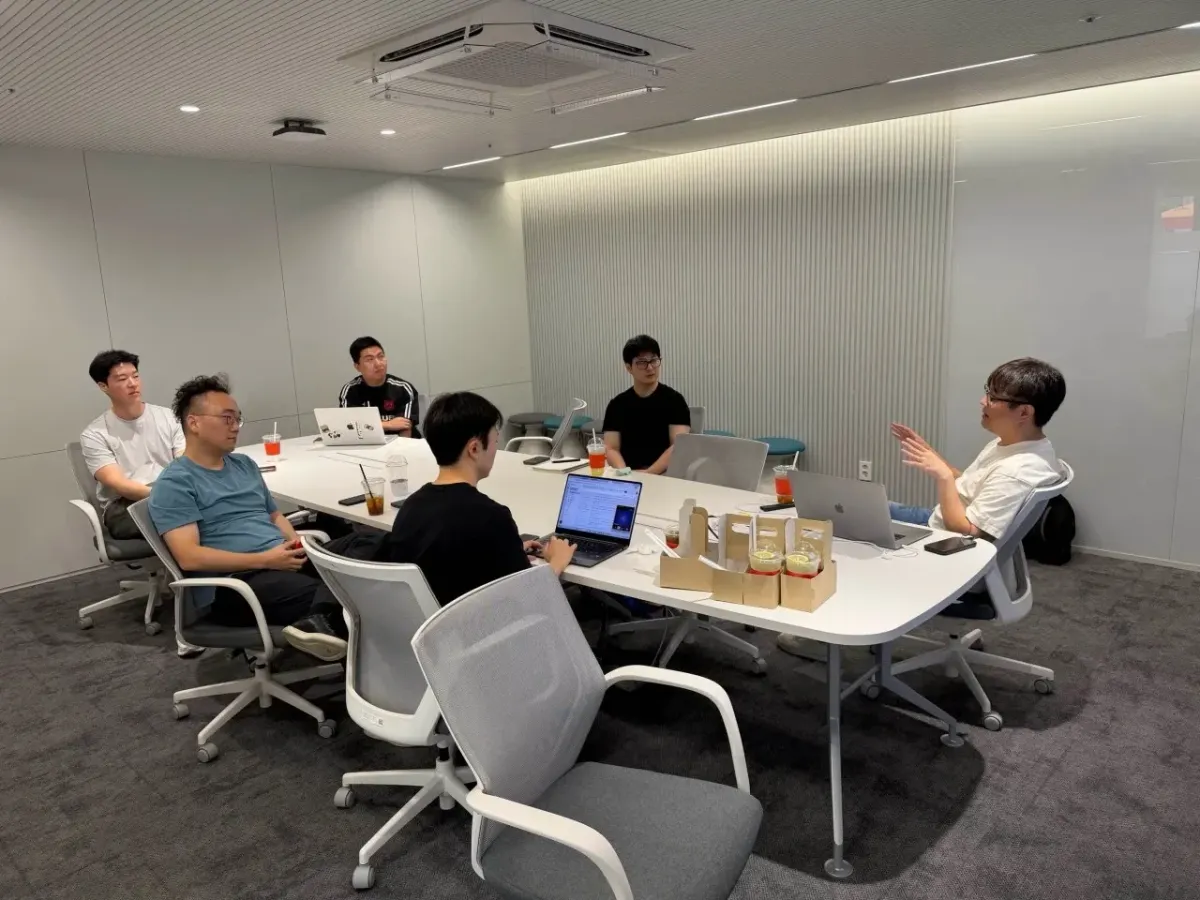
This was written in March 2026. The piece spread further than expected, and people who felt the same unease started gathering. It began as Claude Blue and became Bloom, and today it's a weekly gathering of operators and founders who have already put AI to work.
From the blue of the AI era to blooming together. That's where the name came from.