San Francisco Only Makes Sense Once You Go


Some people stand out at Bloom events, and I reach out to those people separately for a coffee chat. That's how I ended up sitting across from two founders at a Starbucks in Samseong-dong, Seoul, on a weekday evening. Abel Ko was a senior developer at Toss, the Korean fintech super-app, and at Banksalad, another Korean fintech, before leaving to start a company. Mark Kim has been Abel's friend since middle school and ran an art dealing business before joining.
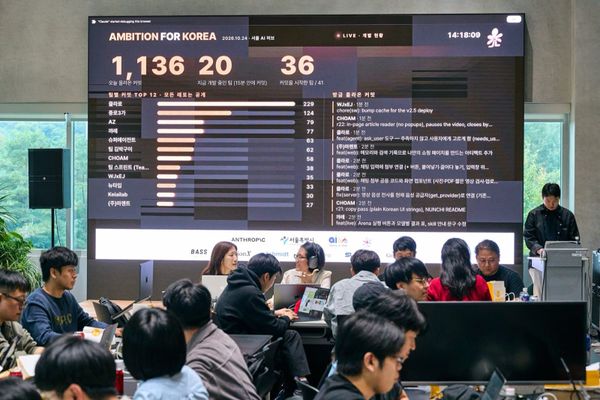
Together they founded Ironact, which builds AI-based marketing tools and sets them up for large corporate clients, and these days they go back and forth to San Francisco for work. We first met at the Bloom x Nebius hackathon in September. Abel took the mic that day, and it stuck with me long enough that I asked for coffee.
That day I was going around the room interviewing participants, and I heard that Abel was the person whose post had gone viral for claiming “spin up 600 AI agents and you can build Toss.” It rang a bell, so when I got home I looked up the post, and the YouTube video too.
Toss runs on about 100 silos, each one a team of a PO, a designer, developers and a data analyst. Abel had replaced every one of those roles with an AI agent and was running silos inside Abel's own Slack.

The PO agent is named FRIDAY, the designer is Black Widow, frontend is Spider-Man, backend is Hulk and QA is Hawkeye. They talk to each other in Slack and review each other's work. When something gets stuck, they pass it among themselves without going through Abel. Screen design, database design and even deployment get done while Abel sleeps, so in the morning Abel checks Slack, approves the code merges and then focuses on strategy.
The post's main point was that AI has always made its biggest leaps by imitating the way people do things. Neural networks imitated the brain, and LLMs imitated language. Now it's time to imitate the way organizations work together.
San Francisco stays vague until you go
When Abel's company started putting together an AI team, Abel was in on it from the very beginning. Over years of writing code, Abel had watched technology get better at a steady pace, but this was different. The curve suddenly turned steep, and Abel's thought was that at this rate, something huge was about to happen.
Abel's first stop abroad was New York, not San Francisco. There, Abel saw how far the world still was from AI, looked into e-commerce and even tried running a business in it. But it started to feel like that path would pull Abel too far away from AI.
So Abel went to San Francisco for the first time, and last December called Mark from there with a simple message: just fly out. Mark agreed on that same call to come to San Francisco the very next day. When the two of them say they're both quick to act, they aren't exaggerating.
Mark used to ask developers for small fixes, always a little worried about imposing on them. Then Mark watched AI make the same fixes with a single click and got so angry that Mark decided right then to go all in, working 14 hours a day. According to Abel, who watched it all up close, Mark caught on to the shift faster than anyone Abel has ever seen. These days Mark builds the whole thing alone.
Mark had spent five years in art distribution. The gallery, an art center that had only opened last year, an art data platform, an IP agency: Mark stopped all of it and bet everything on AI. The reasoning was that right now is when you can understand the technology and the market fastest and act on them, and it's also the moment to break into a bigger market.
In a post written later, Mark counted more than 3,500 hours over roughly 10 months, seven days a week, 12 to 14 hours a day. Until last year, Mark started every day analyzing art auction records. This year the day starts with digging through GitHub Trending, Hacker News and TrustMRR.
Early this year the two of them set up a company together in Delaware, and Mark's role has kept expanding ever since. For the first two months Mark led sales and marketing and designed the overall structure and screens for delivering data and insights. What Mark actually built in that stretch was mostly frontend: landing pages, onboarding, dashboards.
From the third month, while running an influencer seeding automation service, Mark built an internal operations platform that brought market data collection, experiment logs, ad analytics and per-brand agents into a single console. Mark also designed and developed the operations system for an exclusive distribution deal with a major overseas retail chain.
From the sixth month, Mark helped build three things from scratch all the way through delivery. One was a GEO (generative engine optimization) platform that analyzes several brands under a major Korean conglomerate. Another was an agent that hands those results off to each department as action items. The third was a content generation engine where people step into the decisions through conversation.
Taking a codebase apart to understand its structure, then reliably shipping services they'd built themselves to big companies, took far less time than they'd expected. Mark in particular had never worked as a developer. In Mark's view, that meant there was less to unlearn before learning anything new, and it may be why Mark sees things a little differently.
Go once and you get it right away. Never go, and it just stays vague.
That was Abel's answer when I asked how they'd met people in San Francisco. Abel compared it to AI: if you've never used Claude Code, AI feels exactly that vague.
People crowd into AI events out of worry and fear, as Abel sees it, and that's exactly where most of them stop. Once you get your hands on it, you start thinking, “Wait, I could actually do this.” The psychological wall standing in front of that moment is just too high.
I found the same thing when I first started Bloom. It wasn't nearly as big a deal as I'd thought, and you just had to do it. So when people tell me they'd like to try something like Bloom, I tell them to just start, on YouTube or anywhere else. If you've got a story of your own, you can do a lot more than you'd expect once you actually get moving.
You only see the ecosystem once you touch it
Before landing on their current work, Abel and Mark built a few marketing tools and tried automating influencer seeding. On the consumer goods side they even launched an AI-native brand of their own that mass-produced ad videos to test click-through rates. When I said you can't really understand an ecosystem like that until you've touched it, the response was that this is how you learn. I agreed that in the end, you only find out by doing.
I'd assumed they were in K-beauty, so I asked, but they'd already shut that down. Once they tried it, the spot where they could make an impact turned out to be too small. In that industry, being good at AI isn't much of an edge, and OEM and ODM manufacturers make the products for you. So it comes down to who burns more money on branding and performance marketing.
What they do now is help brands get mentioned in AI search, the kind of marketing usually called GEO. As people start asking chatbots instead of typing into a search bar, money from the search marketing market, which was already huge, is moving over too. Once they got into it, though, the problem turned out to be that you can't prove the results in numbers.
You can show that a brand's share of mentions went up for a particular question. But if you don't know how often people actually type that question, it's hard to say what the improvement led to. And since nobody outside can see what goes on inside a chatbot, you can't promise that putting in this much will get you that much back. So this kind of marketing sells on anxiety rather than numbers.
Big companies that already do performance marketing well and have money to spare buy first, as a strategic investment in the next generation. Brands that track ROAS strictly are still watching. Abel and Mark landed their first client by reaching out directly, with no connection at all. Their contact at that client introduced them to the next large corporate client, and that's how they reached the big client they have today.
In this field the moat is measurement data more than technology. Whoever raises a lot of capital first uses that money to buy test samples in bulk and builds estimates from them. The estimate here doesn't come from an AI model. It's a statistical estimate that works out total query volume from a partial sample.
In February, Profound became the first unicorn in GEO. It licensed a large volume of real AI conversation data from outside consumer panels to make those estimates more accurate. The way Abel and Mark read it, the company started first, raised money first and then did everything that money made possible. Data bought with capital often raises a product's value, and every so often, though it's getting harder, that data becomes a moat.
They compared AI search marketing to a vitamin and influencer seeding to a painkiller. It's the difference between something that's nice to have and something you reach for right away because it hurts, without asking what it costs. What I'd heard that morning at a consumer goods company happened to fall on the painkiller side.
Their influencer marketing team is the biggest team in the company, and its biggest pain is the emotional drain of dealing with people: finding influencers and negotiating with them. I asked whether AI tools that automate seeding could take on even that. Abel and Mark, who'd built one themselves, told me those tools can get as far as running DMs with hundreds of influencers at once.
The trouble is that every brand wants a different kind of person, so the criteria never get standardized and there are far too many exceptions. You're also competing on cost against agencies that run on sheer human labor, so even if you're a bit more efficient, the margins are iffy. Above all, brand owners trust influencers that a person picked with their own judgment.
In the end, the hardest thing to automate is human taste.
So after weighing what it would cost to handle all those exceptions, the two of them changed their thinking. Building several brands of their own with the same technology, from 0 to 1, is much faster than going into someone else's company and trimming entrenched work from 100 down to 80.
Inside a company you can't cut headcount right away, and getting even one dataset takes so many rounds of requests that three or six months slip by. What matters is building everything faster than anyone else, “racing with flippers on.” Even that call wasn't there from the start. It came from doing, and their hypotheses are still changing.
The world is still far from AI
For a while Abel and Mark holed up in the office and did nothing but work, like monks training in the mountains. When they came out and talked to people, the world turned out to be much further away than they'd thought. Step even a little outside their circle and the share of people who don't use AI jumps. That held for ordinary people, and it held for developers busy with their day jobs too.
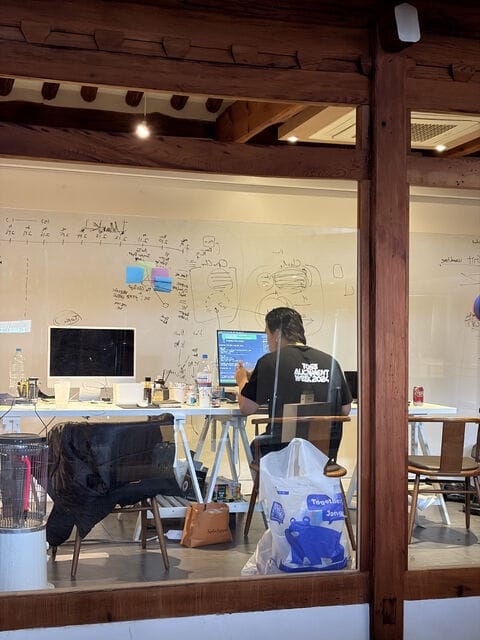
Abel had seen the same picture in New York. Even marketing teams with big ad budgets don't know which image model to use, according to the two of them. They figure whoever bridges that gap at the point where consumers meet the product can grow fast, and that's how Canva grew.
In San Francisco, networking means hacker houses
Networking in San Francisco runs house by house. The hacker houses form a tight ecosystem with each other. During the day people gather at one house to work together, and in the evening they head to Luma events at places like Frontier Tower. You're drinking and talking there, someone asks you to come work at their hacker house, and you just move over. That's how an hour of networking becomes eight.
Abel and Mark decided that going to the AI events posted on Luma and working all day in hacker houses was enough on its own to make a real impact.
There are so many events that hosts serve dinner at all of them just to get people to show up. You can eat some pizza, talk to one or two people and leave, and the food's actually pretty good. You meet investors naturally at these things, and the hacker houses are full of YC founders.
During SF Tech Week earlier this month there were reportedly more than 1,700 events. Once you hear about a cocktail party on an aircraft carrier and events held in rented-out art museums, the phrase “community event” carries a completely different weight.
The friends you make that way introduce you to more friends, and once you're invited to a birthday party, you're finally in. From that point on, you've stopped being people who met through business and become people who met as friends.
The biggest thing Abel and Mark got out of San Francisco was information that doesn't come through in writing. You show up at a morning meetup posted on Luma, something like a running club, and while you're running together, someone in an OpenAI T-shirt starts talking to you and turns out to be a voice AI researcher. That's how you hear early about the companies that'll take off a month later.
There's a temperature there you can only feel on your skin. Text posted on X doesn't carry it.
Mark later added a story from college. Mark skipped a lot of classes, but review week right before finals was different. As professors went over the units they'd put on the exam, Mark gathered everything with intense focus: the tones they unconsciously stressed, how long they lingered on each point, even their facial expressions.
That paid off a lot through sophomore year, and in junior year Mark somehow ended up selling those notes to classmates. The industry Mark spent years in is also full of signals like these between sellers and buyers, and quite a few people enter that market because they're drawn to reading them.
That's ultimately why I do Bloom. What gets said offline is refined and refined again before it reaches X and LinkedIn. That lag has gotten a lot shorter lately, but knowing first still makes a big difference on its own. In San Francisco, right at the center of tech, that goes without saying.
Abel and Mark also think real conversation happens with 20 or 30 people, not 100. Mark felt that firsthand running a small community for several years, and confirmed it again recently while hosting a small salon on marketing and AX (AI transformation). At past gatherings of about 20, everyone got to talk, and people clearly loosen up in a cultural space. That's why I set up small breakout groups at the end of every Bloom event.
Up close, everyone's about the same
Looking back on our conversation that day, Mark traced why offline matters back to a single question: “Am I using AI well enough?” Your feed is tuned to you, and most of what gets posted is only the part people want to show. So browsing inside online algorithms won't really answer that question.
How people who do AI for a living actually structure their products, and how they split their data into layers, comes through far more raw when you meet them, hear them out and see their screens. For anyone taking on a new market, the skill Mark ranks highest is staying in a state where you understand the ever-changing market and technology, and the whole structure underneath, together and at a deep level.
The other thing Abel and Mark brought back from San Francisco was confidence, and it came from those same screens. They'd sit with YC founders and look at what they were working on and at which layer. Whatever they couldn't figure out on the spot, they took apart later. It turned out to be less than they'd expected, and everyone was roughly on the same level.
Then a team whose screen they'd gone through together announced on LinkedIn two weeks later that it had raised $7 million. That's when you start feeling you have to go to a bigger market.
The difference isn't the people. It's the market and the capital.
People who've already made it and have plenty of money keep investing, since no one knows who'll hit big, and when another one hits, they invest again. That virtuous cycle keeps turning. VCs can't leave San Francisco either, because they're afraid of missing a good deal. And not everyone is grinding like crazy. Teams that work at a more relaxed pace than you'd think still become unicorns, while the handful of teams that do grind build companies much bigger than that.
One of them brought up the elephant tied by a rope, which makes the same point. An elephant that doesn't know it's an elephant lives tied to a single rope. But in a big market, even a monkey thinks it's an elephant, so it at least becomes a gorilla. Where you are decides how big you see yourself.
For capital, London comes next after San Francisco and New York, and most big tech companies and AI labs have their second base there too. So many people are heading to London that the advice going around is to go there first if you don't have a US visa, and the number of events on Luma follows the same order.
If you're in fashion you go to Paris, and if you're a musical theater actor you go to Broadway. If you're in AI, it's San Francisco. That's why I want to go to San Francisco too: if it works in tech's mecca, global follows.
I've also written up stories from people who got to San Francisco ahead of us in Just Move to San Francisco and A City of 30,000 Elon Musks.
Moats belong to people who've stopped
A moat is what you cling to once you've decided you're done getting better.
If you keep running, Abel thinks, it doesn't matter much how closely competitors follow. Abel would rather open technology up and grow the market than keep it locked away. Tesla did that, opening up its patents and growing the EV market. Without patents to hide behind, you have no choice but to keep working, and that kind of culture is the one that moves fastest.
Abel doesn't see the world as zero-sum. Instead of splitting one loaf of bread, you just bake two or three. And there are plenty of hard problems nobody has solved yet, like an agent handling more than 200 back-and-forth exchanges on its own. Those are the problems Abel wants to solve.
Abel thinks about money the same way. Even people who made it big in Silicon Valley buy the yachts, the NBA teams and the watches, then come back saying what they really like is building products. Seen that way, Abel doing this now and Abel doing this with a 100-trillion-won fortune look no different from the outside. So what Abel wants is work with impact, work that helps humanity.
To Mark, a moat is closer to an illusion. Pouring money into measurement data isn't a way of telling everyone else to stay out. You do it because you need it to build a better product. That's different from kicking away the ladder, where you drive ad bid prices so high that latecomers can't get in at all.
Still, some people do start kicking once they see the market hitting its limits. Just as there are investors like Warren Buffett and investors like George Soros, in the end it comes down to temperament.
I'll go first and open the door
One of them takes planes the way other people take the subway, since you can get anywhere on Earth in a day. They could become an agency that wins a few outsourcing contracts and makes a tidy profit. But that leaves no next step and no flag planted, so the two of them aren't going that way.
Abel brought up the story of Chung Ju-yung, Hyundai's founder, who walked into a British bank holding a Korean 500-won note with a turtle ship (Korea's famous armored warship) on it and borrowed the money to build a shipyard. An idea like that had no data behind it beforehand, so AI could never have taught it.
Chung Ju-yung and Samsung's founder Lee Byung-chul both saw their businesses wiped out by war and still got back up and built companies. Abel doesn't expect to face anything harder than that, so Abel has to do it too.
I have a European friend I met when we held a Bloom event in Singapore. Their network back home and in Singapore was limited, so getting anything going in AI was hard. They were set on going to San Francisco no matter what. Once there, they kept pushing through one door after another, and ended up seeing an Elon Musk event without even having a ticket.
Watching that friend, I'm reminded that you really have to go and get in the mix. Going there and posting photos you took yourself beats scrolling Instagram in Korea and saying how cool it looks. That's how you climb: you keep building your network and keep interviewing people.
Some Koreans have already gone to the US and are doing well. But a lot of the people Abel meets would come over with just a little more of a nudge, have plenty they want to do there, and still haven't taken the leap. So Abel plans to go first and open the door. Later, when someone's on the fence, Abel wants a community that offers them a room and tells them to come try it.
Abel admits to not really liking K-pop, but figures that bringing people together will have to start with a K-pop party. I chimed in that just serving tteokbokki (spicy rice cakes) would bring everyone out.
On Reddit, and in Seoul
For getting yourself seen without physically moving, Abel and Mark recommended Reddit. A tech product belongs in overseas communities full of people who like to try everything, and posts on Reddit also get cited a lot in AI answers. A close friend of Mark's since college built an API crawler service as a side project. Thanks to well-prepared GEO and SEO centered on Reddit, organic traffic from North America took off, and within six months the service was making $30,000 a month in recurring revenue.
For one of them, your own channel is money. Now that anyone can build things easily, the person people trust and follow matters more than the technology. China's wanghong, its influencer-sellers, showed the same thing in e-commerce: when there's too much to choose from, people buy from someone they want to trust. If you have a channel, even something odd you put out gets seen by tens of thousands of people right away, so it's not a losing deal.
The best part of running Bloom is that I keep spotting underdogs who were never visible above the surface. Finding people like that and getting to know them is fun, and I learn a lot from it, so I ask for coffee chats whenever I get the chance. This meeting happened because Abel caught my eye at the Bloom hackathon.
After Abel finished speaking on the mic that day, people came up with all kinds of questions, and that gave Abel the courage to believe there were insights worth sharing. In Abel's view, bringing people together is the biggest thing of all. San Francisco does that well, and Bloom is doing it right now in AI.
One comment about Bloom was that when overseas tech companies look for a big AI community in Asia, AI will recommend Bloom. Another was that in the next generation, Bloom could run the kind of big developer conferences that used to depend on corporate sponsors. There was also the point that Bloom is good because non-developers can come in comfortably and learn from developers. The explanation that came with it was that most developers love explaining things and have open-source culture in their bones.
In San Francisco, one gathering turns into eight hours. In Seoul, people still scatter the moment an event ends. Mark hopes Seoul's Luma listings will see more events led by communities rather than companies. I want to build a scene in Seoul that stretches that one hour a little longer each time.
Keep reading
Join Bloom
Bloom builds offline rooms where people and technology meet. We run them in Seoul, and now beyond it.
- 💬 Discord community, where events are announced first
- ▶️ YouTube, full talks from past events
- 📸 Instagram, photos from our events
- 🎟️ Bloom app, upcoming events and Mixers