Software Has Eaten Only Five Percent of the World
When Marc Andreessen wrote that software was eating the world in 2011, software was five percent of GDP. It still is. He thinks the other ninety five just became reachable.

AI turns sand, the most common thing on earth, into thought, the rarest. Andreessen calls it the philosopher's stone.
Turning sand into thought
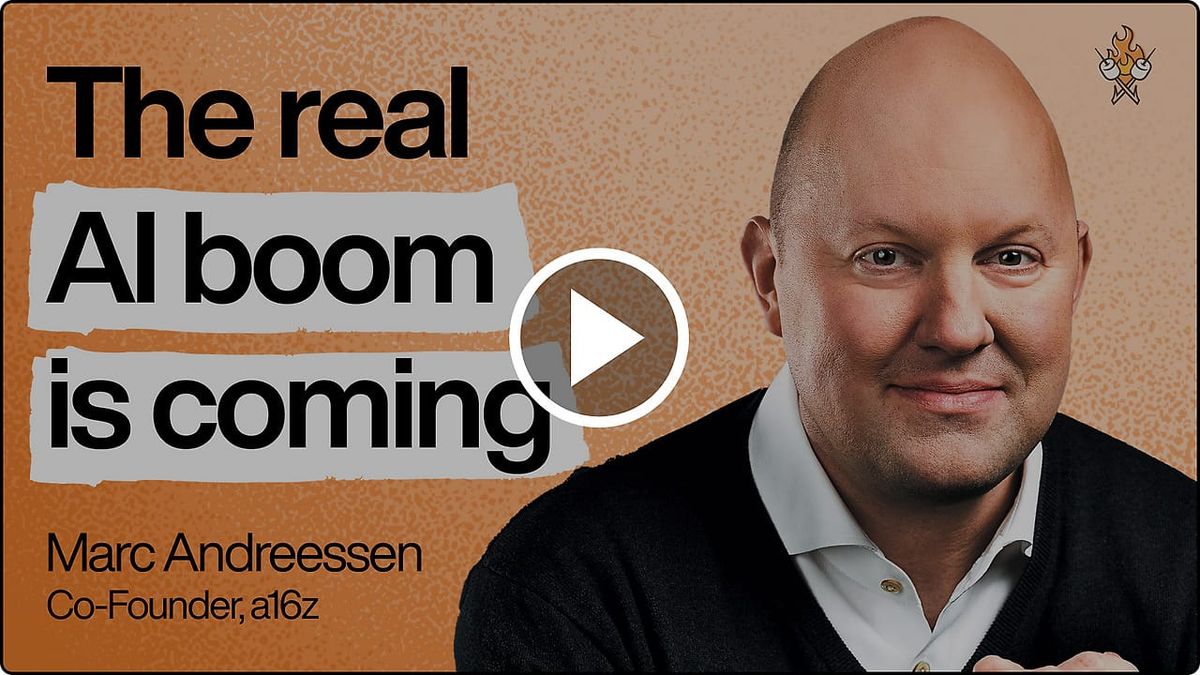
Andreessen built the web browser and founded a16z. Back in 2011 he argued software was eating the world and predicted five billion smartphone users within a decade. The real number came in around six billion.
He calls AI the philosopher's stone. Newton spent much of his life on alchemy trying to turn common lead into rare gold, and never got there. AI does the version that works. It turns sand, meaning silicon, into thought.
The timing was luck
His first point is demographic. Without AI he thinks we were walking into an economic problem, because technological change had been slow for fifty years while population growth flattened at the same time. AI and robotics showed up exactly when they were needed.
Which leads somewhere counterintuitive. The human workers who remain are a premium, not a discount.
Superpowered individuals
People who use AI well don't get twice as productive. They get ten or a hundred times. The strongest coders are already living in that, and they describe a sudden step change in their own output.
There's an important distinction buried in that. Delegate on autopilot and you get mediocre results. Understand the work deeply while you use it and the output is a different thing entirely.
So when someone asks whether they should still learn to code, his answer is an unambiguous yes. Even when the model writes it, judging what good code looks like is still the job. Programmer productivity goes up ten to a thousand times, and programmers don't go away.
His advice on raising kids runs along the same line. Go deep in a field, and stand where AI multiplies the work most. Deep expertise plus AI fluency beats being broadly shallow.
Technology rarely deletes jobs
He's more optimistic on employment than I expected. ATMs historically coincided with more bank tellers, not fewer, and automation reshaped manufacturing work rather than deleting it.
Tasks change and jobs survive. However fast the models improve, regulation and organizational inertia and legal liability keep real adoption gradual. He expects regulated professions like medicine and law to take decades, with humans holding supervision, judgment and accountability.
Three stages of AI-native company building
Stage one is rethinking the product. You add AI to something that already exists, or you create a new category outright.
Stage two is rethinking the organization. One founder plus AI is the whole company, with no engineers or designers or marketers, because the founder plays every role through models.
Stage three is AI running the company. The founder operates a company made of agents, starts with zero human employees, and hires only when there's no way around it.
The most forward founders are already experimenting at stage three.
They stopped asking about market size
Traditional venture capital asks whether the market is big enough and what the addressable size is. a16z barely runs that analysis anymore, because AI made every market size unpredictable.
Nobody forecast that coding assistants would turn into a multibillion dollar category. So the weight moved to the founder: ambition, persistence, the ability to execute. He reached for Peter Thiel's determinate optimism, meaning people who design and build the future instead of assuming it shows up.
The boom has not started
When he wrote that software was eating the world in 2011, software was roughly five percent of GDP. It's still roughly five percent. Ninety five percent of the economy hasn't been turned into software yet.
AI is what finally makes that remainder addressable. On his reading we aren't at the late stage of a boom. We're at the beginning of one.
On burnout
He says he's never experienced burnout, because he finds the work itself interesting. Burnout, in his view, comes from forcing yourself through work you don't want to do. So rather than balancing work against life, he'd have you find work that carries its own meaning, which is the more durable version of the same idea.
Keep reading
Join Bloom
Bloom builds offline rooms where people and technology meet. We run them in Seoul, and now beyond it.
- 💬 Discord community, where events are announced first
- ▶️ YouTube, full talks from past events
- 📸 Instagram, photos from the floor
- 🎟️ Upcoming events