
Your Agent's Memory Is Leaking API Keys
The anxiety is aimed at the wrong target. A conversation on agents, memory, and why individual skill with these tools does not make an organization good at them.


Oracle pointed at the Shadow Data problem, where API keys and internal information scatter through the memory files of an AI agent, and put forward the answer of managing that memory inside a database.
📅 28 May 2026 | 🤝 Bloom × Oracle × Channel Talk
🎤 Channel Talk's CAIO
🎟️ See the event page
Why agent memory turns into a security hole
Oracle is a company that sells databases, and yet the keynote topic was AI agent memory, and the link between the two runs like this. Use Claude Code or run several agents and files pile up locally, memory files that keep hold of the context of the work. There is more inside them than you would think: API keys, passwords, and internal information too if you have connected Gmail or a company system. Data like that, sitting unmanaged and open to the outside, is what gets called Shadow Data.
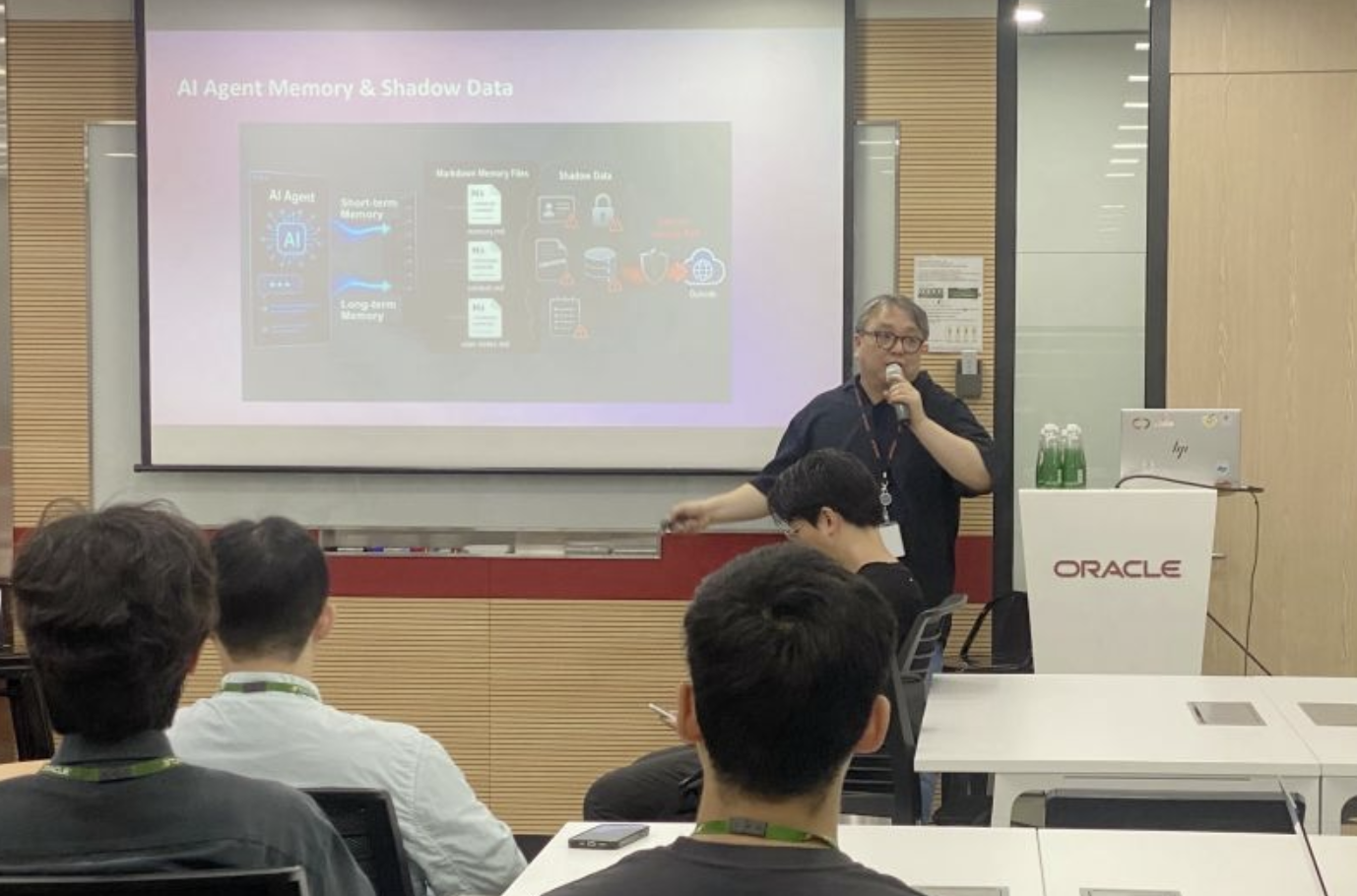
For personal use it does not matter, but from the moment you use AI for company work the story changes, because important company assets end up scattered across local files on somebody's PC. The answer Oracle put forward was simple, which is to manage the memory an agent uses inside Oracle DB. Install one package and it attaches straight onto an existing OpenAI or LangChain framework. Storage moves from local files to the database, which tightens security, and summarisation and embedding save tokens as well. When several agents write records at the same time, transactions put them in order.
The governance part was memorable too, because companies that have brought AI in now send the engineer responsible over once a month to review how prompts have been used over the past month and to build the skills they need. That works because every one of those records sits in the database. The more advanced AI gets, the more people there are who do not know what information is left where, and that gap is where the risk comes from.
Why he bet his life on AI
Channel Talk's CAIO worked as a VC for 7 to 8 years before joining at the start of this year, walking into a company he had invested in himself. The trends kept changing while he was a VC: when blockchain took off everyone invested in blockchain alone, and after that it was the metaverse. When AI arrived he read it the same way. "This will burn out in 2 to 3 years too." What broke that was a line from the CEO of one of the companies he had backed. "It looks like AI will not replace people. The person who uses AI well will replace the person who cannot." From that day he was up all night vibe coding.

Choosing the customer support market was the result of analysis through an investor's eyes. There are two things an LLM does best, problems that have an answer and work built on language, and after coding the next thing that meets both conditions was support. Anybody can do it without a licence, there is a manual, and it happens through conversation. The Korean SaaS market is at most 2 trillion won, while the call centre market is 10 trillion won.
The steps that changed the organisation, all the way to unlimited tokens
The first thing he did at Channel Talk was automate the sales team's meeting records. There were four meetings a day, and each one took 40 minutes from writing up the notes to entering them into Salesforce. With a transcription tool and an automation workflow he made that whole process feed into Salesforce by itself.
Getting to unlimited tokens happened in stages, and setting up a dedicated AX team failed, because work piles onto it and it does not know the actual business. The next approach was to put one person who uses AI well inside each team, and the mood of the organisation slowly started to change. The real turning point was the performance review. They put the question of what impact you produced with AI last quarter into the review criteria and handed out personal Claude Code accounts across the company. From the next day, team chat exploded with people saying look what I built.
The requests that piled up that way led to unlimited tokens, and the reasoning was simple. An hour from someone who uses AI well is worth more, so letting them use more beats making them wait because they ran out of tokens. Once it was open, a non-developer came out at 1 million won a month and one developer at 50 million won a month. Asked whether that developer had really done that much work, the CTO said yes. People in their mid to late 20s with no leader title were handling the load of ten people on their own, and a barista at the in-house cafe built a tablet ordering system alone with Claude Code.
Somebody who uses AI well is somebody who is good at the work
The CAIO's routine is one LinkedIn post a day, which takes an hour or two from research to writing. He said that after coming to a startup he went 3 weeks without writing and felt himself getting stupider, because handling only what sat in front of him took away the time to think more widely. Stop thinking and your ability to think shrinks.
Putting out work that obviously came from AI makes your evaluation worse, he said. The more the age belongs to AI, the more it matters to summarise down to the core, and a short piece with only the essence left beats a long document that smells of AI. Asked what humans should concentrate on in the age of AI, the answer was short. "We are Homo sapiens. We should concentrate on thinking." An LLM looks all-powerful, but the illusion breaks quickly once you build agents yourself. That phrases like context engineering and prompt engineering exist at all is proof that an LLM does not sort it out on its own. Guardrails, context and direction are still a person's job.
The conclusion was clear: somebody who uses AI well is in the end somebody who is good at the work, who instructs clearly and can review clearly what comes back. AX at a large company runs on the same principle. If the CEO uses AI well the organisation uses it well, and an organisation that hands it off with we have somebody good at AI, go and try it does not use it well, so the executive has to use it personally.
Choosing growth rather than efficiency
The CAIO argued against the end of office work, because more became possible after AI arrived rather than less. A large company can choose efficiency with AI, but Channel Talk picked a different direction, which is to grow more. They are hiring more right now, they have run subway advertising and they have put salary increases on the table. The logic is that when one person who uses AI well arrives, the work does not shrink, the amount of work you can produce grows.
The future Channel Talk is drawing is not selling a tool, it is replacing the work people do. Customers are already appearing where AI handles 80% of support. Replace only 10% of the 10 trillion won call centre market and that is 1 trillion won. As an ideal picture he described an organisation where the manager is the AI: put the CEO's context into the AI and the AI evaluates and hands out the work, with AI doing the actual tasks and people sitting above that.
One conclusion that nine tables reached
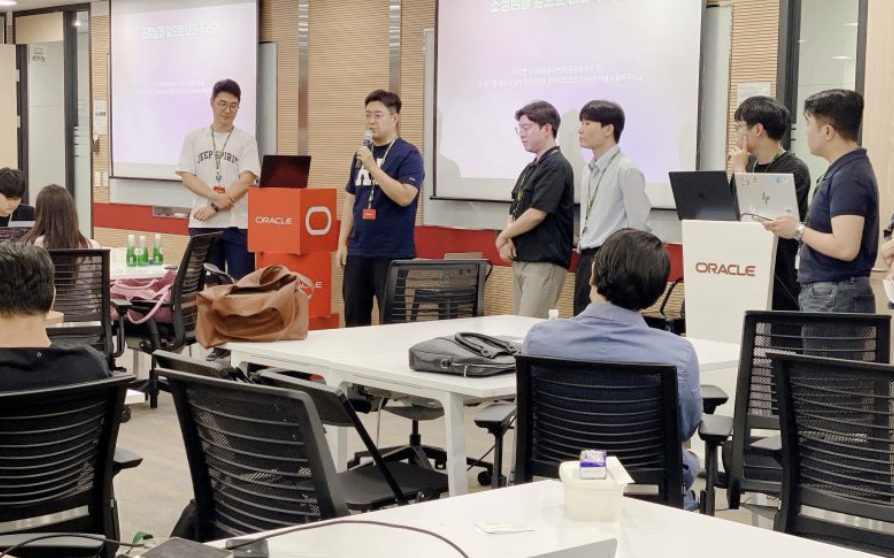
The first question in the table discussions was how far you can trust the output of an AI agent. Nine tables from different industries and different careers landed on a strikingly single conclusion. Execution goes to AI, the final decision goes to a human, and only the degree of intervention differed. In finance the damage from one error is large, so the level of intervention is high, while some said they leave the coding stage almost 100% to AI. There was a single criterion, which is how much responsibility the decision carries. A stage that carries no weight of responsibility can be handed to AI, and a heavy decision has to be made by a person.
The second question was how people actually use it today. Automating gift voucher delivery, producing a needs blueprint automatically from a recorded customer conversation, turning unstructured manufacturing data into templates, automating expense processing: everyone was already building something in their own workplace. There was an experiment that applied the dropout concept from model training to context handling and raised performance, and a method of putting several models to cross-validation. Somebody who is not a developer built a 3D modelling app from photographs and demonstrated it to a client.
The third question was education for the next generation. A first-year student majoring in data science got a burst of applause for this. "Education right now is education in finding a fixed answer, and AI is better at that. Unlike a calculator or GPS, AI makes you hand over the thinking itself. The next generation should deliberately keep AI at a distance and grow the ability to think." Another table said the same thing in different language, which is that knowing how to speak, instruct and delegate has become the core, rather than knowing how to use a particular language. Natural language education comes before coding education.
What a company can take from this
Put the night into working language and four things remain.
- Manage agent memory. Do not leave Shadow Data scattered across local machines. Control it and record it in a database or something equivalent, and you have your security and your governance.
- Push the transition with evaluation and with resources. Put AI impact into the performance review, and do not be stingy with tokens for the people who use them well.
- Decide between efficiency and growth. Settle first whether you are cutting headcount or producing bigger work with the same number of people.
- Split the boundary by the weight of responsibility. Hand execution to AI, and let a person make the final decisions that carry real responsibility.
Frequently asked questions (FAQ)
Q. What is Shadow Data and why is it dangerous?
- The memory files that Claude Code or several agents pile up locally can hold API keys, passwords and internal information. Left scattered and unmanaged, company assets end up exposed on a personal PC, so they need to be controlled in a database or something equivalent.
Q. How did Channel Talk get to unlimited tokens?
- The dedicated AX team failed. After an AI champion was placed in each team, AI impact went into the performance review and Claude Code went out to the whole company, requests exploded. Judging that the time of the people who use it well is worth more, they opened tokens with no limit.
Q. How far should AI output be trusted?
- The criterion is the weight of responsibility. Execution stages that carry none go to AI, and final decisions that carry a lot are made by a person. All nine tables converged on this.
Q. What should the next generation be taught?
- AI is better at finding a fixed answer. What matters instead is defining the problem, knowing how to speak, instruct and delegate, and the strength to think for yourself. The line that natural language education comes before coding education came up again and again.
Watch it again
Keep reading
Join Bloom
Bloom builds offline rooms where people and technology meet. We run them in Seoul, and now beyond it.
- 💬 Discord community, where events are announced first
- ▶️ YouTube, full talks from past events
- 📸 Instagram, photos from the floor
- 🎟️ Upcoming events
Based on a Bloom event with Oracle and Channel Talk in Seoul.