95% Use AI, 1% Use It Safely
The gap between using AI and using it safely is where most enterprise risk sits right now. The fix starts somewhere much smaller than a system rollout.

📅 21 May 2026 | 🤝 Bloom × Microsoft
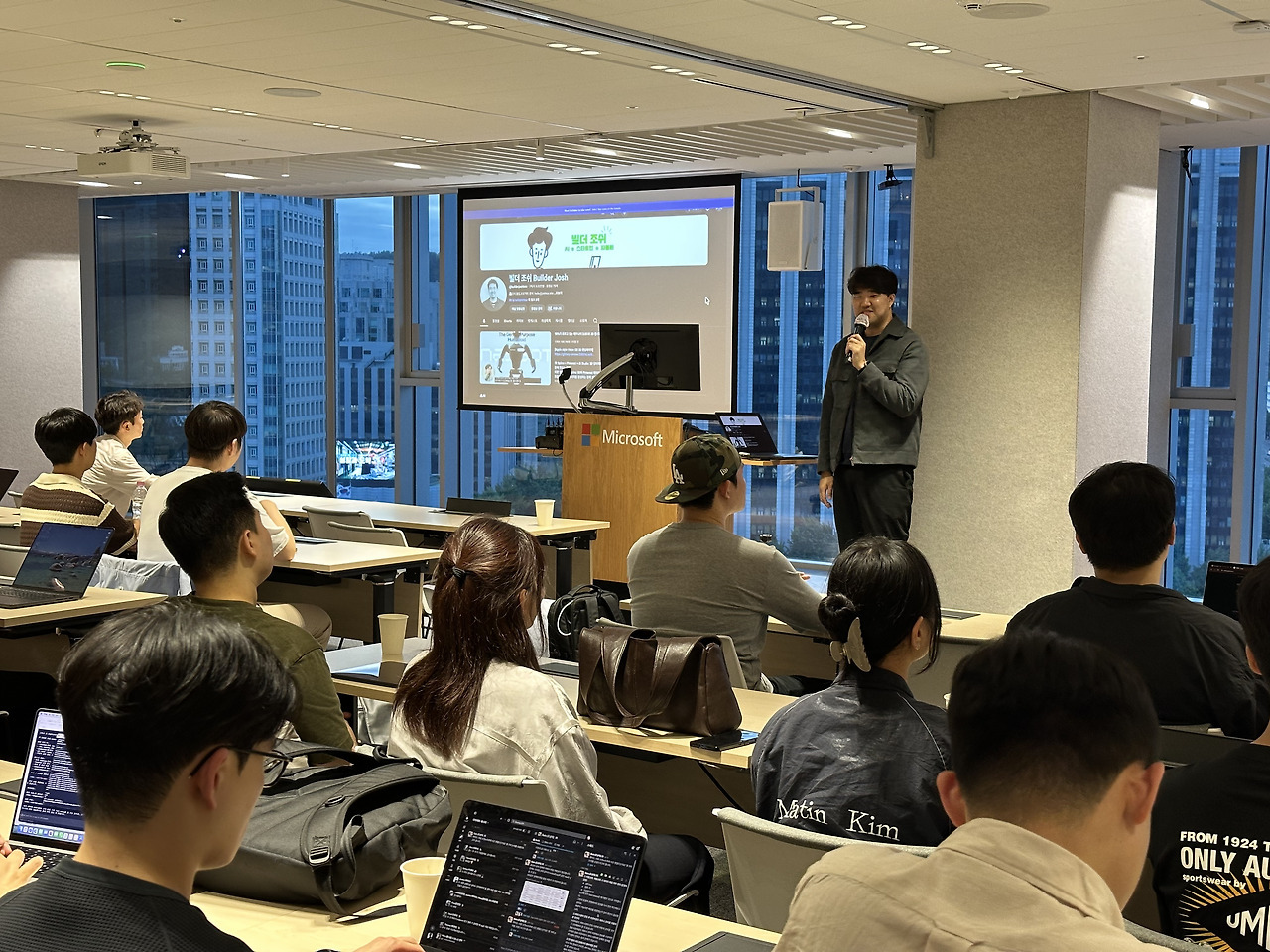
🎤 Builder Josh · a security manager from Microsoft
🎟️ See the event page
95% are using it, 1% are safe
The talk from the security manager at Microsoft ran 5 minutes and the pin point was clear. The research he cited says 95% of companies have already adopted AI and are using it, while only 1% are ready to use it safely. Take the largest enterprises out of that number and you can treat the remainder as close to nobody.
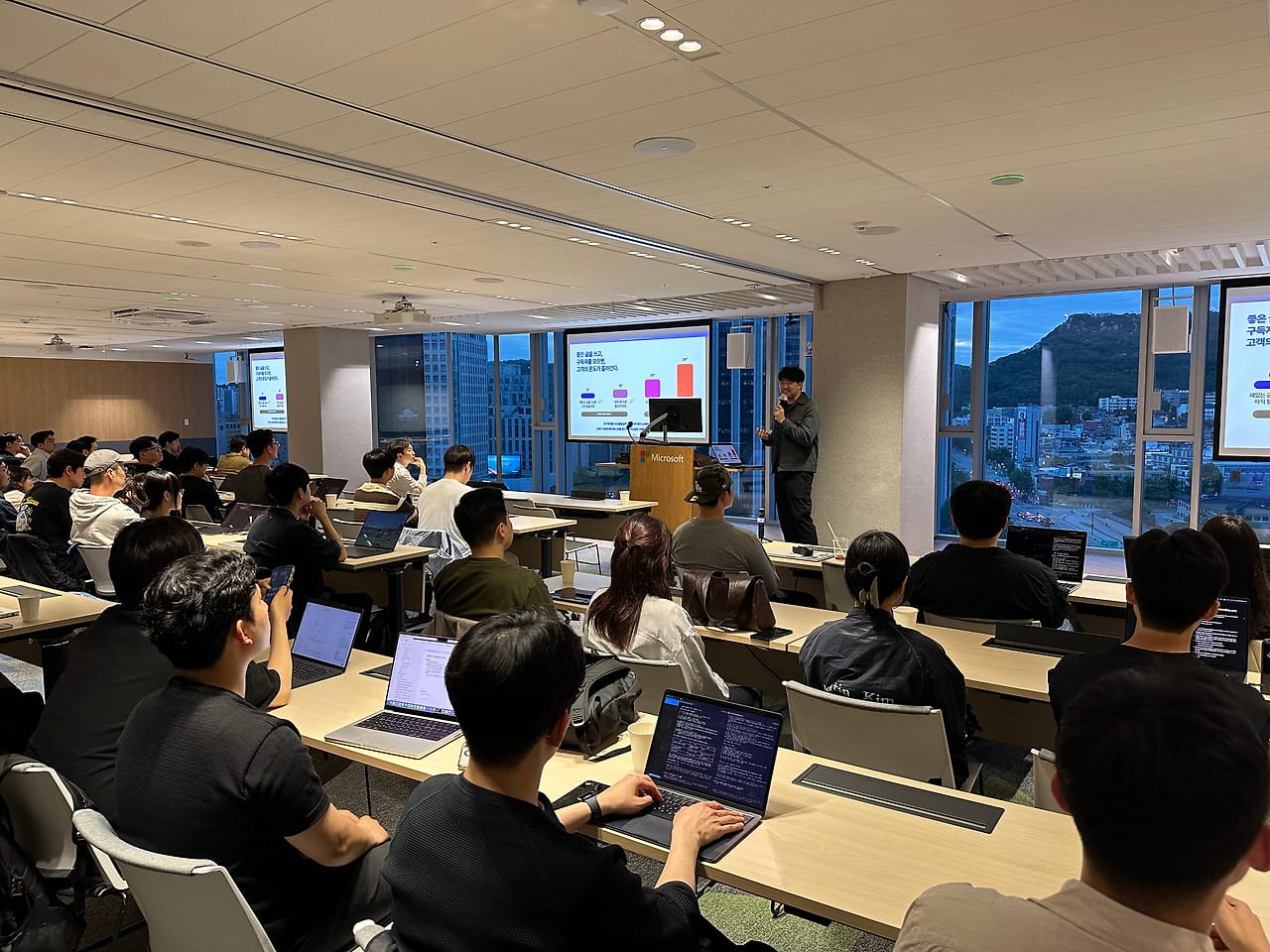
Microsoft defines itself as the biggest security company in the world, and a company known for PowerPoint and Teams has its reasons for saying that. Almost every company runs something of theirs, which puts them second only to the US Department of Defense in the volume of attacks they take. They collect attack signals from 190 countries by the second, and they spend an amount close to Naver's market capitalisation on security research and development alone.
The core message was account management, and while security covers tools, devices, cloud and network and gets complicated, guarding a single account well still prevents 99% of incidents. One real case carried the point. A developer switched off multi-factor authentication, or MFA, for 10 minutes to share a YouTube account, and in that window his Google account was taken and 1.2 million won of Gemini API charges went through. Password attacks ran at 7,000 per second before generative AI, and AI has pushed that down to milliseconds.
The second point was data oversharing, because developers paste sensitive material such as API tokens straight into a prompt all the time, and OpenAI detects tens of thousands of leaked tokens in a single day. Attach an AI agent to Slack and data like personnel records can come out in one prompt. That is why DLP labelling and data separation matter. Put simply, the preparation to use AI safely has to follow the ambition to use it well.
From designer to the bone to AI native founder
Builder Josh studied design in high school and again at university, which is why he calls himself a designer to the bone. He started his working life at an agency in 2012. Then he taught himself to code, published a book about it, and moved to SK Telecom, and his salary jumped around that point. It kept climbing after that, and he closed out 13 years as an employee.

The problem arrived in year 13, when he did not know the next step. He had followed the stable path society lays out, and the question that surfaced was whether he could do the executive job that comes after team lead. At the time he saw an executive only as a leader who takes an organisation in hand and drives it, so he fenced himself off as somebody who only needed to be good at design. Only after running a company did he learn how far apart hands-on skill and management sit. In 2023 he found the potential in a newsletter-based content business, ran a loop of throwing things out, learning and throwing again, and left in January 2024.
Trust is a thing that accumulates
The core of a content business is trust. He quoted Chung Ju-yung, the founder of Hyundai, who said business is accumulated trust. The principle behind Justin Welsh, the top LinkedIn creator in the world, fits on one page too. Good content gets picked by the algorithm and gets you found, and longer content lets people go deep, and trust piles up along the way. Gather followers on short form such as Threads or LinkedIn, convert them to long form such as a newsletter and YouTube, and once you hold emails and phone numbers that leads into education products or an ebook.
He makes content the data driven way, working out what the market wants from the numbers rather than what he feels like making. He concentrates on long form, and in a heavy week that means 3 videos of 40 minutes to an hour and 2 newsletters. He started YouTube properly in November 2025 and has been adding around 10,000 subscribers a month. His read is that short form alone does not accumulate trust, and that YouTube is the one platform holding discovery and relationship in the same place. That channel is the funnel that brings customers into Joshua, his AX agency.
How AI native companies actually work
Making content turned him into a reporter on AI native organisations. His favourite case is GPTers, where an AI agent handles an AI study programme of tens of thousands of people from recruitment through to the wrap-up. It sends texts from the database, sorts students by status, sends the Zoom links, summarises the recordings and pulls out what to improve. The key was the persona, and they gave it an exact name and speaking style and fed it yesterday's conversations, the meeting notes and every conversation from the thirty-odd study groups running at once, every day. A familiar presence rather than a stiff piece of software is what gets members using it without resistance.
Other cases pointed the same way. At Delta Society the whole staff including non-developers work with GitHub and Claude Code as the single source of truth, or SSOT, and the standard operating procedure, the SOP, is rewritten daily, so what was learned yesterday becomes today's guide. SpaceY, an AX consulting firm, instructs AI to build during a 45 minute meeting and has a prototype on the screen by the time the meeting ends. Samyang Foods stood up a new AI native team instead of converting the existing organisation and standardised on a small set of tools to move quickly. Two things were common to all of them: a new organisation with no legacy, and high vibe coding literacy.
How Joshua works
The Joshua tool stack goes like this: Claude Code and Codex are the operating system, and an agent called Hermes does the hands-on work. GitHub is the company-wide SSOT, Slack is the hub where people and AI work together, and Obsidian puts meeting notes and shared files into a visible shape. A 300,000 won cloud recorder captures a meeting, a Zapier webhook drops it into Obsidian, and Hermes reads it through GitHub. Meeting records pile up and the agent learns the context from them.
Their Slack agent handles newsletter drafts, issues tax invoices and quotes, sends SMS, and drafts B2B emails through a Gmail connection. They built their own internal ERP as well. At 9 every morning Hermes proposes that day's work to the PM, the assistant and the PD out of the context it has accumulated. None of it is binding and it sits at the level of a reference, and the time people spend in the morning working out what to do has gone down.
He did not hide the limits either, since automating external communication that matters is still hard and the final review takes more time than he expected. There is a literacy gap between team members too. The near-term goal is for AI to take over 20 percent of all the work. Asked about the claim that 80 percent is possible, he said honestly that he does not know, and that 20 percent comes first. The biggest change even so is that they now record 100 percent of their meetings. What he left us with was plain. "An AI native shift is not a change, it is starting again from 0. Record the meetings first, record the conversations."
What came off the tables
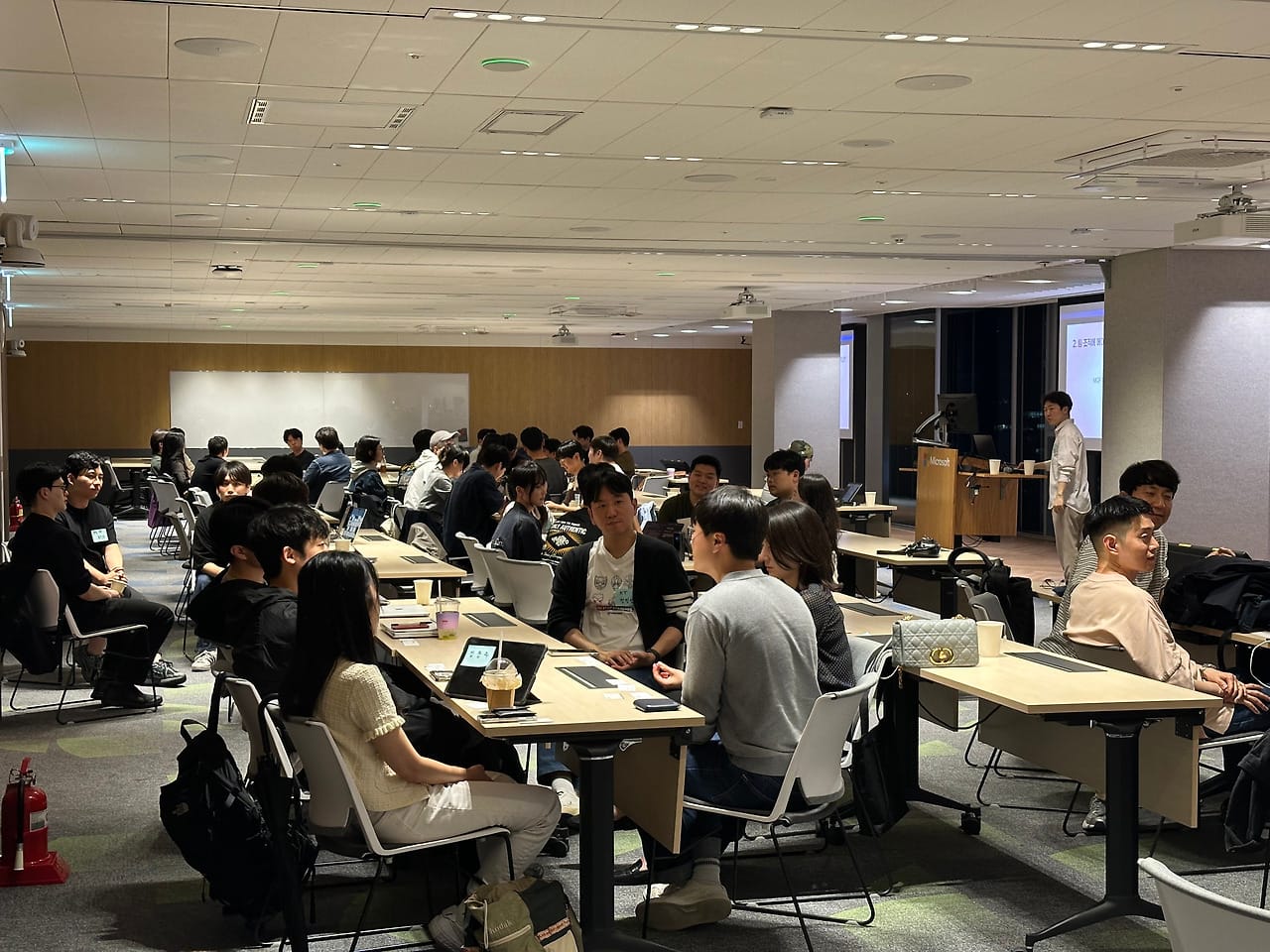
After the talks, 10 tables presented, and someone from Lotte Innovate brought greenfield and brownfield into it. An environment with no legacy can automate the whole chain from design through to delivery, while a company trying to lay AI over existing systems runs into limits like token caps. One line stayed with the room. "If Claude cannot do it, that does not mean it cannot be done. It means you have not found the skill yet." Someone from Hanwha Vision talked about relief. Everybody is grinding away running agents and setting up harnesses, and confirming that he was not lost on his own was worth the evening.
The practical reality came out too, and someone from a global manufacturing group said the technology has become familiar while plenty of teams have never settled the question of how they are working right now, so defining the process comes first. A startup participant said they built a 100 page government grant proposal with an agent and won the grant. Someone from a large company said the opposite, that they cannot even use Claude Code inside the building, so they learn the methods through outside activity and carry them back to the team. There was also a story of one Korean conglomerate finishing a cloud-based Claude Code rollout quickly. Different industries, different sizes, and the same two points underneath.
Loading the data is where everything starts
His closing message is the one that stays longest. An AI native shift is not a repair of the existing way, it is a start from 0, and the starting point is the meeting record. The reason large companies get stuck connecting internal data to AI is the load it puts on the security team, because building an isolated environment and closing off every route out is not simple. So the starting point he proposes is modest, which is to press record right now. Once meeting notes count as data and start to accumulate, every conversation and every piece of tacit knowledge becomes material for AI.

That is also why the stories from 10 tables sounded so alike. The technology is out there in plenty, and process, accountability, literacy, data and organisational culture are simply slower to catch up with it. Closing that gap is the job this community has taken.
What a company can take from this
Put the evening into working language and four things remain.
- Protect the account first. Multi-factor authentication (MFA) and decent account management on their own stop 99% of security incidents. Put DLP and data separation in place so tokens and sensitive material never get pasted into a prompt.
- Start accumulating meeting records. The starting point of an AI native shift is not a grand system, it is pressing record today and turning the conversation into data.
- Start with a new team. Standing up a separate AI native team with no legacy is faster than converting the whole existing organisation.
- Look at literacy and process together. Handing people the tools is not enough on its own. Define who hands what to whom and how far it goes, along with the process and the accountability, before anything else.
Frequently asked questions (FAQ)
Q: What does it mean that one account can stop 99% of security incidents?
- Security stretches across tools, devices, cloud and network, and most incidents still begin with a stolen account. Doing MFA and account management properly prevents the large majority of them.
Q: How do you stop data oversharing when people use AI?
- Keep API tokens and sensitive material out of prompts, and put DLP labelling and a data separation scheme in place when you attach an agent to Slack or anything similar. Leaked tokens are common enough that they get detected in tens of thousands a day.
Q: Where should an AI native shift start?
- With the meeting record. Before you build any grand system, press record now and accumulate the conversation as data. Treat it as a start from 0 rather than a repair of the way you already work.
Q: What do you do when the existing organisation will not change?
- The Samyang Foods route is realistic. Rather than convert the whole existing organisation, stand up a new AI native team with no legacy and standardise it on a small set of tools.
Watch it back
Keep reading
Join Bloom
Bloom builds offline rooms where people and technology meet. We run them in Seoul, and now beyond it.
- 💬 Discord community, where events are announced first
- ▶️ YouTube, full talks from past events
- 📸 Instagram, photos from the floor
- 🎟️ Upcoming events
Based on a Bloom event with Microsoft and Builder Josh in Seoul.