Ambition for Korea x Anthropic

On Saturday, October 24, we wrapped up the Ambition for Korea hackathon at Seoul AI Hub, and it was a success.
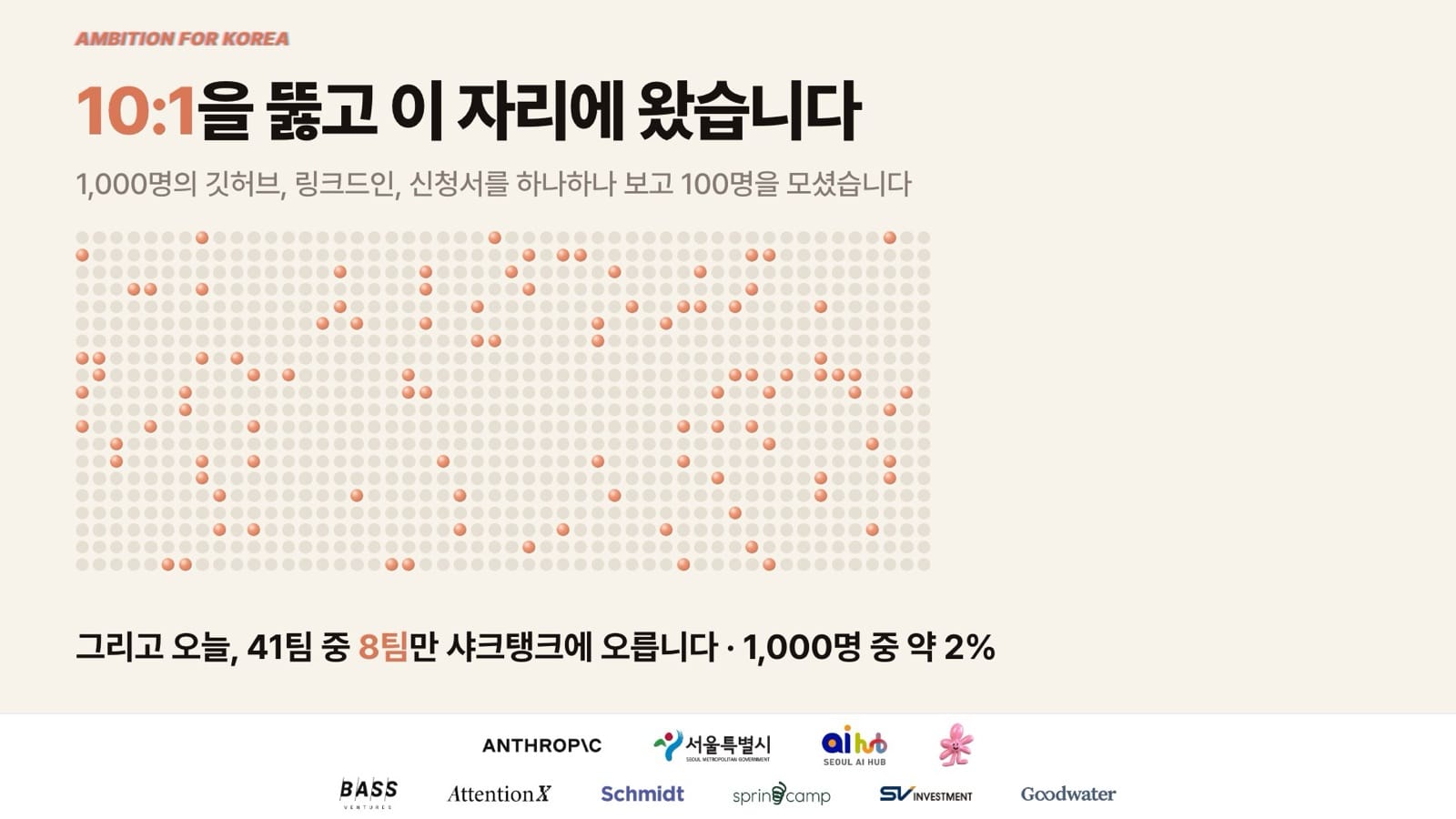
About 100 builders beat 10-to-1 odds to get in, each one picked after we went through their GitHub, LinkedIn and application carefully. They formed roughly 40 teams of two to four people. Eight teams made the finals, and five of those matched with a VC.
Above all, thank you to everyone who applied, so many of you from the very start. I really wish we could've hosted every one of you. Since it was an AI hackathon, we ran the whole thing on AI, planning and operations both, with real-time checks, status sharing and feedback loops. We learned a lot doing it, and we'll use that to come back at a bigger scale next time.
We also designed the program to feel as tense as Show Me the Money, the Korean rap competition show. So you can see for yourself what the room felt like, I'm open-sourcing the hackathon program Claude and I built together.
There are so many people to thank. I especially want to thank Yeop Lee at Anthropic, who planned the hackathon's theme with us and talked it through in depth. We'd already have been grateful for the $500 in credits every participant received. Then, on the day, Yeop surprised each of the eight finalist teams with another $5,000 in credits, and everyone got a lot more locked in.
Thank you for support worth more than 100 million won. I was also really glad to hear, in the fireside chat, about Anthropic's vision for the Korean market and the practical help it's offering startups that want to grow and expand overseas. Bloom got its start this April with Claude Community under the banner “Claude Blue to Bloom,” so this partnership means even more to us.
I'm also deeply grateful to Taeyang Lee of BASS Ventures, Sukone Hong of AttentionX, Jaewon Lee of SCHMIDT, Kyungpyo Ko of SpringCamp, Taehong Park of SV Investment and Sinhae Lee of Goodwater Capital. Once building got going, they went through every team's demo link and pitch deck PDF closely, from the afternoon until late.
Looking back, it was grueling work, with a new team to score almost every five minutes. Even so, they left detailed one-line comments that gave a lot of participants real insight and something to aim for. In the evening session they judged each team's pitch Shark Tank style, gave generous feedback on the spot and even followed up with meetings. Thank you again, truly, for that kind of commitment.
A huge thank-you to Hyeonhee Shim of Seoul AI Hub and to the Seoul Metropolitan Government for making it possible to hold the event in such a great space. Thanks as well to CJ CheilJedang and Snowflake for sponsoring delicious snacks and drinks. And as always, thank you to Junshu Kim, Yale Kim, Jaemin You, Jung Min Kang and JongHyeok Lee, who worked behind the scenes so that everything ran without a hitch.
Thank you once more to everyone who joined the Ambition for Korea hackathon. I hope this Saturday turns out to be the first step for Korean builders heading out into the world, and a reference point for what follows, rather than a one-off event. We'll keep coming back in better forms, and we'll keep sharing the behind-the-scenes stories and insights along the way.
Today is Day Zero
I opened by explaining why we were holding this hackathon in the first place. Bloom wasn't built from a strategy or a plan. It grew on its own, in answer to the call of the times. When we held our first event with Claude Community in April, 2,100 people signed up in three days. We couldn't host them all at once, so we kept telling people we'd see them next time, and then the time after that. Five months on, we're still running events.
Since then, 8,000 people have come to more than 40 events, and in July we also ran one with Claude Community in Singapore. I'd say we've grown up alongside Claude from the start. That's why the day we officially teamed up with Anthropic meant so much to Bloom.
With a real chance to work together, Yeop Lee at Anthropic and I talked freely about what kind of event we should do, and the phrase that came out of those talks was Ambition for Korea. Yeop leads startup events and programs across Asia-Pacific, including Australia, India and Japan. But as a Korean, Yeop wanted to cheer on Korean companies moving into bigger markets.
Anthropic was taking the Korean market seriously too, seriously enough to open a Seoul office this June. So we agreed to run our first one-day hackathon together. Once we did, the Seoul Metropolitan Government, Seoul AI Hub and six VCs who shared the goal signed on one after another.
These days “going global” has become a cliché. We all know how hard it actually is, which is why I always felt a little embarrassed saying it. Are we not serious about it, or are we really serious? So I called the day Day Zero and asked everyone to form a team and take a real, serious shot at it, even if only for one day. One day isn't going to settle anyone's global expansion. We built it hoping people would use it as a stepping stone and leave with the drive to keep moving forward.
There are plenty of reasons going global is hard, from business and operations to funding and tech partnerships. But I told everyone, “Korea is still a pretty big market, you know. And I think there's a bit of a trap in that.” What I meant was that, for this one day, we'd break the usual order of trying things in Seoul and in Korea first and only then going global. Since these were brand-new teams anyway, I asked them to cut ties with whatever they'd been doing so far, make today Day Zero, and redraw their business to target overseas markets from the start.
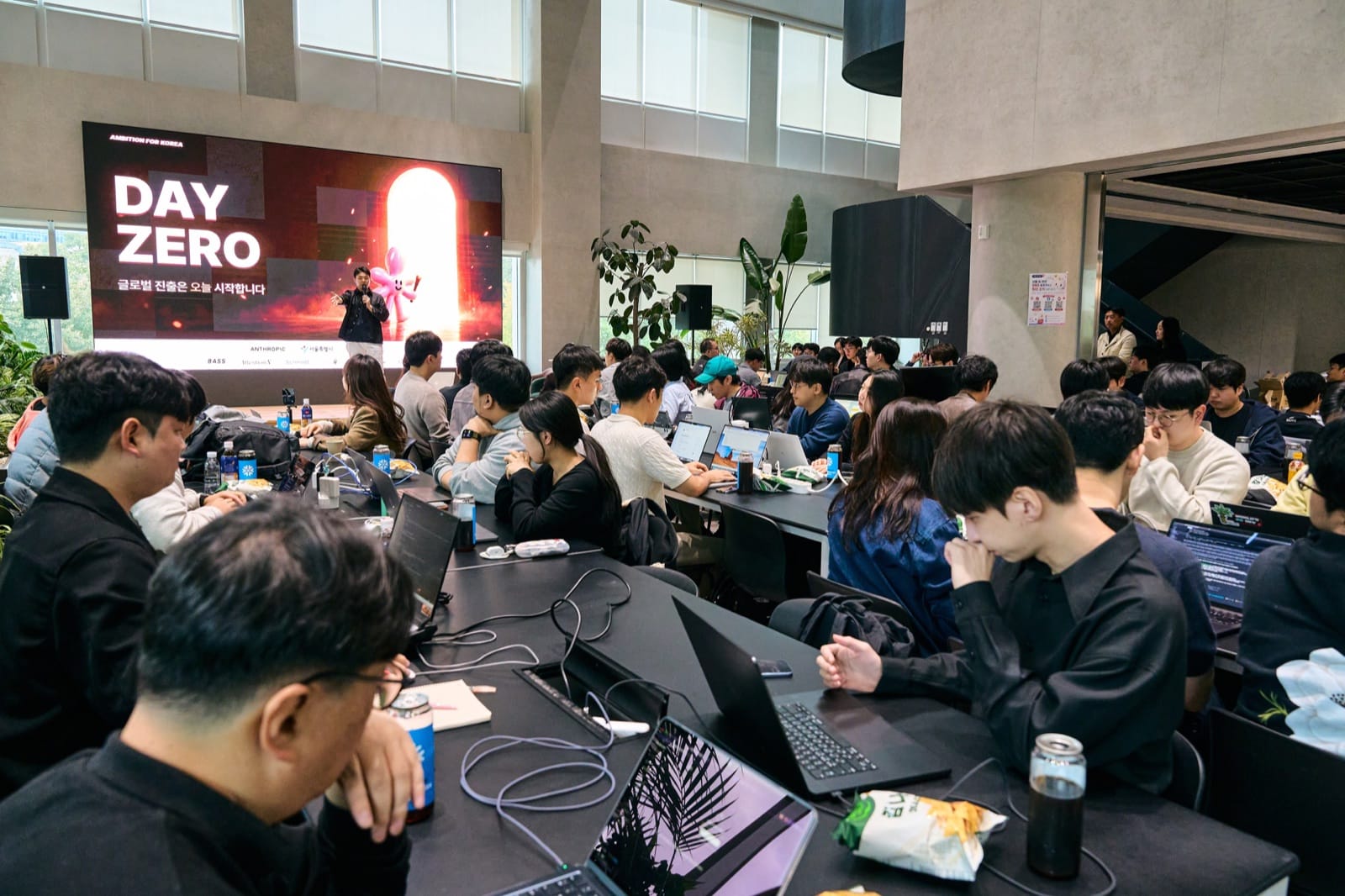
I also introduced the partners behind the day. Anthropic took care of the technology, while Seoul AI Hub and the Seoul Metropolitan Government, which gave us the space, covered the government side. The business side went to six VCs we chose from firms that help startups go global or run global funds.
Sponsors kept us fed through the day. CJ CheilJedang's bibigo sent 120 each of Hetbahn Faro nurungji tea (a toasted-rice tea) and bibigo seaweed nachos, and Snowflake sent 120 iced Americanos with cheer-up stickers on them. The coffee was itself a prize: Bloom had taken first place in a competition we'd entered during an earlier collaboration with Snowflake.
I told the room the VCs each have a slightly different vision and direction, so hearing those differences would be part of the fun. I also slipped in that I'd talk to people during the day about support beyond credits, and see if I could get us a surprise or two.
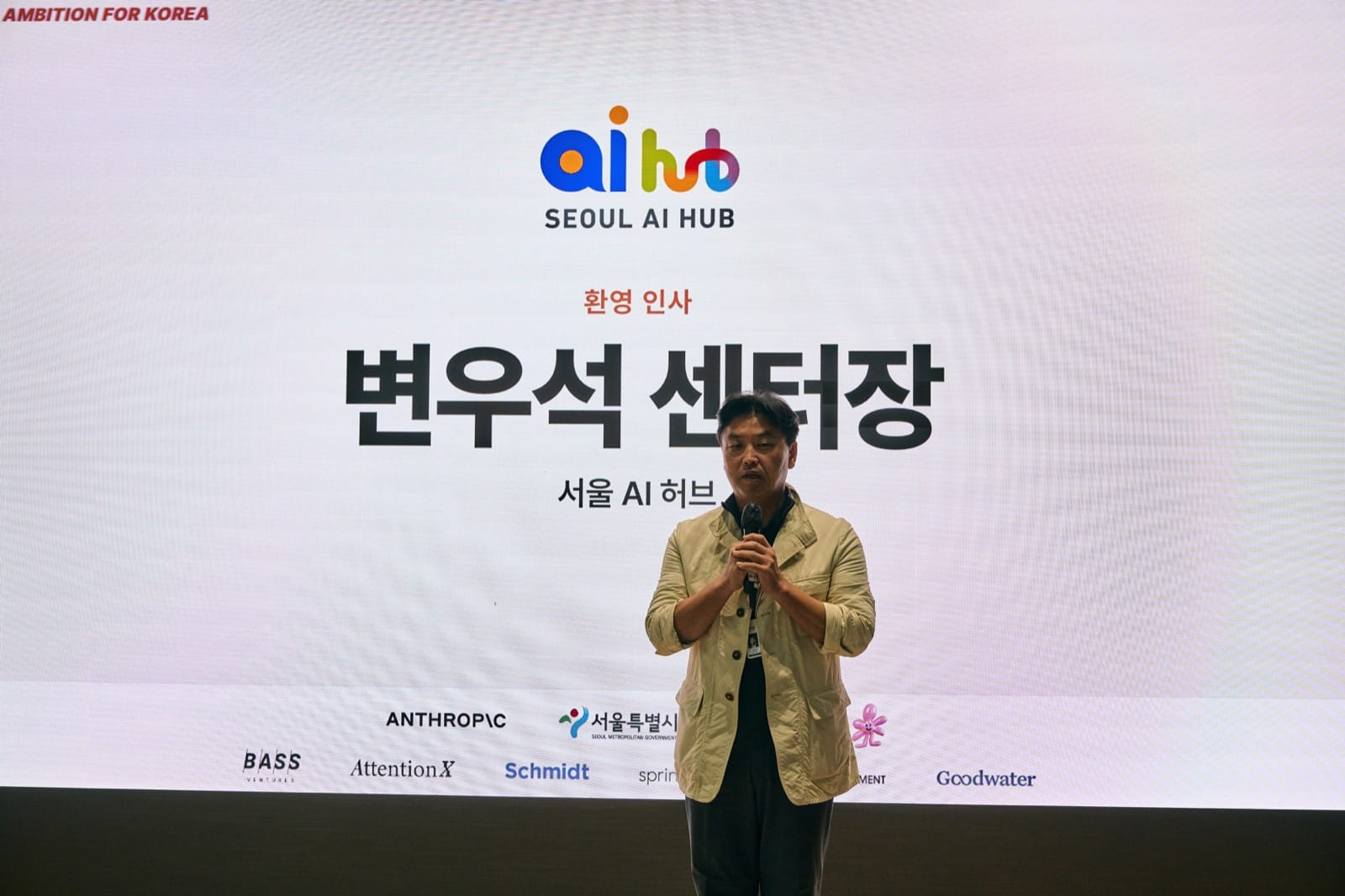
Wooseok Byeon, director of Seoul AI Hub, opened with a joke about sharing his name with the actor Byeon Woo-seok: “My name is Byeon Woo-seok, sorry I look like this.” He cheered on the office workers who'd come out on a Saturday they could've spent sleeping in. “I sincerely hope the small attempts you make today become a first step that leads to starting a company and even going global.”
Seoul AI Hub is an agency under the Seoul Metropolitan Government. It runs an industry AX (AI transformation) program that supports open innovation so large and mid-sized companies can grow alongside startups. It also accelerates 100 AI startups based at the hub, offers a 400-company membership that anyone can join, and runs free training and an overseas expansion program.
The hub plans to grow that overseas program next year. It's also setting up a global big tech center inside the hub, with space and programs where people can meet Anthropic on an ongoing basis, and it's heading toward partnerships with other big tech companies as well.
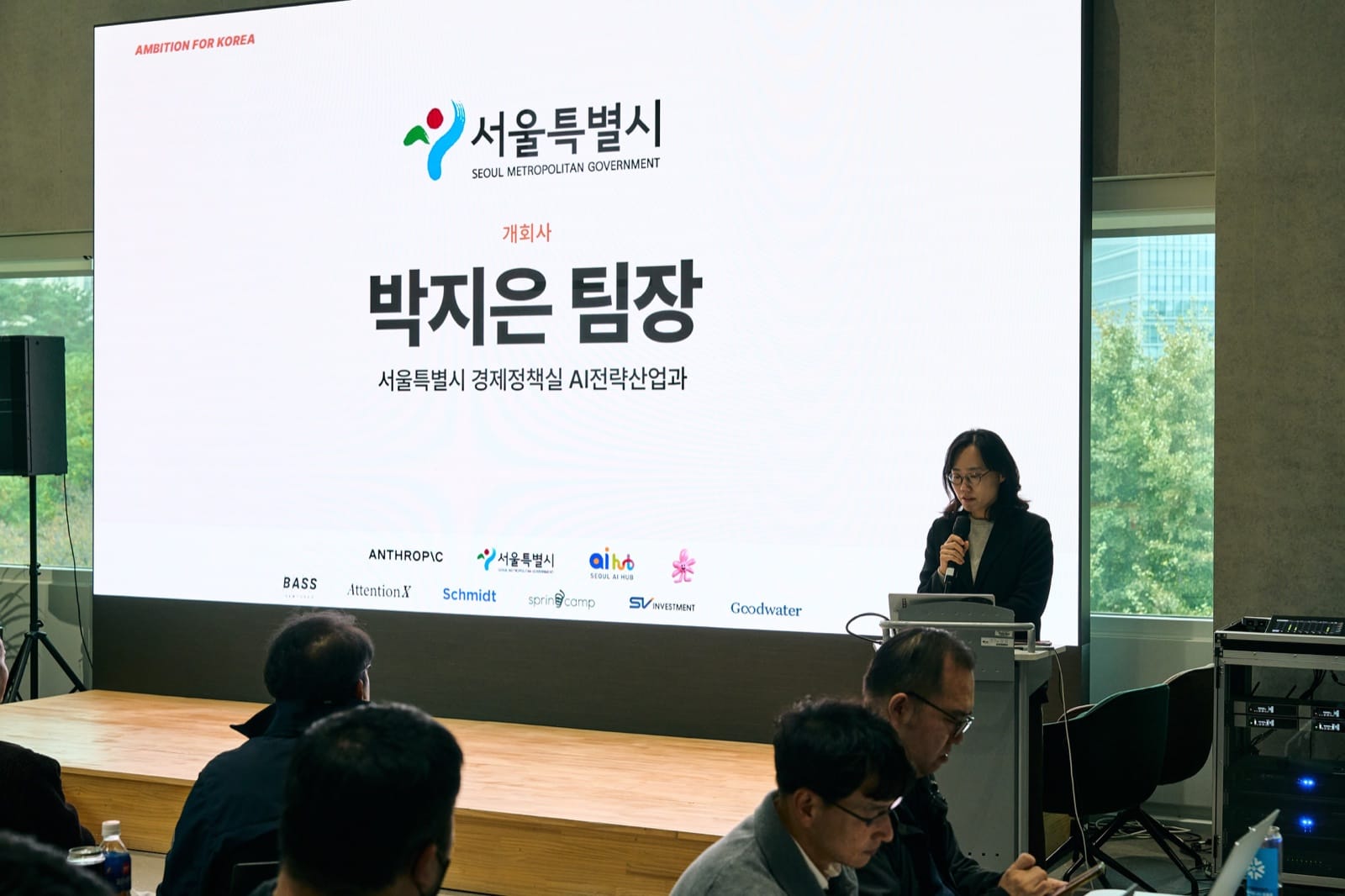
Next came Jieun Park, team lead in the AI Strategic Industry Division of the Seoul Metropolitan Government's Economic Policy Office. Park could feel the energy of everyone who'd shown up on a Saturday morning, and had some news to share. This year, for the first time, the UK's Tortoise Media measured AI industry capability city by city, and Seoul ranked third in the world. In the country-level rankings, Korea had been fifth. Park credited the result to the people in the room.
I can't help thinking this result reflects the effort of people like you, who come out on your own on a Saturday like this to work on AI technology.
Park promised the city would do a lot to support the events the hub holds from here on, then left, sorry not to be able to stay through the VC judging that evening.
Building got easy, selling is the hard part
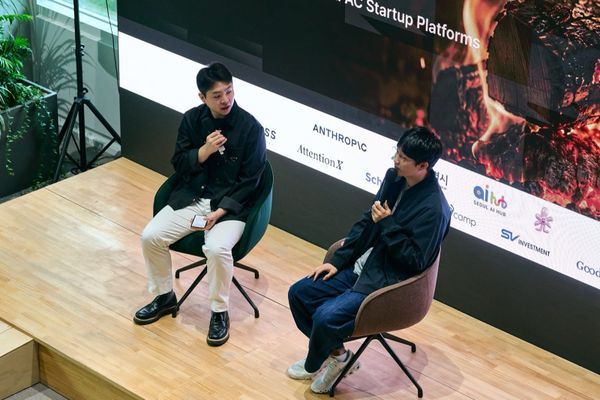
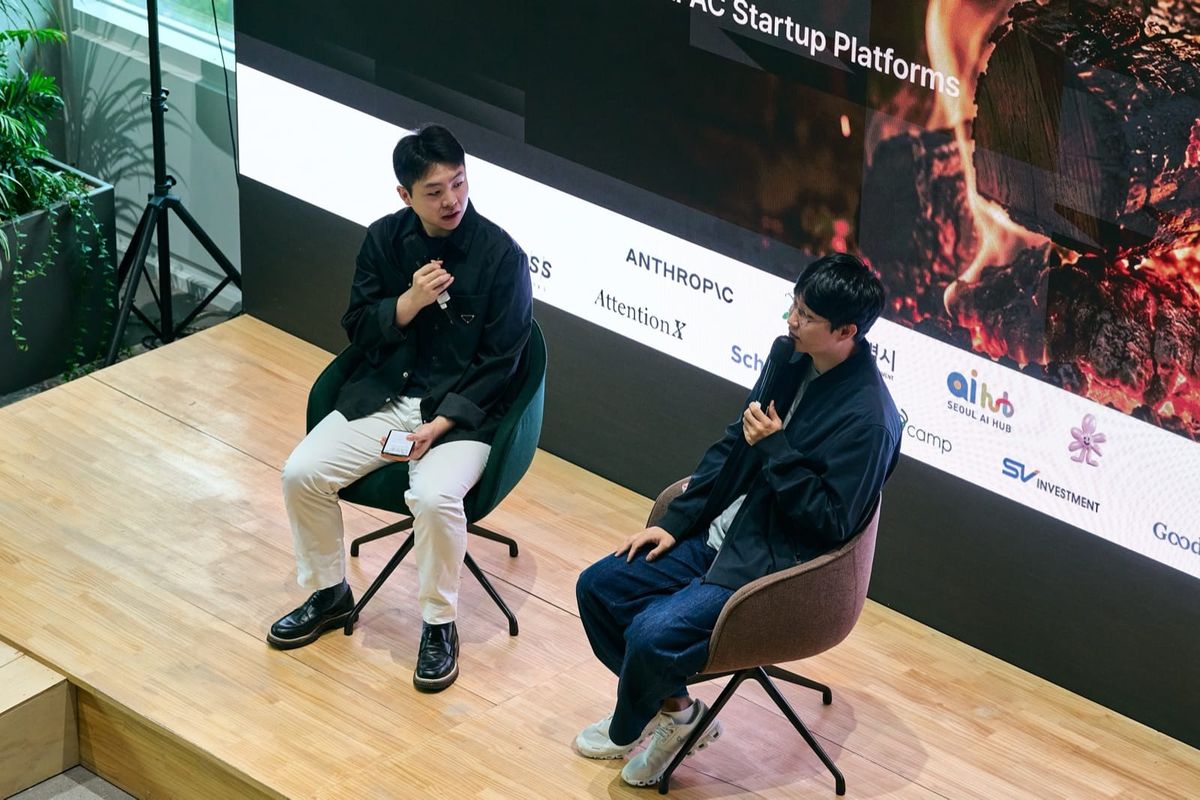
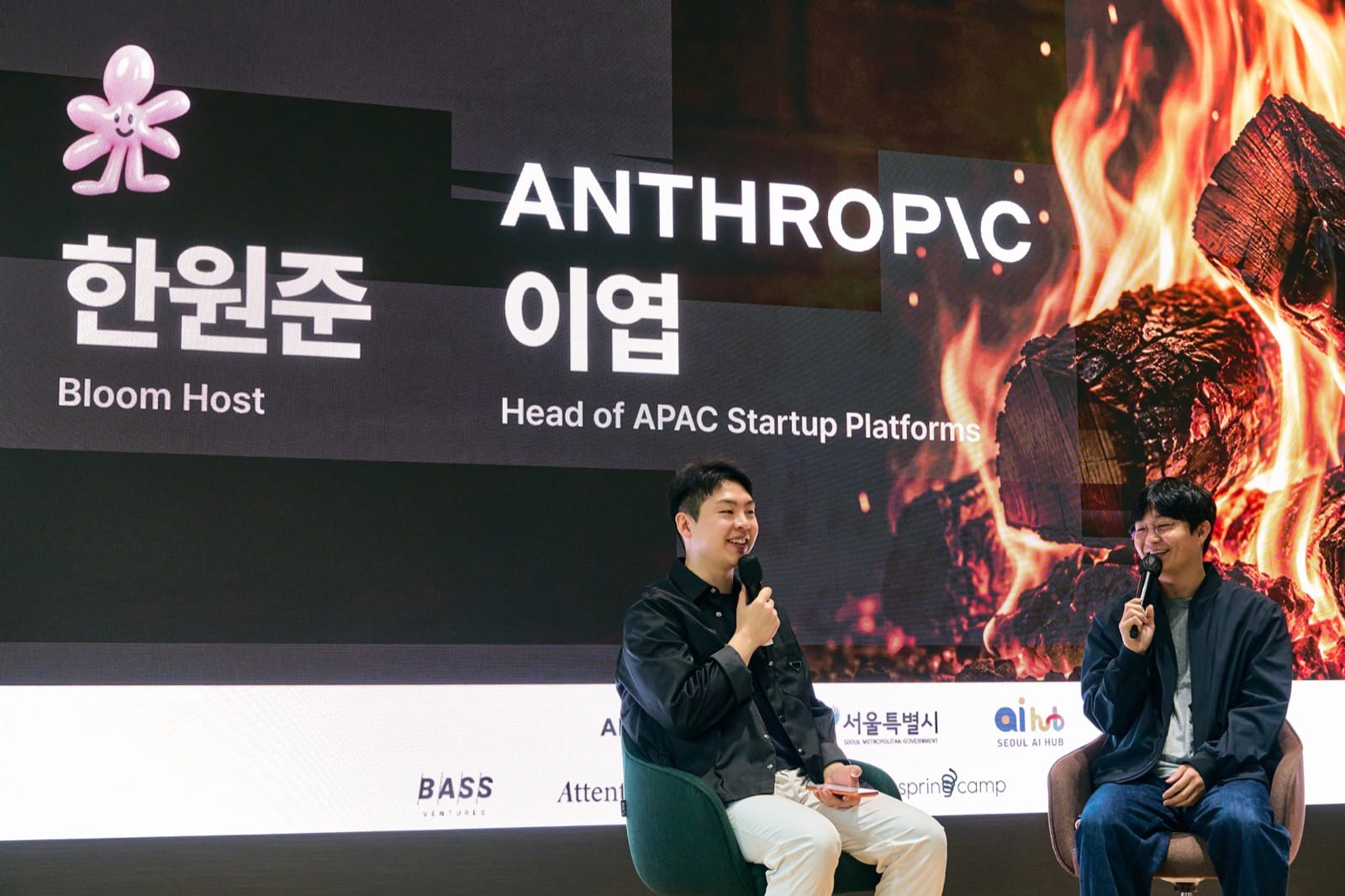
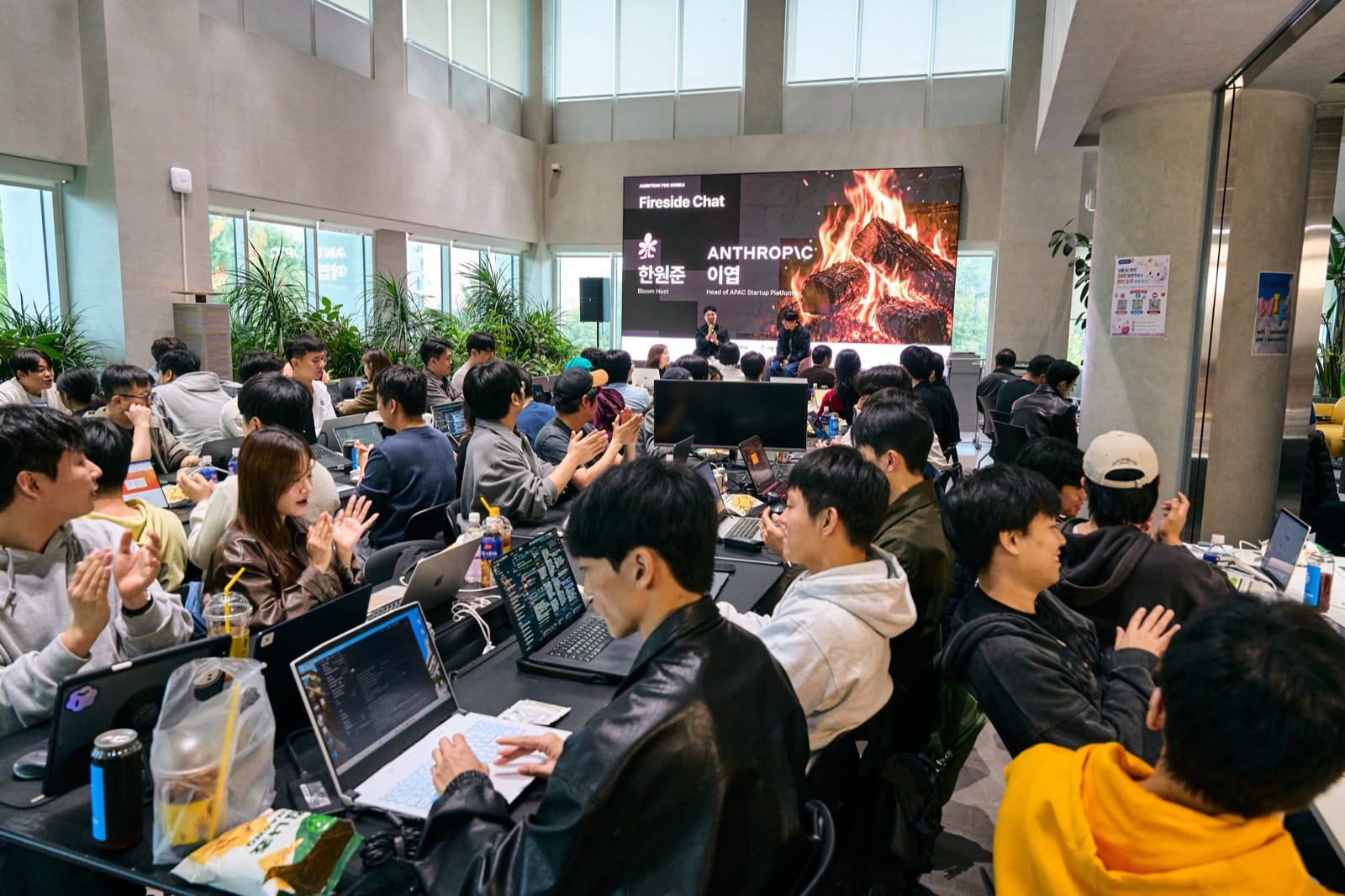
My guest for the fireside chat, which I moderated, was Yeop Lee, Head of APAC Startup Platforms at Anthropic. Yeop builds and runs Anthropic's startup programs across Asia-Pacific, the credit program among them. Yeop opened by noting that Anthropic holds a lot of hackathons all over the world, yet the energy in Korea is unusually high. These days Anthropic mostly runs short ones, where the build has to be done within two hours. Yeop has entered about four hackathons and never won a prize, so a room like this one is a thrill to see.
Yeop joined Anthropic last September as its first Korea hire, and sees Korea as a very important market and ecosystem, with numbers to back it up. Per capita, Claude usage in Korea is about four times the global average. Worldwide, usage splits almost evenly between automation, where you hand off a task entirely, and augmentation, where AI helps you do the work. In Korea, the balance tips toward augmentation. It's a place that thinks hard about how to use AI, and a lot of feedback from Korean startups has made its way to the Claude Code team and the model team and been built in.
When I asked what sets Korean teams apart, Yeop pointed to mindset.
I think it's a strength, and also something that could use a bit of work. There seems to be a mindset of testing things in Korea first and then going global.
That can mean getting well prepared and competitive in Korea before heading out. An Indian team, by contrast, will often start from the assumption that whatever it builds in India is going straight to the US, or going after Europe, and that's a different strategy. Part of why Anthropic co-planned this hackathon is that it can do a lot more to help when more teams go global from day one. That's exactly the point I'd made in the opening about aiming global from the start.
Anthropic opened its first Asia-Pacific office last October, and within a year it had five. The fifth, in Singapore, opened just last week. I asked about the pros and cons of covering Asia-Pacific from Korea. Yeop ending up in Korea was actually something of an accident, and Anthropic doesn't have a dedicated Asia-Pacific hub. Yeop is in Korea, the APAC finance lead is in Japan, the applied AI technical lead is in Australia, and so on. The idea is to stay flat and move fast instead of piling up the layers you get when everyone sits in one place.
They all belong to headquarters as one team, with no regional branch in between. So feedback from Korean startups and leaders doesn't stop with the Korea team. It goes straight to headquarters and to the teams in other countries.
As for this setup, with VCs, government and a community putting the event together, Yeop sees it as far more effective than Anthropic going it alone, because together they can give builders the resources to grow faster. I'd been thinking the same thing.
Hackathons used to run three days and two nights, and the fun was in the building. Now that AI turns out a prototype in no time, some people say hackathons aren't fun anymore. So we planned this one to keep ideas from ending in the room and carry them into a business, tying everything from Anthropic's technical support to VCs testing the business case into a single day.
I asked what kind of teams Yeop hopes to see come out of Korea. Teams that solve problems at a global scale. Anthropic does a lot of B2B and works with a huge number of companies. These days it also runs a program that connects startups directly with enterprise customers to help them sell, and it's widening the basic credit offer to include benefits beyond API credits.
Bloom began with Claude Blue, the blues people get about AI, so I asked whether Yeop feels closer to Blue or to Bloom these days. Yeop goes through it with every new model, and shared a personal example. Yeop gets several hundred emails a day and has a self-imposed goal of keeping unread mail under 30. Now Claude writes about 90% of those emails, pulling in Yeop's tone and real material, and Yeop just reviews them and hits send. Getting there took a lot of trial and error.
We all carry a real worry that leaning on AI will wear down our ability to think critically. Yeop shares that worry, and the answer so far came from a conversation with Anthropic co-founder Ben Mann. Ben is finding a balance by setting aside time for structured reading and by deliberately doing some tasks by hand, even ones AI does far better. It's a problem without a right answer, so Yeop suggested we work it out together by sharing what we find.
I added that Claude has a feature that asks you questions and guides your thinking instead of handing you the answer right away. To me, it reads as a sign that Anthropic cared from the beginning about letting people use AI while staying in charge of their own thinking.
When I asked about the mood among builders abroad, Yeop brought up teenage founders. You rarely meet a 14-year-old founder in Korea, but overseas their numbers are growing. The keynote speaker at Australia's biggest startup festival, which Anthropic sponsored heavily, was 14 and came with their parents because they couldn't travel alone. Technology opens the door for founders like that, and across the ecosystem there's a sense that VCs and governments should be backing young founders too.
I shared a story from San Francisco, where a teenager who works with friends of mine dropped out of high school and still gathered people on X to write several papers. Closer to home, a YouTube video Bloom recently filmed with a 17-year-old high schooler has passed 300,000 views and nearly 400 comments. It made me think the walls of career, age and experience really have come down in the AI era.
Last, I asked Yeop what matters more than tech, credits and tokens, and it came down to go-to-market. Building has gotten too easy, and so has building a product that looks convincing. Big companies have started building their own tools with AI, and the products coming out of those in-house teams are pretty good. So understanding the end customer's problem precisely matters as much as the skill of building a good product fast. That's also where the most common failure Yeop sees among builders comes from.
Building is so fun and so easy that people just build. They launch, the response isn't great, and they decide it's because some feature is missing. Then they go back and build again, without enough strategic thinking.
It gives you the illusion of progress, but a year later sales are often weak. Yeop's advice was to keep checking whether you're actually testing the hypotheses you've set, and whether you can test them faster. I added that while people like to say distribution is the moat these days, distribution isn't easy either, and showing your product to friends won't tell you whether it's any good. Meeting people from other fields at gatherings like this one and seeing how they react is part of that testing. That's also why we brought in VCs as judges that day.
The surprise I'd hinted at in the opening came at the end of the fireside. Yeop decided to give every team that made the finals an extra $5,000 in Claude credits. Each team got it as a unit, whatever its size, for the members to split among themselves.
How we built the day, from selection to deadline
We planned the day as 12 hours, opening at 9 a.m. and closing at 9 p.m. The Seoul Metropolitan Government gave opening remarks at 9:00, Anthropic's fireside chat followed at 9:20, and at 9:40 we revealed the missions and walked everyone through the credits. Then teams had 7 hours to build, from 10 a.m. to 5 p.m. VC judging didn't wait for the deadline. It ran the whole time, taking submissions in the order they came in.
Submissions closed at 5 p.m. Dinner doubled as prep time for the Shark Tank round. From 7 p.m. the 8 finalist teams took the stage for 10 minutes each. At 8:30 we announced which VCs had matched with which teams. The opening and the Shark Tank round were on the 4th floor, where the stage and the LED wall are. Teams built on the 3rd and 4th floors.
We took applications from individuals, not teams. Even if you came with a team, every member had to apply separately. Anyone 18 or older could apply for free. The form asked for one link to your own work and a sentence or two about what you wanted to build for an overseas market.
In total, 960 people applied. We went through every GitHub profile, LinkedIn page and application one by one and invited 105. They formed teams of 2 to 4, which gave us 41 teams. Two-person teams were the most common at 24, followed by 11 teams of three and 6 teams of four. The opening slides rounded this to 100 out of 1,000, a 10:1 ratio, and made it clear from the start that only 8 of those teams would make it to the Shark Tank round.
On the participant page, you typed in the email you'd applied with and your team came up. Some people had used a different email to claim their credits, so we linked those addresses ahead of time and any of them would pull up the same team. Around lunchtime we reminded everyone that the Shark Tank pitches would be in English, but the deck and the forms could be in English or Korean, whichever was easier.
Along with the 2-page cap on the pitch deck, we handed out a kit ahead of time. We figured most people wouldn't open PowerPoint at all and would build their slides with an AI like Claude instead. So the kit bundled a guide you could hand straight to the AI, an HTML template, logo strips for light and dark slides, and the partner logos.
Of the 8 finalist teams, 6 dropped the logo strip in as is. On the Shark Tank LED wall, we placed each team's deck inside the event frame with the logo strip along the bottom. That way anyone taking a photo from any seat would get the team's screen, Ambition for Korea and the partner logos in a single shot.
Same $500 for everyone, every repo public
The rules started from one idea: everyone competes with the same resources. The technology is the same for everyone, so the only things that can make a difference are the idea and the execution. Each participant got $500 in Claude credits, and that was it. The credits covered both Claude Code and the API calls of the apps teams deployed. Teammates could also pool theirs in a single organization.
We could have handed out unlimited credits, but we capped them on purpose. Nobody could keep going on a personal or company account once theirs ran out, either. Core AI functions like decision-making and generation had to run on Claude alone. Supporting tools for things like design or video were fair game, at each person's own expense.
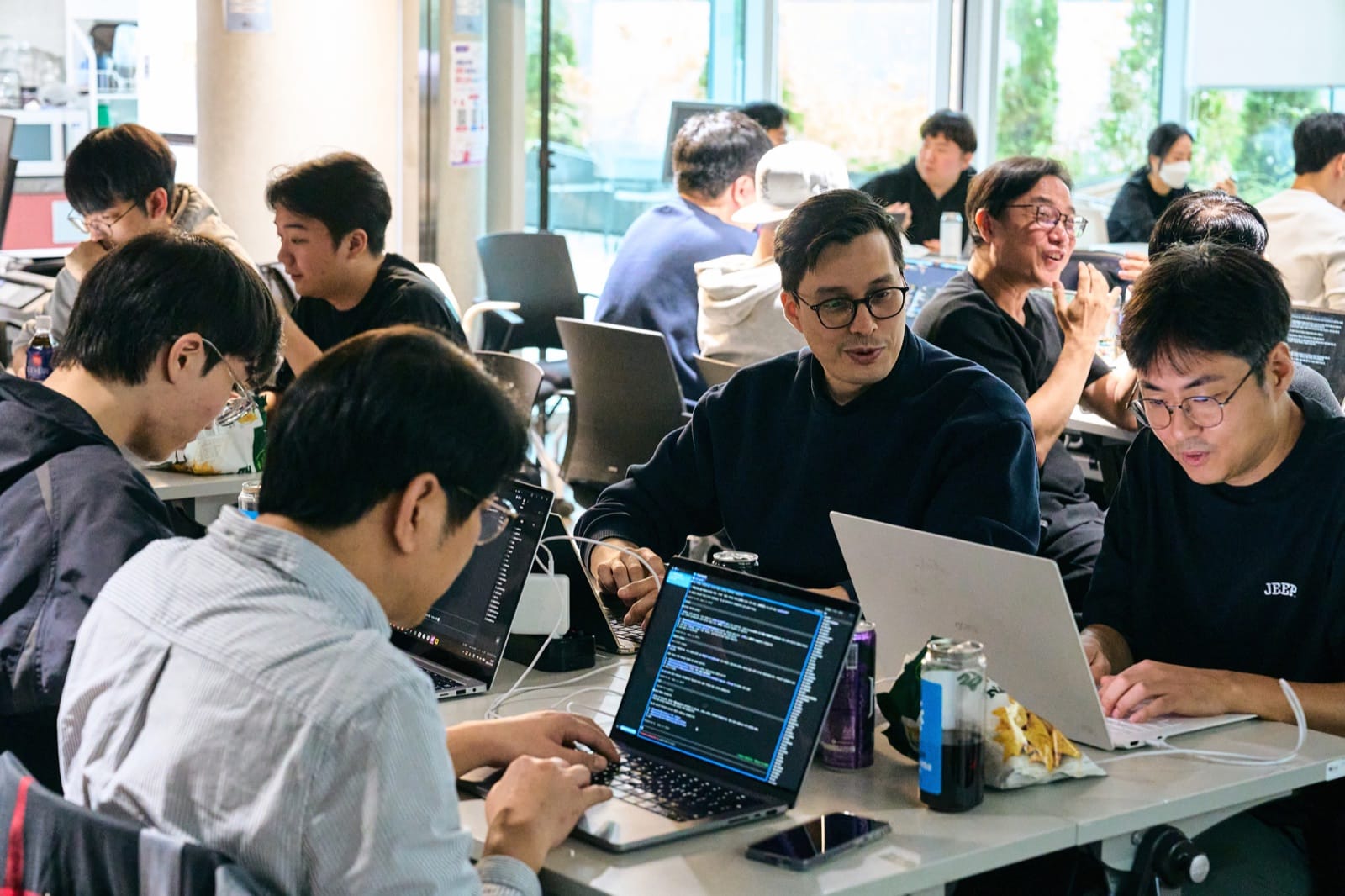
There's no airtight way to verify that only work done on the day gets judged. So we kept the missions secret until that morning, and for everything else we tried to make cheating a hassle and easy to catch. Planning and development had to start that day, on site. Code could only go into a new public repo created after 10 a.m. Every team's commit history was out in the open, too.
The site doubled as an alarm system. Every few minutes it read the public commits from each team's declared repo. If a team's first commit came before 10:00, the site tagged it “Pre-10:00 commit.” If that first commit alone brought in more than 3,000 lines of code, the tag was “Large first commit.” Both showed up in orange next to the team name on the ops console and on the VCs' judging screen. A third flag caught any repo that already had more than 20 commits the first time the site read it. Not a single team ended up with that one.
When Claude suggested this setup around midday the day before the event, I asked that the VCs be told exactly why it was on their screen. So on the judging screen, clicking “Why look at commit history?” opened an explanation that we'd decided to judge only what was built after 10 a.m. that day. Under it was a note: “Even a project that starts from a template can get big, so please use this only as a reference when you make your call.”
Participants never saw the flags. A flag also didn't knock anyone out automatically. The reference panel on the judging screen showed what the team said it had built new that day, its commit count and the time of its first commit. It also had a GitHub link that went straight to the code as it stood at the moment of submission. When a VC saw a flag, it was up to them to open the history and decide. Of the 36 teams that submitted that day, 4 got “Pre-10:00 commit” and 3 got “Large first commit.”
On the morning of the event we added one more note. Teams were free to use public open source, but they shouldn't fork it. They should bring the code into a new repo and credit the source instead, because a fork carries the original project's old commits and trips the “Pre-10:00 commit” flag. The rules also said never to commit API keys (hide them with .env and .gitignore) and to keep apps running until 9 p.m. so the VCs could try the demos themselves.
Each result was frozen at the commit from the moment of submission, so nobody could tweak the code afterward to change the judging. I knew some people wouldn't love having all their code in public. Here's what I told them at the opening.
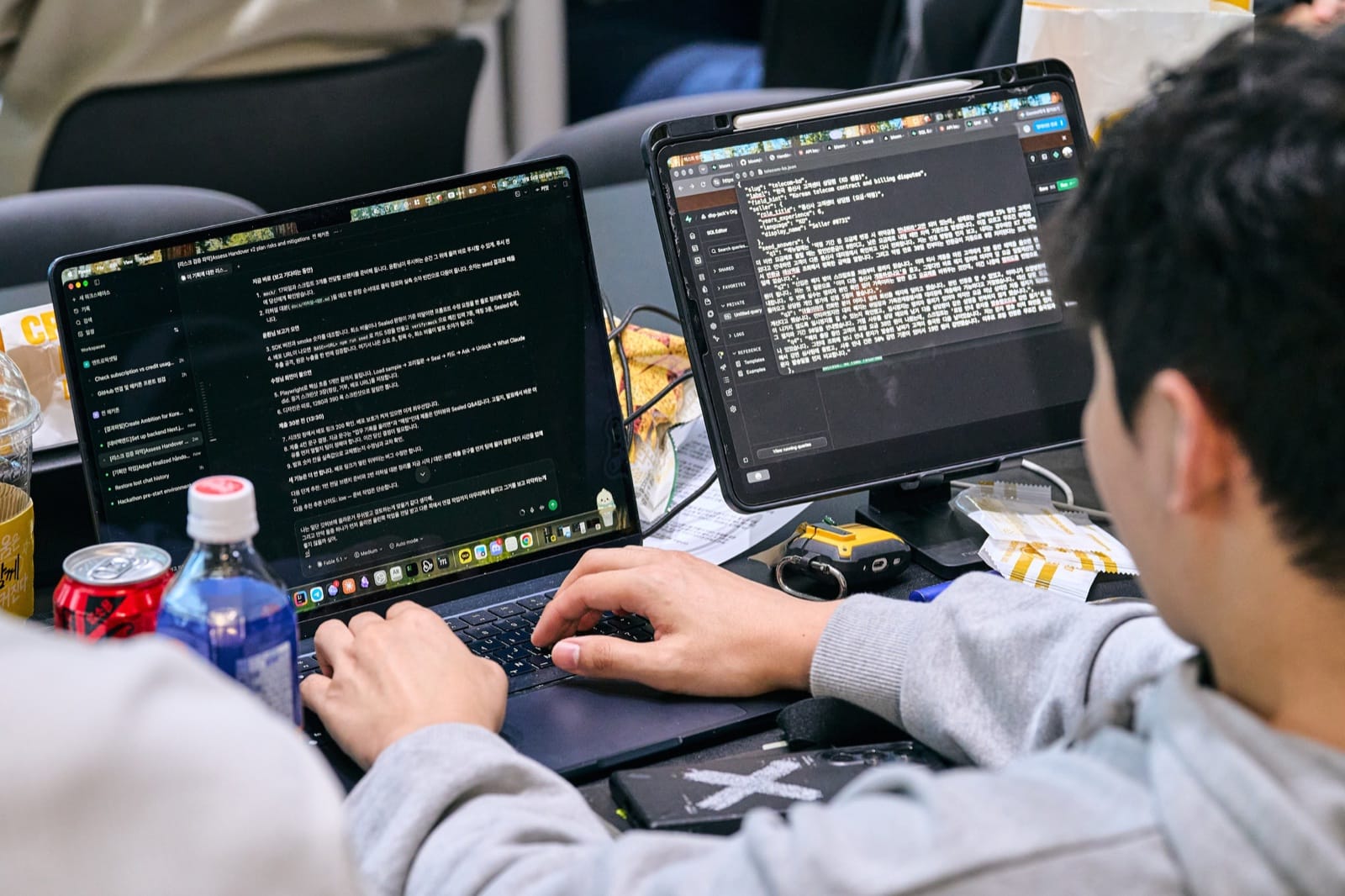
These days I think of ideas as a public good. What matters is how far you push an idea. So I'd actually love for you to share your ideas and put them out in the open, with the attitude that you'll just keep moving ahead of everyone else.
What I meant was this: instead of kicking the ladder away because someone might climb up after you, don't worry about them and keep going.
Teams submitted twice, on the same page. First, by 10:30 a.m., one person per team declared a topic by entering one mission, a one-line idea, a target overseas market and a public GitHub repo. They could edit that declaration only until the deadline. The final submission was due at 5 p.m., and each team got exactly one shot at it.
It asked for the service name, a one-line description, the target customer, a demo link, demo instructions telling VCs what to click first, a pitch deck PDF of 2 pages or fewer, and a separate note on what was newly built that day. There was a checkbox for teams that had brought in some existing code, and another confirming they understood they couldn't resubmit. As for the deck, I asked teams to make it so they could “just nail it, right there, in 2 pages.”
As submissions came in, the six VCs each tried the demo on their own laptops, went through the deck and pressed PASS or FAIL. The only question was whether they wanted a follow-up meeting with that team. We told teams that was all they needed: make a VC desperately curious about them at first sight. Votes counted in the order they arrived. Whichever side reached 3 first decided it. A team with 3 PASS votes made the finals, and 3 FAIL votes meant it was out.
With six VCs, a result usually came by the fifth vote. Teams couldn't see which VC had voted which way. Only the one-line comments the VCs left appeared on screen, with no names attached.
It looks like majority rule, but in practice the order of the votes decided the outcome. Since voting stopped as soon as one side hit 3, there was never room for the sixth VC's vote. Even at 2-2, whoever clicked next and what they clicked split the finalists from the teams that went home. Teams that submitted first got judged first, so submission order moved results too. In the afternoon we changed things so that results were announced, and finalist slots handed out, in submission order as well.
The moment all 8 finalist slots filled, the hackathon was over for the day. Submitting early meant getting judged early, but if you submitted before you were ready and got cut, that was the end of it. Polish until 5, though, and there might not be a slot left. That's why I warned everyone at the opening, “It could all be over at 3.”
Pitching in Korean at a global hackathon would've been a shame, so at the opening I asked teams to do at least the Shark Tank pitch in English. “You don't need to be a native speaker at all. You're going to run a global business anyway, so just imagine you're in the US right now and do it in English.” From there we settled on a 3-minute pitch in English and 7 minutes of Q&A in Korean.
Homework from the VCs, plus a Wildcard
The VCs set the topics themselves, and we didn't reveal them until about 9:40 that morning so no one could prepare in advance. On the mission slides of the opening deck, each press of the clicker flipped one card on the LED wall. The moment the last card turned over, the topic declaration window opened automatically on the participant page. The six firms set 9 missions in total. On top of those came one more option, the Wildcard.
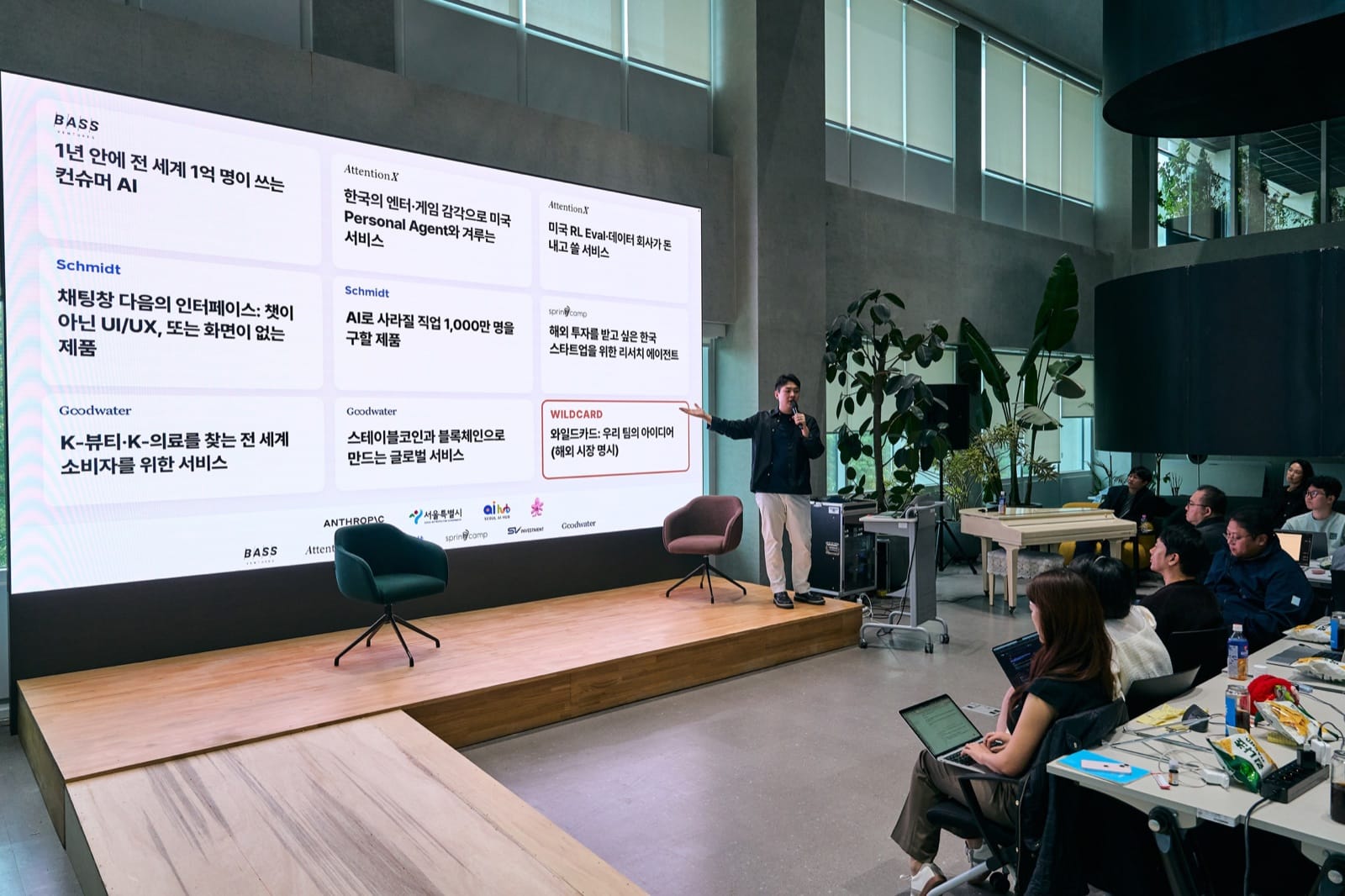
BASS Ventures, whose motto is “We play together for crazy dreams,” has backed Travel Wallet and MarqVision. CEO Taeyang Lee judged for the firm. Its mission was a consumer AI used by 100 million people worldwide within a year, and four teams picked it: AZ, HuhKimHyeonggunJunwoo, Super Agent and Magent. AZ and HuhKimHyeonggunJunwoo made the finals. On the evening stage, HuhKimHyeonggunJunwoo chose BASS Ventures, the firm behind its mission, and set up a follow-up meeting.
AttentionX is a US fund that runs a fellowship for AI researchers and founders, with investments in AIM Intelligence, Dentronic and others. Sukone Hong represented the fund, which brought two missions. Five teams went for the first, a service that takes on US personal agents with Korea's entertainment and gaming sense: CHOAM, Klaro, Chilling Soft, Team Hoyeonjigi and Kim & Yang. Six went after the second, a service US RL eval and data companies would pay for: Arakyn, Kkyare, Naru, unknown, Return to the state and TangibleIdea.
Klaro made the finals from the first mission and Arakyn from the second. That evening AttentionX set up follow-up meetings with two teams, Arakyn and Dongbyeongsangryeon (a Korean idiom for “fellow sufferers”), which had worked on SV Investment's mission.
Jaewon Lee judged for SCHMIDT, an investor in FuriosaAI and Innospace whose tagline reads “Backs startups going after large markets.” Its first mission, a product that saves 10 million people whose jobs AI will erase, drew 7 teams, the most of any mission that day. The second, an interface beyond chat (a UI/UX that isn't a chat window, or no screen at all), drew 4 teams. Of the 11 teams across the two missions, NERO was the only one to reach the finals.
SpringCamp's tagline is “Extraordinary founders spring here,” and it has invested in Ohouse and Class101. Partner Kyungpyo Ko was there for the firm. Its mission was a research agent for Korean startups that want overseas investment, and not a single team picked it. Even so, that evening SpringCamp set up a follow-up meeting with Team Sprint, which had worked on SV Investment's mission.
SV Investment, whose motto is “Stand An Egg,” has invested in Rebellions and HYBE. Taehong Park judged for the firm. Instead of a specific topic, it sent four investment criteria. One was a business that automates work people used to do and so has an economic and technical moat. Another was a business with proprietary data in one vertical, like manufacturing data. The third was a business that's easy to take overseas because the same demand exists in other languages and cultures. The fourth was one with no clear competitor, where you can grab the market first.
Boiled down to one sentence, those criteria became the mission: AI that replaces human work in a vertical with proprietary data, like manufacturing. Three teams chose it (Dongbyeongsangryeon, Team Sprint and Bearing), and two of them made the finals, the highest rate of any mission.
Goodwater Capital is a US VC whose mission reads “We empower exceptional entrepreneurs everywhere to change the world for good.” Its portfolio includes Toss and Coupang. Sinhae Lee judged for the firm. Goodwater didn't want to box in anyone's imagination, so it kept its two missions broad on purpose. Five teams, including WJxEJ, JaeDragon, Team Sparks and Jongno 3-ga, went for a service for consumers worldwide looking for K-beauty and K-medical. Keiailab took on a global service built on stablecoins and blockchain.
Neither mission produced a finalist, but on the evening stage Goodwater Capital set up a follow-up meeting with Klaro, which had worked on AttentionX's mission.
Each VC mission is a topic its author is always on the hunt for, so choosing one gives you better odds of getting picked. Still, I was sure some teams would have a better idea than any of the topics. So, taking into account the ideas people had written on their applications, we added one more option, the Wildcard. A team could skip the missions and go with its own idea, as long as it named its target overseas market down to the country and the customer.
We were also upfront that a Wildcard idea might look like it went beyond what the VCs had imagined, but it might also be a business they weren't interested in to begin with, which could count against it. Only one team chose the Wildcard, Tragatize, and that team ended up taking the last finalist slot.
Topic declaration was due at 10:30, but we extended it three times and finally closed it at 11:10. Of the 41 teams, 36 declared a topic, and once a topic was declared it couldn't be changed partway through. Each declaration went up automatically in the participant channel. From the afternoon on, the LED wall and the live page showed how many teams were attempting each mission, along with their names.
The afternoon the green and red dots lit up
When I designed the rules, I had two Korean TV shows in mind: Culinary Class Wars, the Netflix cooking competition, and Show Me the Money, the rap competition. I wanted that same tension packed into a one-day hackathon. The left side of the LED wall stacked teams in the order they submitted, while the right side held the 8 finals slots, empty at the start. Every time a VC made a call, a green or red dot appeared on that team's row. To push the tension further we hooked up speakers, so each result came up on a “made the finals” or “eliminated” screen after a drumroll.
Three VCs judged on site and three judged from wherever they were. For the ones who weren't in the room, I wrote in the ops channel: “If you come up to the fourth floor, the whole room buzzes every time a VC votes live.”
Once the build started at 10, commits began piling up in every repo. By the end of the day the 41 teams had pushed 2,812 commits. Klaro committed the most, with 446. Around 11:45 we handed out Cry Cheese Burger sets on the fourth floor, and people ate at their laptops while they kept building. I'd assumed everyone would rush to submit. Once the build got going, though, everyone was reading the room to see who'd go first, and the first submission didn't land until 2:34 p.m., four and a half hours in.
It came from CHOAM, with Nunchi, “the agent that reads the room,” which uses a camera to read the face of someone watching a video and speaks to them first. One VC wrote, “Impressive, creative use of the camera to let the AI agent judge the user's context.” Nunchi got as far as 2 PASS votes, but FAIL reached 3 first.
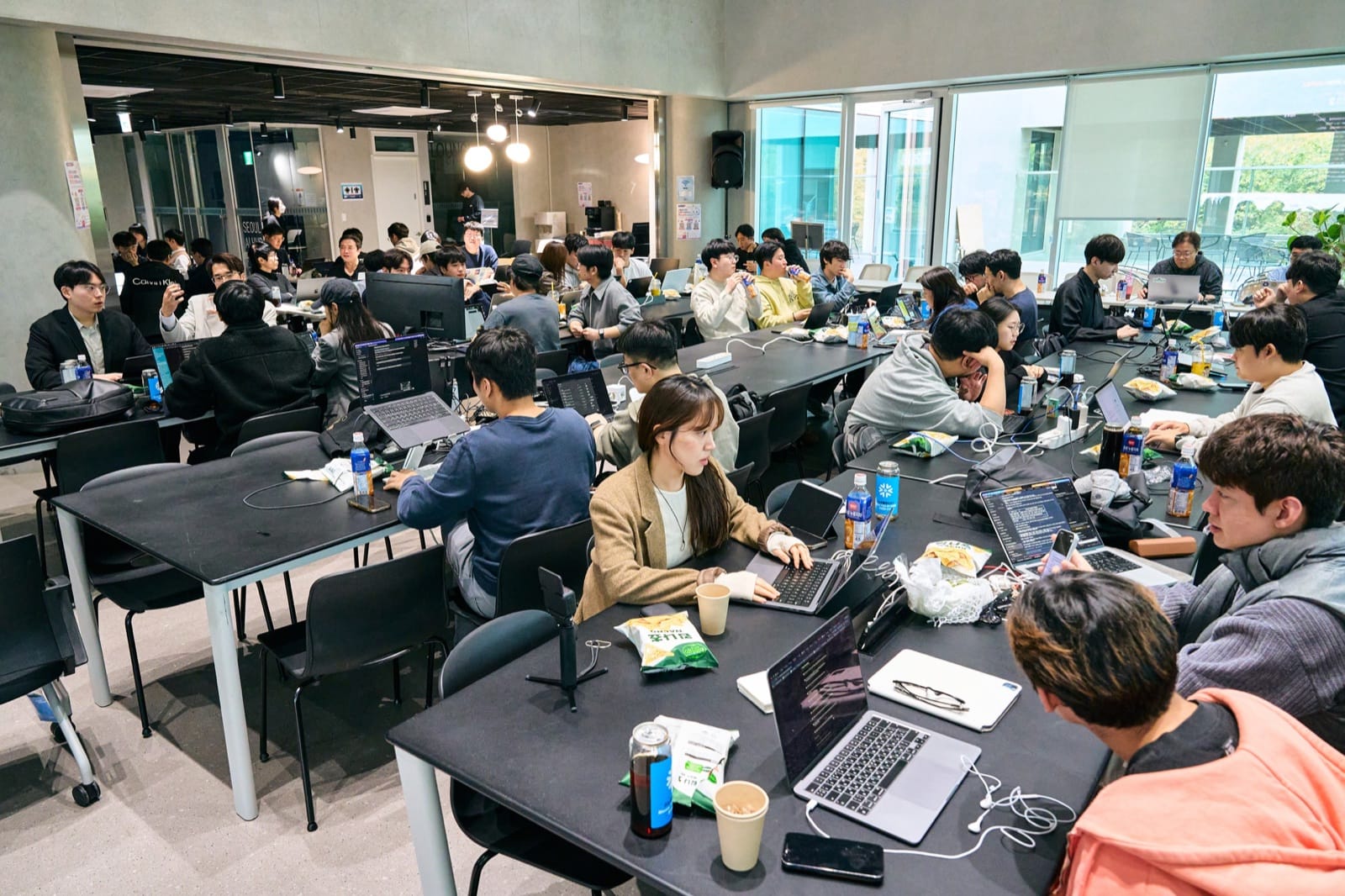
From then on, word went around that the competition was brutal. Around 3:30, watching FAILs pile up first, I'll admit I worried the 8 slots wouldn't fill. Still, I didn't want to step into the VCs' judging, and I didn't want to lower the 3-vote bar I'd already announced to 2. So I left the rules as they were and told the VCs in the ops channel, “Even if I end up gathering the 8 teams through a second-chance round, please feel free to judge honestly.”
At 4:17 I wrote a second-chance rule as well and posted it in the participant channel. If slots were still open after the deadline, eliminated teams with at least one PASS would move up, most PASS votes first, with ties going to whoever submitted earlier. In the end all 8 slots filled, so we never had to use it.
Results were announced in submission order, not in the order teams passed. If a later team hit 3 PASS votes first, its row waited on screen under “Results coming soon” until the team ahead of it had a result. A FAIL went up the moment it reached 3 votes. When several results came in at once, they appeared one team at a time, 22 seconds apart, so the room had time to applaud each one.
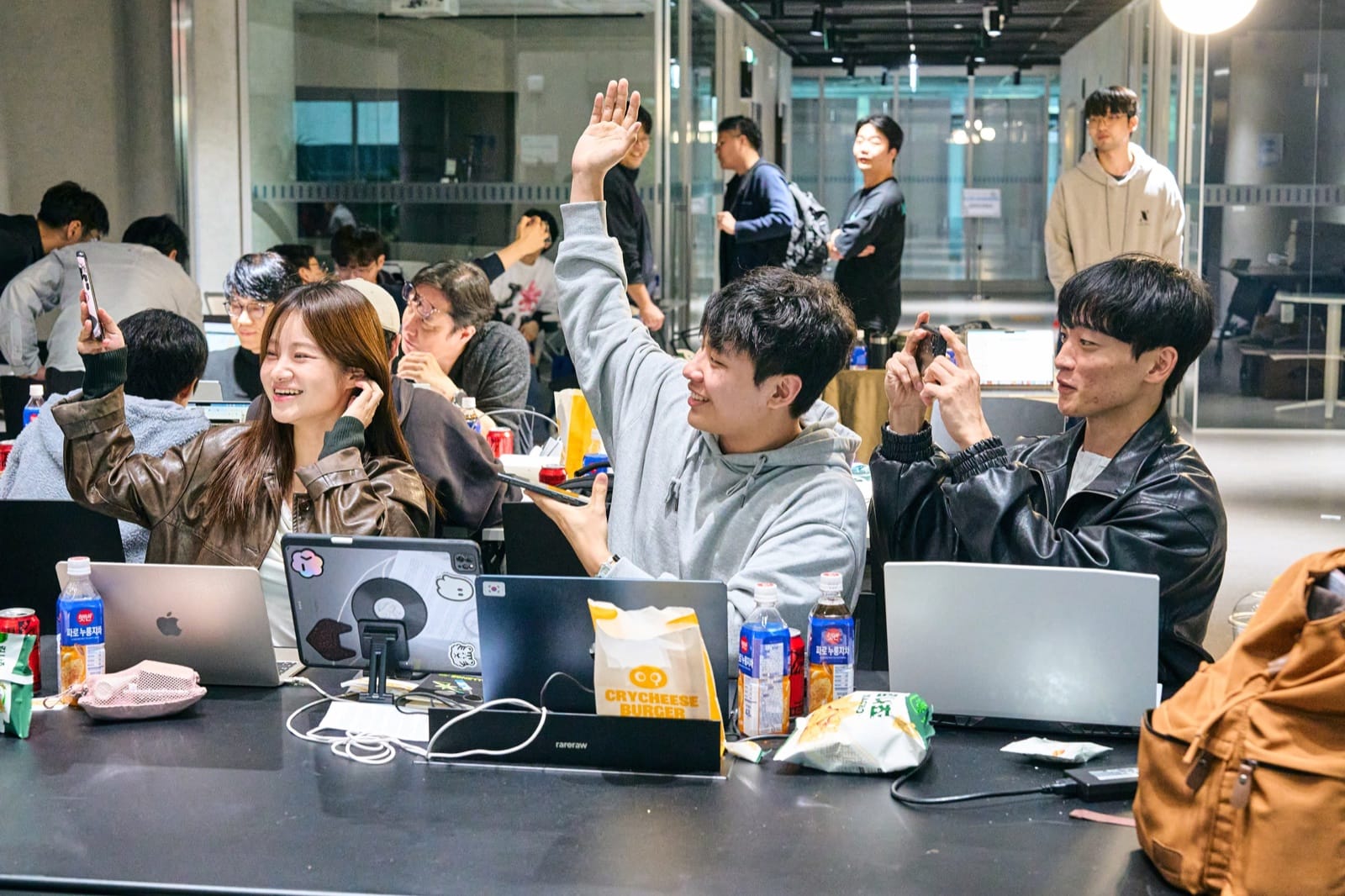
14:34 First submission in, as entry number 1: CHOAM's Nunchi.
15:07-15:38 Nine teams piled in within 30 minutes, and the entry count climbed to 11.
15:45 With 12 teams in, not one of the 8 finals slots had been filled yet.
15:48 The day's first verdict was an elimination. The second team to submit got 3 FAIL votes.
15:56-16:01 CHOAM got as far as 2 PASS votes and stopped at 2-3, and the third team to submit went out too. The first three results of the day were all eliminations.
16:05 The first finalist: Arakyn took slot one with 3 PASS and 0 FAIL.
16:15 NERO took the second slot, 3-1.
16:36 Right after the team ahead of them was announced as eliminated, Dongbyeongsangryeon's result came up. I took the mic and said, “Three pass, two fail, a really close one, and you're in the finals.” That put them in the third slot.
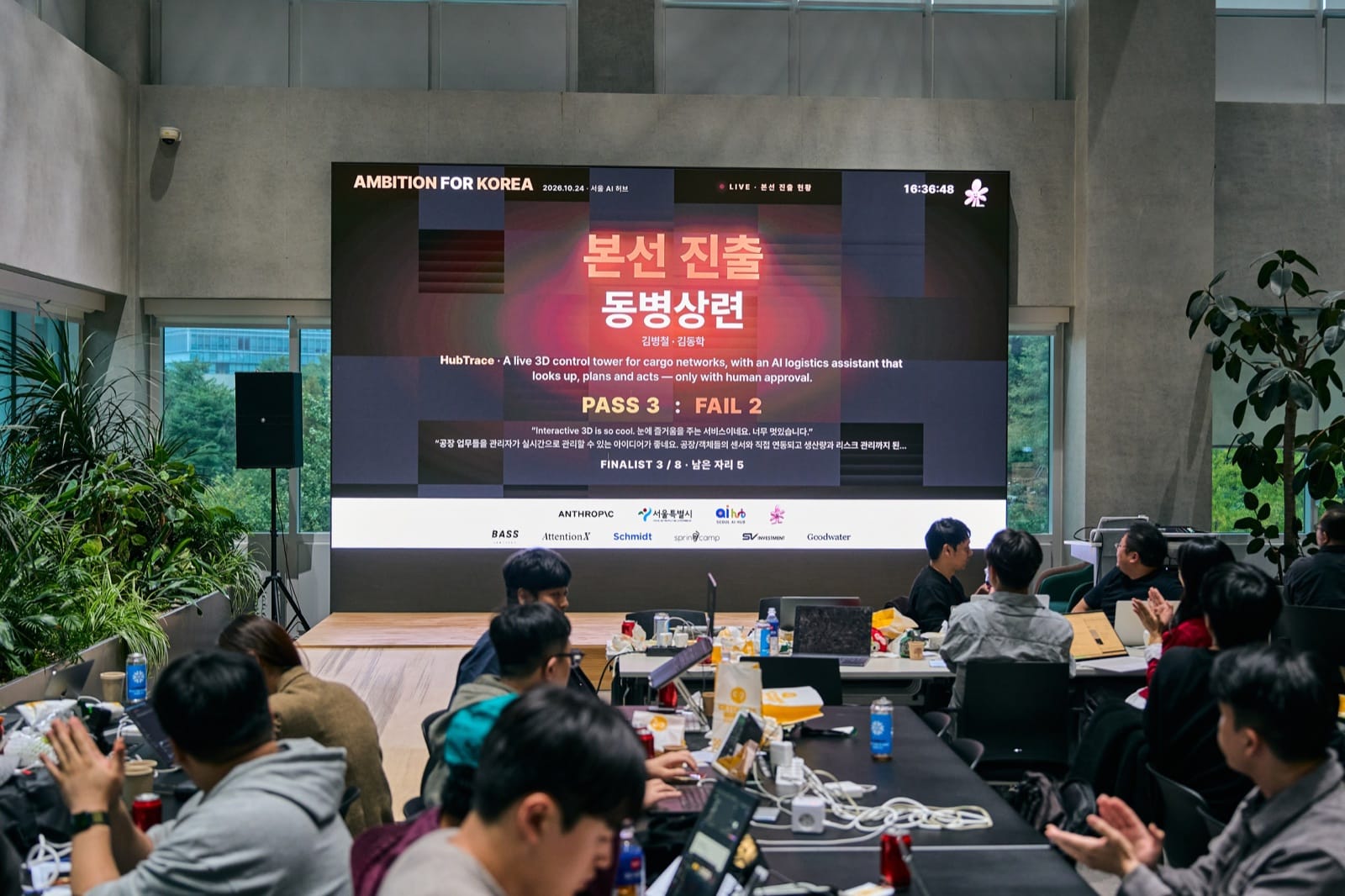
16:36-17:01 In the 25 minutes before the deadline, 17 teams submitted.
16:47 Team Sprint hit 3 PASS votes first, but AZ had the earlier entry number and still had no result, so the screen showed “Results coming soon.”
16:52 AZ's votes swung back and forth between PASS and FAIL until they stood at 2-2, then sat frozen there for 10 minutes.
16:53 Meanwhile, Klaro moved into the fourth slot, 3-2.
17:01 Submissions closed at 36 teams when the last one came in.
17:02 AZ's last PASS came in to settle it 3-2. Together with Team Sprint, which had waited 15 minutes, they filled the fifth and sixth slots at once.
17:25 HuhKimHyeonggunJunwoo took the seventh slot, 3-1.
17:36 Tragatize, competing on the Wildcard, took the eighth and final slot 3-1. That closed the finals. Judging ended right there for the 8 teams still waiting on results.
The order the votes came in kept it nail-biting to the very end. Only two teams went straight through on 3 PASS votes without a single FAIL, Arakyn and Team Sprint. Dongbyeongsangryeon got two PASS votes, then two FAILs in a row, and survived on the fifth vote. Klaro's first vote was a FAIL, and they turned it around. AZ held at 2-2 for 10 minutes before going through.
It cut the other way too. Three teams, CHOAM among them, got two PASS votes and still went out 2-3 because FAIL reached its third vote first. Seven teams got a PASS on their first vote, got their hopes up, then took three FAILs straight. And at the moment all 8 slots filled, there was a team sitting at 2-2.
Of the 17 teams that crowded in between 4:36 and 5:01, right before the deadline, the 8 that submitted after 4:54 never got a result, because the finals filled before all the VC calls were in. That was the rule showing itself plainly: submit early and you may go out underprepared, submit late and there may be no seat left. Over the day the six VCs cast 121 votes and left 114 one-line comments. Looking back, the daytime build hours were far livelier than I'd expected, because the live scene of teams competing, going out and getting through stacked up on screen all day long.
It was an AI hackathon, so AI ran the operations too
It started around 11 a.m. the day before the event, when I pasted the event page link into Claude Code and said I needed a deck to put on the LED. It didn't take long to see that PowerPoint wouldn't cut it. To show passes and eliminations live, we'd have to build the screens ourselves.
Before we built a single screen, Claude and I worked the rules out in detail. How would we check the condition that only work built that day gets judged? Should results go up the moment 3 votes are in, or when I press a button? How much of the vote counts and one-line comments should be public? The questions came one at a time, and every answer we settled on went straight into the rules and the screens.
If all 8 slots filled in the morning, the other 90 people would have nothing to do all afternoon, so one idea was to open slots in rounds at 1, 3 and 5 o'clock. In the end we kept it to one rule, first come, first served. The partner logo strip on every LED and presentation screen came out of the same conversation, since there was no good spot on site to hang logos. So did the way we packaged the kit: participants were going to build their pitch decks with AI, so we bundled everything to be easy to hand straight to an AI.
All of it was built with Claude Code the day before: the LED on site, the ops console on my laptop, the judging screen each VC opened on their own laptop, the submission page where participants declared topics and turned in their work, the live status board, and the stage timer. All day long, they ran off the same data.
That evening I went into one VC's judging screen myself and cast votes to test it, fixing the screen as I went. Then, the night before the event, we put 33 items through a rehearsal, from finding teammates and topic declaration to blocking duplicate submissions, the automatic decision at 3 VC votes, the results reveal, commit tracking, and the Shark Tank timer and matching.
At 1:57 p.m., with no submissions in yet, I mentioned that the status board was too quiet. In the middle of the event, the AI put a dev activity screen on the LED within 5 minutes, showing the number of commits pushed that day, how many teams had committed in the last 15 minutes, a commit leaderboard by team, and the commit messages that had just come in. Two minutes later it built another screen showing how many teams were taking on each mission.
At 2:11 the AI added a banner that ran a strip and a chime along the bottom of the screen whenever a new submission came in, plus a deadline mode that locked the screen on the closing countdown from 4:30. At 2:30, because text on the 16:9 LED layout was too small on phones, it opened a separate live page built for portrait screens. It also scheduled submission status updates on Discord for 3:00, 3:45, 4:15 and 4:40, each carrying the real numbers at that moment.
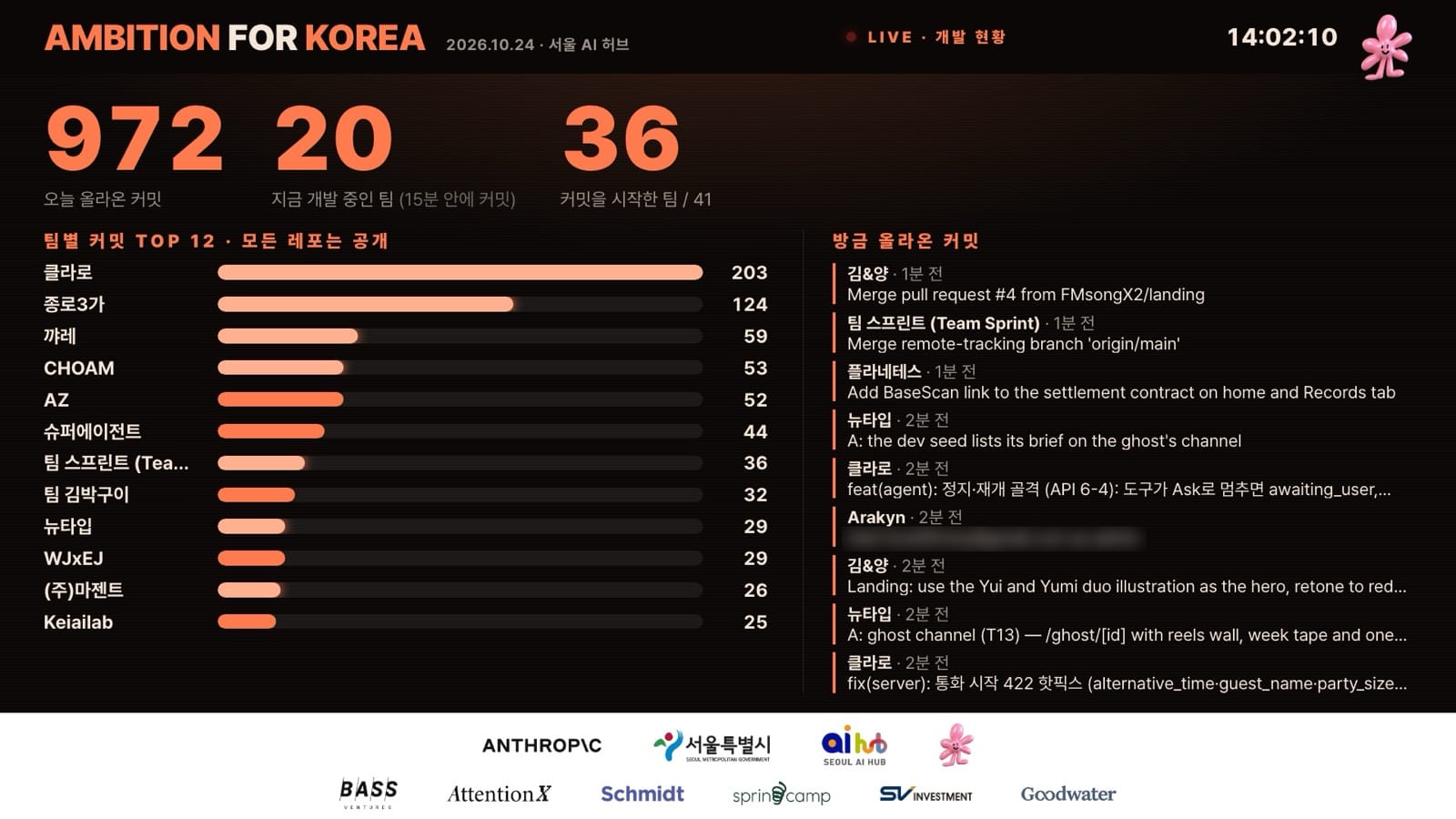
At 3:14, with judging in full swing, I had labels like “VC 1/6” replaced with dots, one lit for each VC that had decided. When someone pointed out that an orange dot didn't say whether a vote was PASS or FAIL, the dots changed 8 minutes later: green for PASS, red for FAIL and gray for VCs who hadn't decided yet. From 3:16 a result went up the instant 3 votes were in, without me pressing anything on the console. At 3:24 we switched to assigning results and finals slots in submission order.
By 4:25 the VCs had been judging in whatever order suited them, and votes for late submissions were stacking up first. I had the judging screen changed to let each VC vote only on the 3 earliest submissions they hadn't judged yet. When I asked to swap the wording from “final round” to “finals,” the change reached the LED, the live page, the judging screens and the automatic Discord messages within 1 minute.
On Discord, AI was also the first to answer participants' questions. Bloom Ops, a bot we'd originally built to collect feedback on the Bloom app, spent the day as our ops bot, answering questions and posting announcements, while a separate bot confirmed each submission as it came in. When someone asked a question, Bloom Ops replied first with a label marking it as an AI answer, basing its reply on the rules and the purpose of the event, and only brought the unclear ones to me.
Someone asked whether they could make just their pitch deck with Lovable. Bloom Ops first replied that it had passed the question to the organizers. After we checked, it posted the follow-up: build the deck too in a way the Claude credits can cover, and use the kit. Once I'd settled an answer, it went straight into the bot's guidelines, and it never had to ask me the same question twice.
Of the 65 questions that came in that day, the median time to the AI's first reply was 31 seconds, and 52 got a reply within 2 minutes. In the morning, while I ran the opening and the fireside, and in the evening, while I was on the Shark Tank stage, the bot held down Discord. All I had to do was read the summary it posted every 30 minutes.
When we flipped every mission card on the LED, a post laying out each mission one by one was already up on Discord before I'd said a word, along with a note asking teams to declare their topics by 10:30. The bot also put up the extension notice each time we pushed back the topic declaration deadline, and the note telling everyone to pick up lunch on the fourth floor at 11:45.
The rules got sharper over the day as questions came in. When someone asked at 10:12 whether they could use open source, an announcement went up within a minute: yes, but don't fork it, and credit the source in the README. At 10:33 someone asked about using another company's judgment model, such as JEV. No other AI models were allowed, and anyone who needed judging or classification should build it with one of Claude's lightweight models.
At 10:41 a question came in about using external APIs for AI services that aren't LLMs, like STT or TTS. The bot first replied that it would check with the organizers, then posted the conclusion 4 minutes later. APIs for voice and image conversion, which Claude can't do directly, were fine, but the core AI functions like judgment and generation had to be built with Claude alone.
At 10:52 someone said their topic declaration was getting cut off by the character limit. A minute later we raised it to 500 characters for the idea and 300 for the target market. Around 3 p.m. a participant wanted to include mock data, so the demo instructions field went up to 1,500 characters. Whenever a question came up, an announcement followed, such as an explanation of what happens at 3-3 after a participant asked, and tips for the VCs on how to review demos.
The bot posted 205 messages in the participant channel. On top of 72 answers to questions, it posted automatically 38 times as topic declarations came in and 28 times as results were confirmed. At 3:45 p.m. it put out a status update: 12 teams had submitted so far, all 8 finals slots were still open, there was 1 hour 14 minutes left before the deadline, and teams that were ready would do better to submit now.
Each result hit Discord with its PASS and FAIL counts at the same moment it appeared on the LED with its sound effect. All 28 calls that sent a team to the finals or out were made automatically, by whichever side reached 3 votes first, and the organizers didn't change a single one by hand.
In the ops channel, where the VCs and the organizers worked together, the bot posted 83 messages. It pinged every VC each time a submission came in, 36 times in all. At 10:38 it posted which teams had declared topics under each mission, and it kept up a steady run of judging rules, tips for reviewing demos and reminders about judging order.
From 3:16 we set it so that once 3 VCs had made their calls, the result went straight to the screens on site and to Discord without an organizer checking first. During the evening Shark Tank, a notice popped up saying each team was now taking offers, and the VCs moved over to the Shark Tank offers tab on their judging screens. We'd also set things up in advance so that when a VC joined the ops channel through an invite link, the bot gave them permissions within 1 to 2 minutes.
On the ops console on my laptop, 11 buttons along the top switched the LED between the waiting screen, opening, topics, live board, commits, mission status, break, Shark Tank, matching, announcements and closing. On the left, teams stacked up one row each in the order they submitted, with their status, the six VCs' votes and the decision, and the commit flags I described earlier sat next to the team names.
On the right were the remaining slots, the counts of submissions, eliminations and finalists, a preview of what was on the LED at that moment, and the controls for the slides and the Shark Tank run. I'd also built buttons to flip a result to PASS or FAIL by hand and a field to enter votes on a VC's behalf, but nobody ever had to change a call by hand.
Each VC opened the judging screen on their own laptop from their own link, and their firm's name and logo sat at the top, so they could tell at a glance it was the right screen. On the left was the team list in submission order with each team's status. The middle held the team's details: mission, target, demo instructions, buttons for the demo and the pitch deck, and the commit history.
On the right were the PASS and FAIL buttons, a box for the one-line comment and a notes field. One-line comments showed up on the screens on site with no names attached, and the notes were for the organizers' eyes only. The 35 submissions that had a repo were locked to their commit at the moment of submission, and the automatic backup ran every 5 minutes, 271 times in all.
The night after the event, I used the same data to build an archive that groups all 114 VC one-line comments by result and by mission, with no VC names. AI also drafted 11 results reports for the six VCs, Anthropic and the Seoul Metropolitan Government, plus thank-you and introduction emails, and I reviewed them before sending. That's how a handful of organizers could run a one-day event at this scale.
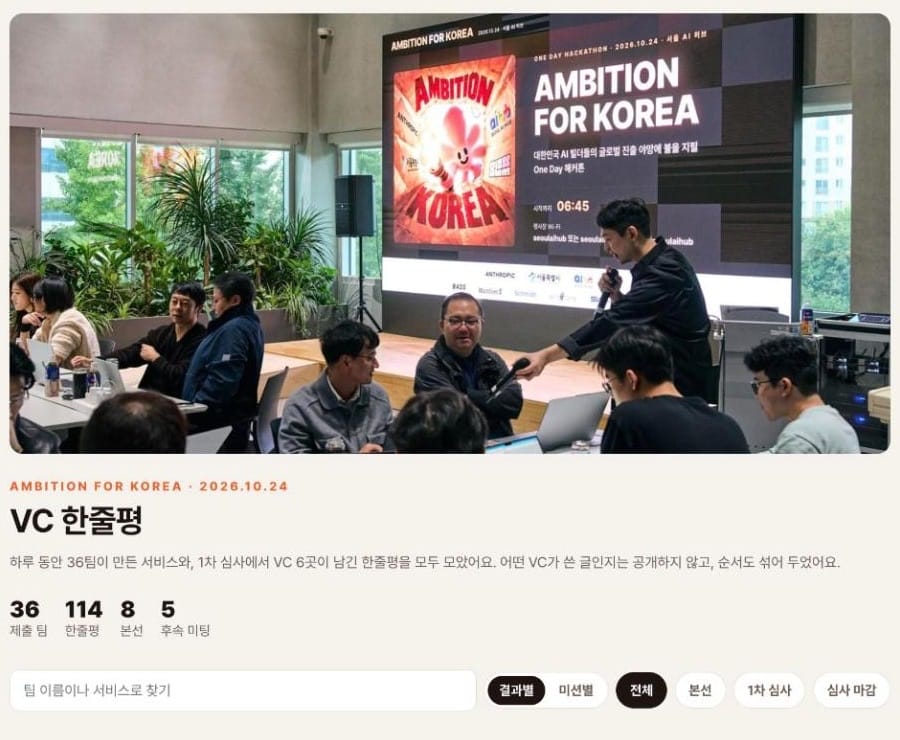
This was my first time running a proper hackathon like this, so I prepared as much as I could beforehand, and talking things through with AI kept turning up ideas I'd never have thought of on my own. We built a separate ops console. We split the screens for the LED, the VCs, the participants and the organizers, added real-time features and Discord integration, and split the bots into one that takes questions and one that takes submissions. All kinds of things happen once an event is underway, but thanks to that prep, I think we kept it fun right to the end.
We're open-sourcing the hackathon so anyone can run one
The software we ran that day is now public as bloom-hackathon-kit, under the MIT license, so anyone can take it and adapt it. It's the same program 105 participants and six VCs actually used for a full day. I pulled out the event settings and removed the secrets like admin keys and bot tokens, along with the participant data, partner logos, and the photos and video from the venue. What's left is cleaned up so you can spin it up right away with demo data.
Over the one day we ran on it, 960 people applied and 105 of them came together as 41 teams. Those 41 teams pushed 2,812 commits to their repos. The six VCs cast 121 verdicts on the work 36 teams submitted and left 114 one-line comments. The Discord bot posted 288 messages across two channels and gave a first answer to 65 questions in a median of 31 seconds. Of the 28 rulings that decided who made the finals and who was out, not one was changed by hand. Five of the eight finalists picked that way went on to follow-up meetings with VCs.
Participants find their team on the submission page using the email they registered with, declare a topic and submit their work once. A public live page shows how many finals slots are left and where judging stands. Each VC opens a judging screen from their own link, looks over the demo, the pitch deck and the commit history, and leaves a PASS or FAIL with a one-line comment. In the evening, they use the offers tab on that same screen to raise a hand for the teams they'd like to meet.
At the venue there's an LED board that puts results up with sound effects, plus a stage timer. The ops team handles scene changes, deadlines and match confirmations from one ops console. After the event, you're left with an archive of the one-line comments with the VC names taken off. The kit also includes the server API that handles submissions, votes, matching and commit tracking, a Discord script that announces results automatically, and the rules documents along with the setup we used to have Claude answer Discord questions first.
You can take the rules as they are, too. Everyone competes on the same credits, code only goes into a public repo created that day, and each team gets one submission. VCs judge in the order submissions arrive, and whichever side gets to three votes first decides the result. The door shuts the moment the finals slots fill.
On the evening stage, VCs raise their hands offering a next meeting instead of an investment, and when more than one steps up, the team chooses. People have started saying hackathons got boring now that building is easy. I wanted one where nobody can let their guard down all day, and where real meetings are what's left at the end.
Hit the “Deploy with Vercel” button in the README, and the repo gets copied to your account, with the website, a Redis database and storage for pitch decks all created in one go. The only thing you need to set is the ops console password. Each VC gets their own judging link, and those are generated from that password and show up in the console automatically. I'd love for other communities, schools and companies to run a one-day hackathon like this with a single button.
The stage asked for a next meeting, not an investment
At 7 p.m. in the Shark Tank round, the eight finalists took the stage in front of the six VCs, in the order they'd made the finals. Each team pitched for three minutes in English from a two-page deck, then took seven minutes of Q&A in Korean. Teams had to fit both the deck and the demo into those three minutes, so a team member drove the demo on the ops laptop while I handled page turns and screen switching from the console. The time left showed up on a timer on a tablet at the front of the stage.
What this stage put on the table was a next meeting, with no promise of investment. When Q&A ended, each VC tapped “I'd like to meet” or “Pass” on their own laptop, and the logos of all the VCs who wanted a meeting went up on the LED at once. If several stepped up, the team picked one. The setup let the VCs do the courting for a change, pitching the team on why it should go with them.
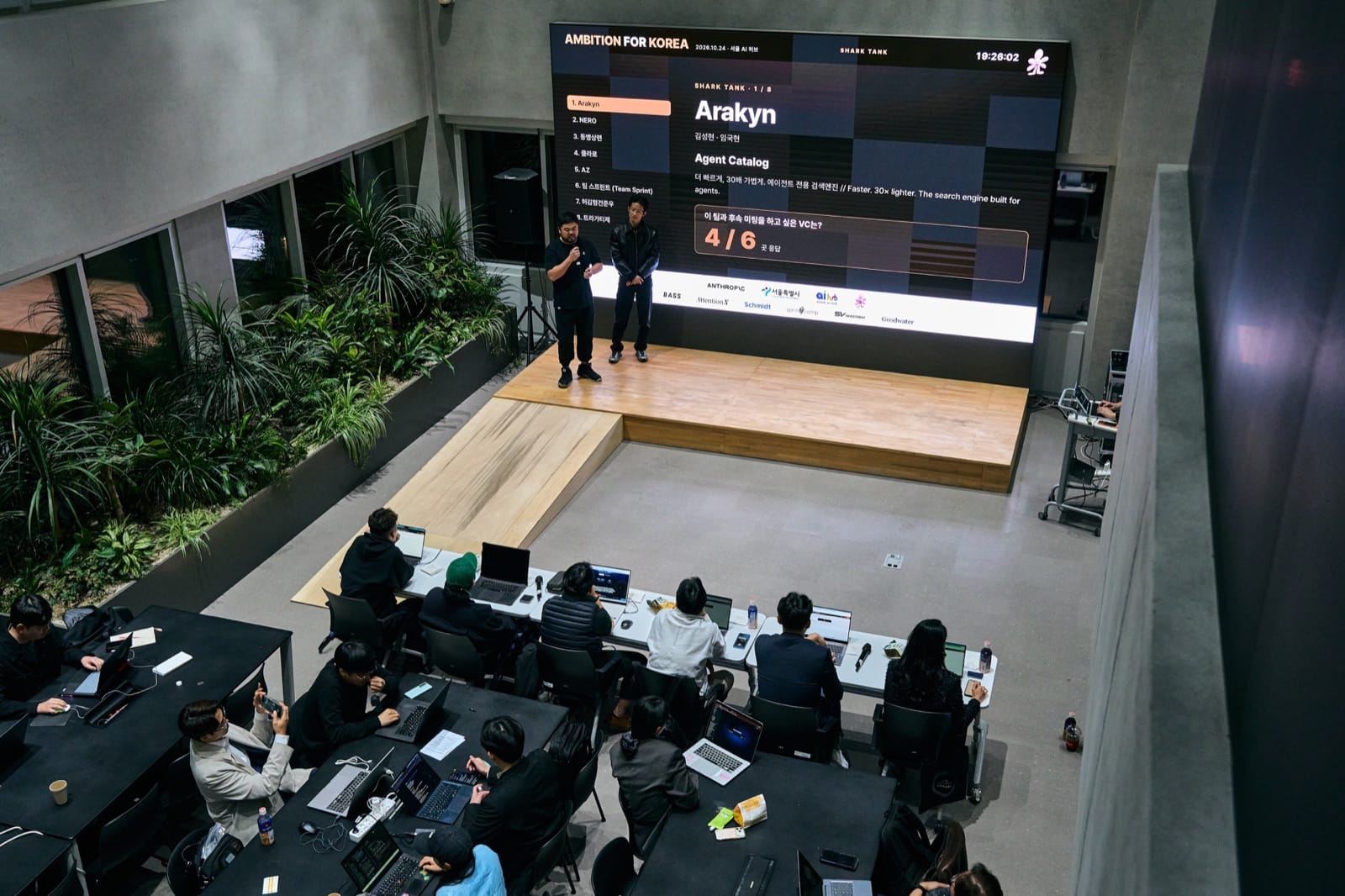
Giving each team its offers right there on stage was something we settled 30 minutes before showtime. Around 6:30, while running through the flow on the console, I asked whether we'd match each team right after its pitch and then move on. It turned out the system had been built to do all the matching in one batch after all eight teams were done. I asked for a change on the spot, and by 6:37 the console, the LED and the VC screens had all been updated and were live.
At first each VC could match with only one team. During the rehearsal it started to bother me that a VC who matched early couldn't even make an offer to the teams that came after. So at 6:45 I asked for that limit to come off, and five minutes later a single VC could match with several teams.
One VC was running a little late. While we waited to start, I asked the finalists how the day had felt, for the VCs who'd missed how intense the daytime had been. Here's how one member of Team Sprint answered.
Honestly, you could have just scored us carelessly, but I read the feedback one comment at a time and every single one was thoughtful. It was a good experience, the kind where the feedback alone would've made it worth coming. And building with my teammates gave us a much better result than I'd have gotten on my own.
Arakyn's name is a small tweak on Arakyd, the company that makes droids in Star Wars. The team is two friends who already knew each other, and they brought along a business idea they'd been talking over for a while. They were also the first team to make the finals, so I thanked them. I'd nearly gotten jittery early on, and they lifted the whole room. NERO was a group of people who'd become friends through various communities and decided to enter together.
Before the stage opened, the VCs introduced themselves one by one. Taeyang Lee, CEO of BASS Ventures, went first. Sukone Hong of AttentionX described the firm as a US fund that focuses on US companies, but one that's open to talking any time with Korean founders who are seriously thinking about expanding to the US. Jaewon Lee of SCHMIDT introduced SCHMIDT as a firm that backs every round, from pre-seed to IPO.
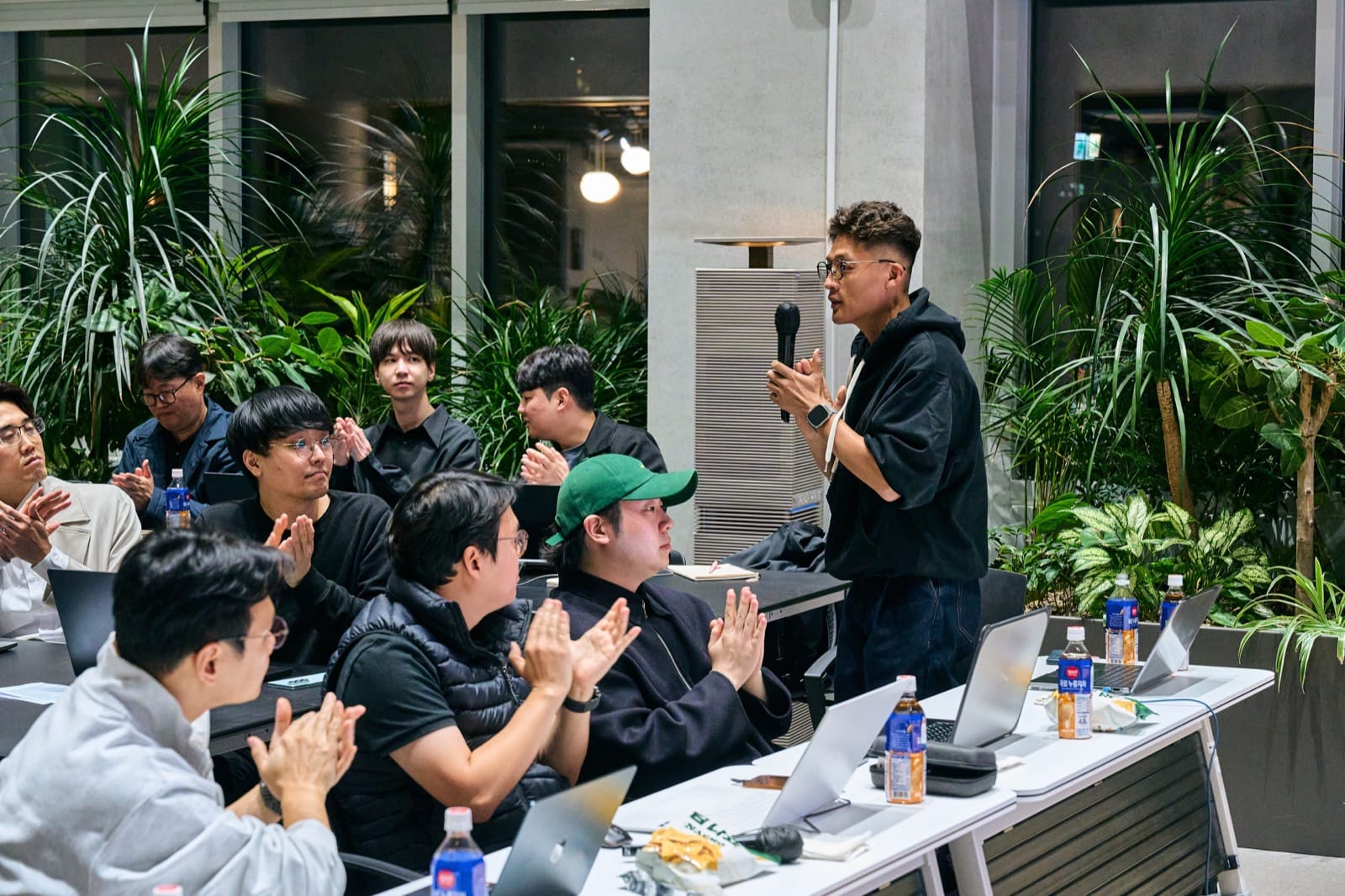
Kyungpyo Ko, Partner at SpringCamp, explained that starting two or three years ago SpringCamp set up a local entity in the US and put people there so it could invest in companies entering the US market. “Picking eight teams was so hard,” Ko added. Taehong Park of SV Investment had been impressed by teams that delivered great pitches in so little time during the document review, and planned to use the evening as a chance to learn about new ideas.
Sinhae Lee of Goodwater Capital introduced the firm as headquartered in the US, investing mainly in consumer tech, with around $5 billion in assets under management. Pointing to Toss and Danggeun (known abroad as Karrot) in the portfolio, Lee asked that we keep it fair and fun through the end.
The VC intros wrapped up, and at 7:12, with Arakyn, the first team, on stage, their deck didn't come up on the LED. Lifting the matching limit at 6:45 had also wiped out part of the code that the console's deck and demo buttons and page turns depended on. I asked Claude to fix it right away. While it tracked down the cause, I put Arakyn's deck PDF up myself (Claude had opened it in Finder) and got the pitch going first.
Six minutes later, at 7:18, the fixed console was redeployed. It was clearly a technical problem to anyone watching, but I was told that in the room it passed fairly smoothly.
The agent searches, picks and makes the call for you
Arakyn's Agent Catalog is a search engine built just for AI agents. Ask an agent to buy you black headphones under $100 and it roams across countless websites. Those sites are full of heavy data an agent doesn't need, like CSS files, high-res images, animations and video, so tokens leak away the whole time.
Agent Catalog gathers product information from platforms like Taobao, Coupang and Amazon in advance, organizes it in a form agents can read easily, and serves it through an API. In a side-by-side run it used close to 30 times fewer tokens than searching with a browser. The money comes from a paid API.

Arakyn is a two-person team that chose AttentionX's mission, “a service US RL eval and data companies would pay for.” In the “built today” field of the submission, they wrote that everything, from choosing the idea to building it, started from zero. The demo instructions asked you to run a real agent searching through a web browser next to one searching through Agent Catalog, then compare the results.
The first page of the pitch deck split problem, solution and business model into three columns, with the product free for regular agent users and sold as an API subscription to companies that need data in bulk. The second page had a number on it, about 300,000 product records collected in roughly three hours. By the evening pitch, that number had passed 500,000.
Why start with manufactured goods and parts? Arakyn's answer is that the more standardized something is, like a 30mm nut, the harder it is to find online and the easier it is to sort as data. Questions also came up about what happens if a big company like Google or Shopify opens similar data to agents, and about the legal side of crawling. In Arakyn's view, pulling many platforms' data into one place is different from one company opening up its own. And since the model hands buyers off through purchase links instead of selling anything directly, there's room to work things out with the data providers.
Manufacturers already have their suppliers lined up, so the plan is to go after individuals first, like someone building a drone who needs one specific part. As agent traffic grows, manufacturers that want more places to sell will come and list their products on their own.
One team member works in data collection and builds hardware on the side. They've spent a lot of time digging through overseas sites for parts that are hard to find in Korea, and they see the edge in the fact that product specs rarely change, so data you organize once stays useful. In the first round of judging, one VC had written, “A data service for an endlessly growing number of agents. Good chance agents will be buying products within the next few months.” In the Shark Tank round, AttentionX hit the button to meet them.
Klaro opened its pitch with a question, “Who's your bias?” Your bias (K-pop slang for your favorite idol) might be a K-pop group, an actor, or a pro gamer like Faker, and fans want to go wherever their bias has been. But the moment they land in Korea, they run into Korean-style booking platforms, and the AI agents they pay a monthly subscription for stop at the border. Klaro's Bias is a travel agent for K-fans that lets you follow the path your bias walked, like a quest.
Klaro is a three-person team that took AttentionX's mission, “a service that takes on US personal agents with Korea's entertainment and gaming sense.” The team pushed 446 commits that day, the most of all 41 teams. In the submission's “built today” field they listed quest-style onboarding, a Claude agent, a VM sandbox and phone reservations in Korean.
The pitch deck explains how one Claude plays three roles. There's a personal agent that builds quest lines out of public fan pilgrimage spots and Korean map data, an operator that works Korean services on your behalf inside a VM dedicated to each traveler, and a voice agent that calls restaurants in Korean. The deck also noted that of the roughly 18.5 million people who visited Korea in 2025, 42% first thought of the trip because of K-content. Over the next seven days, the team plans to add a real phone line and a waitlist and open a beta for K-fans visiting Seoul.
On stage, Bias found Yujeong Sikdang, the restaurant where BTS used to eat as trainees, from nothing more than a sign spotted in someone's Instagram story. The place only takes bookings by phone, so Bias called it in Korean on the user's behalf. The demo was wired to a mock restaurant, but it showed the whole flow. The restaurant said 7:00 was full and 7:30 was open, one tap confirmed the booking, and the flow carried straight into Google Maps.
Most travelers don't pay for an AI subscription every month, so Bias works like an eSIM, where you pay up front for the days you'll be in Korea. One app does the work of ten local ones, and the plan is to sell it where travelers already shop for things like eSIMs and rental cars. There are 225 million K-fans worldwide, and they come back to Korea for every comeback (a K-pop group's new release) and every concert.
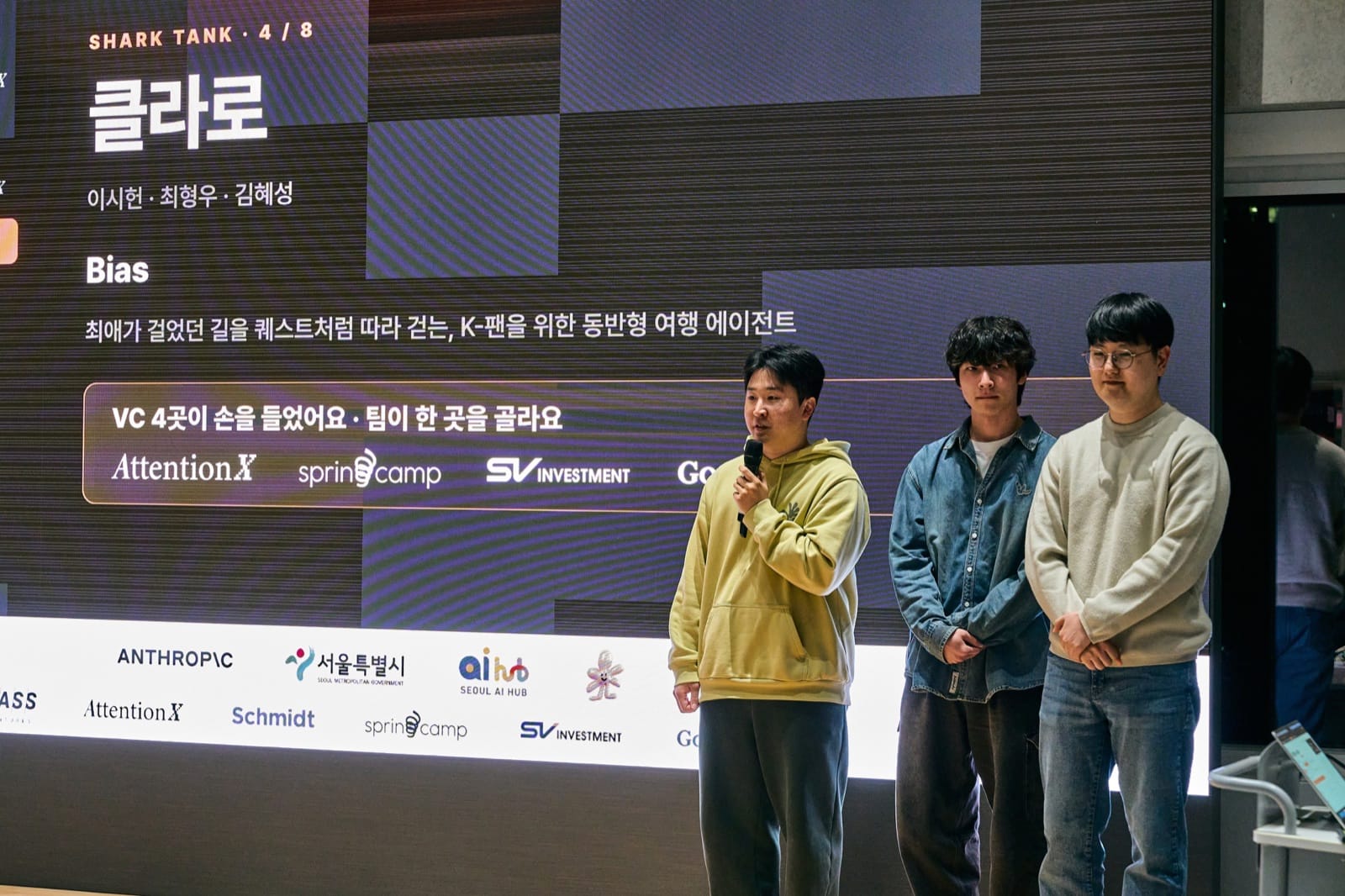
The Q&A started with how the founder had managed before a service like this existed. Klaro described it as an agent for the length of a trip only, aimed at people who don't use AI much day to day and only pull out a maps app or Gemini when they travel. It takes care of phone calls, bookings, directions, even conversations with taxi drivers. It opens up two days before departure, so travelers can book phone-only restaurants or exhibitions ahead of time.
Why would a popular restaurant bother taking a call from an AI? Klaro's view is that foreigners can't call at all right now, so just being able to book by phone is already an improvement. Another question, asked in English, was how Bias would tie into the existing economy where restaurants pay idols and influencers to bring in visits. The team is thinking about extending the service to influencers and offering restaurants ads, similar to search ads, with discounts for people who book.
In the first round of judging, this team had gotten both of these comments: “Not a simple guide, a service that gets you over the barriers,” and “A business model where a similar service launched three years ago and was acquired.” In the Shark Tank round, four VCs asked for a meeting all at once. I flipped the format and opened time for the team to question the VCs. Klaro plans to grow beyond K-culture into Chinese, African and other Asian cultures, so they wanted a partner that could help in that direction.
The VCs made their case in turn, with the know-how of a US headquarters that has invested in consumer services around the world, local staff based in Boston and Singapore, and a read on the team's model and product skills. The VC that has been helping Korean startups expand into the US put it this way.
Looking at just the K-fan part, it isn't attractive yet. A travel agent on its own isn't attractive either. But once you put the two together, it's attractive.
Klaro picked Goodwater Capital. It was the first time that day several VCs had gone after the same team.
Tragatize took the last finals slot through the Wildcard, and its pitch opened with a question. When a tourist falls for a small Korean brand and then flies home, what happens to that shop? “It loses her forever.” Last year 18.9 million tourists visited Korea, and once they're back home, they have no way to buy again. Product pages are only in Korean, nobody replies in English or Japanese, and an agency can cost as much as 1.8 million won a month.
So with Tragatize, a seller uploads one video and AI turns it into three short videos in seven languages. Each video carries a phone number, and when someone calls it, the AI phone agent Tize picks up. On stage, a caller said in Japanese that they wanted to buy a knit sweater, and Tize checked the product and texted over a link to the product page. The presenter noted that the seller hadn't done anything the whole time: “She was sleepy.”
That afternoon the team asked an actual seller and heard there was demand. They also confirmed that around 4,000 small-business brands in Seongsu, Myeongdong and Hongdae, three busy Seoul neighborhoods, are getting inquiries from foreign customers. It's a subscription with no commission, starting at 29,000 won a month. Calls cost about 100 won a minute, and the next step is a pilot with 10 stores in Seongsu.
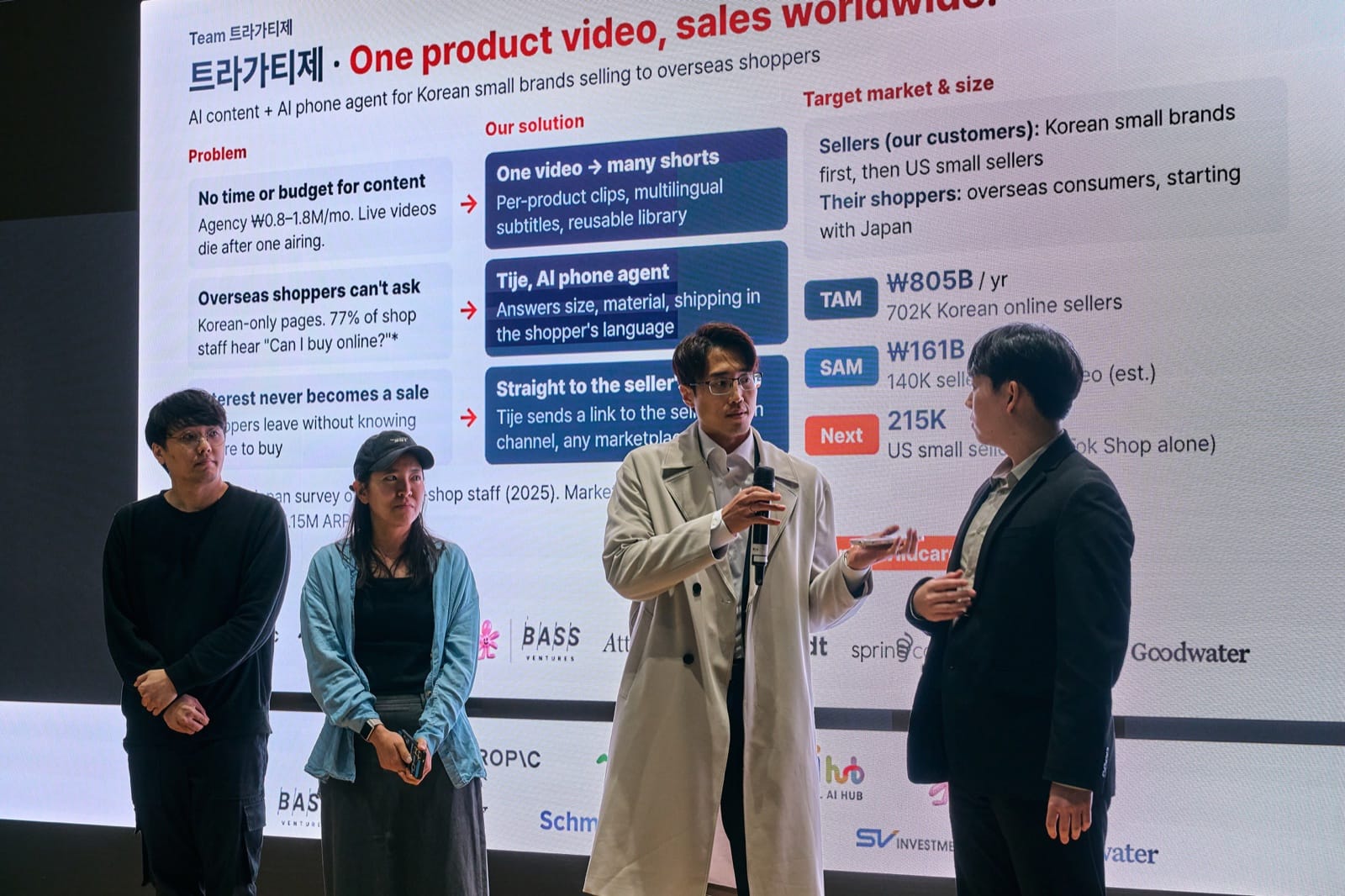
Tragatize is a four-person team, and its first round of judging came back three PASS votes to one FAIL. If you follow the demo instructions in the submission, one sample button shows real AI output that was run ahead of time (a script, three short videos and copy in seven languages) within 15 seconds. Type one line about your own product or upload a vertical video, and a real AI short-form video is ready one to two minutes later. Call the number on the screen and Tize actually picks up, walking you through the product, the price and where to buy it.
The pitch deck put the market at 805 billion won a year, based on 702,000 online sellers in Korea, 140,000 of whom use video, and named the next target as 215,000 small businesses in the US. Claude Sonnet 5.5 handles the highlights, translation, subtitles and Tize's replies, but Tize only answers within the data the seller has provided.
One team member runs live commerce and always found it a shame that a live video disappears after one use. The hint came from China's live commerce during COVID, when brick-and-mortar shops filmed their own broadcasts to sell. In Q&A, someone pointed out that many small businesses don't even have an online sales channel or a way to take payment, so getting to an actual purchase might need something like escrow. Tragatize plans to put a purchase link in the text message, and for shops without one, to bring them onto the platform and add payment and shipping itself.
The plan is to start in Korea and expand to Japan, Southeast Asia and the US. In the first round of judging it got the comment, “As commerce channels get lighter, I expect this could become a marketing tool that individual business owners can easily access.” It didn't lead to a follow-up meeting that day, though.
HuhKimHyeonggunJunwoo opened its pitch for Onehouse by asking whether you'd ever seen the suggested friends on Facebook or Instagram. The presenter had never tapped one, since there was no telling who those people were. On social media today, you have to make the first move, whether it's a follow or a connection request, and the platforms lean toward deepening ties with people you already know over building new ones. So the team started from this thought: a friend who knows you well and also knew everyone in the world wouldn't hand you a list of ten names. They'd introduce you to ten people themselves.
Open the link and you're in a room, no sign-up and no profile, and an agent called one, which knows everyone's information, starts the conversation. Ask for a designer to work with on a side project, and one scans the 290 or so people in the room, puts up the best match, and explains what that person is looking for right now and why the two of you fit. The plan is to start with builders among US college students aged 18 to 24 who are looking for co-founders, teammates or new friends, then expand to all of Gen Z.
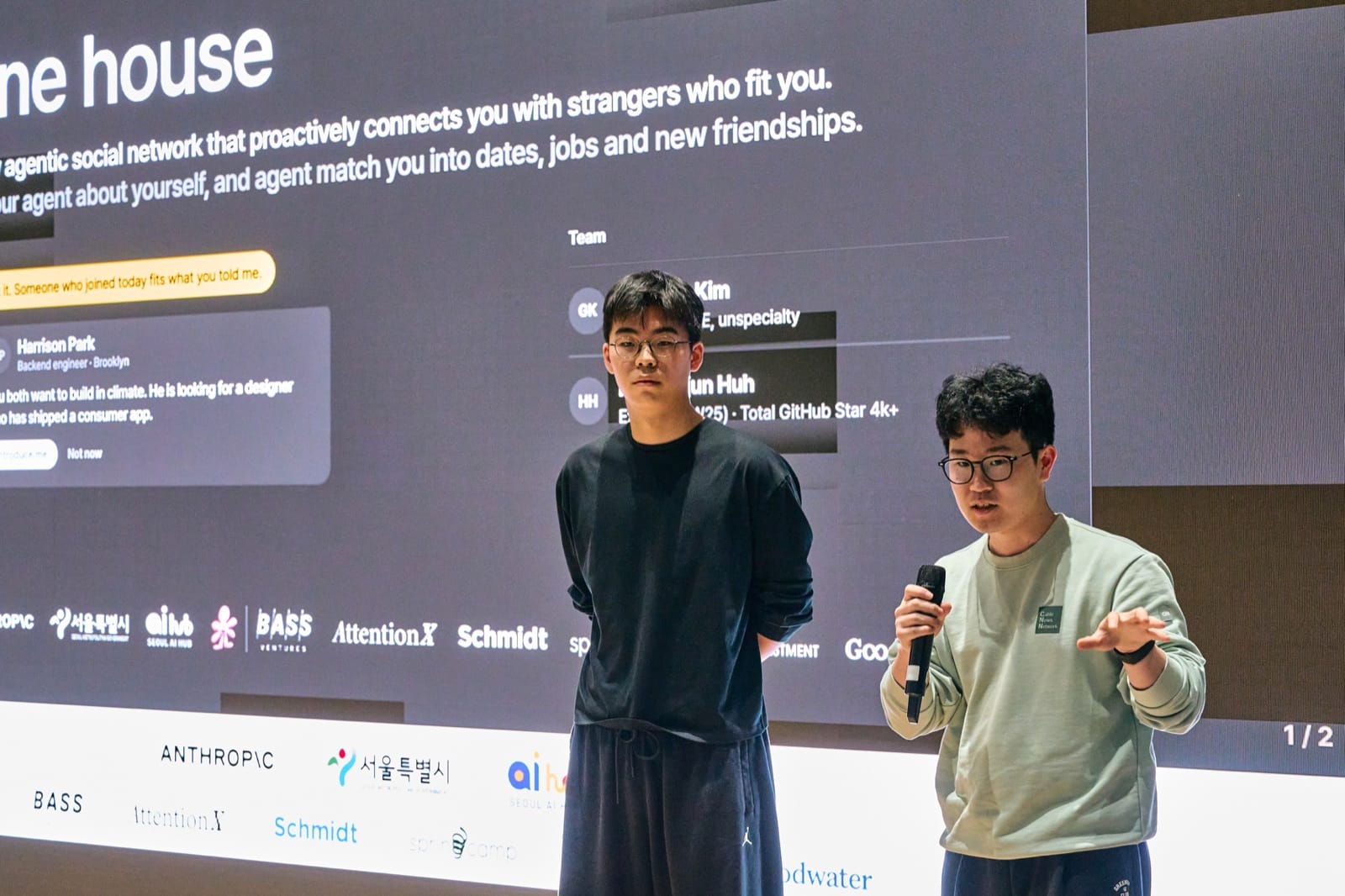
HuhKimHyeonggunJunwoo is a two-person team that chose BASS Ventures' mission, “a consumer AI used by 100 million people worldwide within a year.” In the “built today” field of the submission, they wrote that they made every part from scratch. The pitch deck sizes up today's social media with numbers from the court ruling in the FTC's lawsuit against Meta. Friends' content accounts for only 17% of time spent on Facebook, and just 7% on Instagram.
The deck lays out how to use Onehouse in three steps. Instead of posting, you tell the agent about yourself. The agent reads what you said along with your LinkedIn and GitHub links, then finds people who fit and explains why. A conversation only opens once both sides say yes. That way a stranger can't start talking to you before you've both agreed.
Q&A covered whether this is a service for finding people with a clear purpose or a social network for widening your circle like LinkedIn, how it draws out intentions that are hard to put into words, and how it keeps up as interests change. Onehouse sees itself as closer to a social network. The agent picks up your interests and conversational style from the onboarding chat, then suggests connections over time. It'll also read outside links like LinkedIn and search the web regularly to keep that information fresh.
The network starts in tight-knit communities, like founders looking for a co-founder or a designer, and grows as each person who gets connected is in turn linked to the people they're looking for.
In the first round of judging, this team had gotten the comment, “An angle that uses simulation to take care of the effort that goes into judgment calls.” Three VCs stepped up to meet them, and HuhKimHyeonggunJunwoo didn't even ask them anything before choosing BASS Ventures, the firm behind the mission it had picked.
Human know-how and the work floor become data
NERO's Handover is an answer to SCHMIDT's mission for a product that saves the 10 million people whose jobs AI will erase. Claude interviews people in jobs AI is about to wipe out, draws out what they know, and seals it into a know-how pack. Blind cards, with company and system names stripped out, connect that pack to companies and AI, and each connection can turn into a pack sale, a pay-per-question inquiry or a hire.
On the selling side are BPO call-center agents in Manila who are facing layoffs. The Philippine BPO industry employs 1.9 million people, and its trade association has cut its 2028 employment target from 2.5 million to somewhere between 1.85 million and 2.14 million. On the buying side are US companies that run customer-service AI, along with companies that sell AI evaluation data.
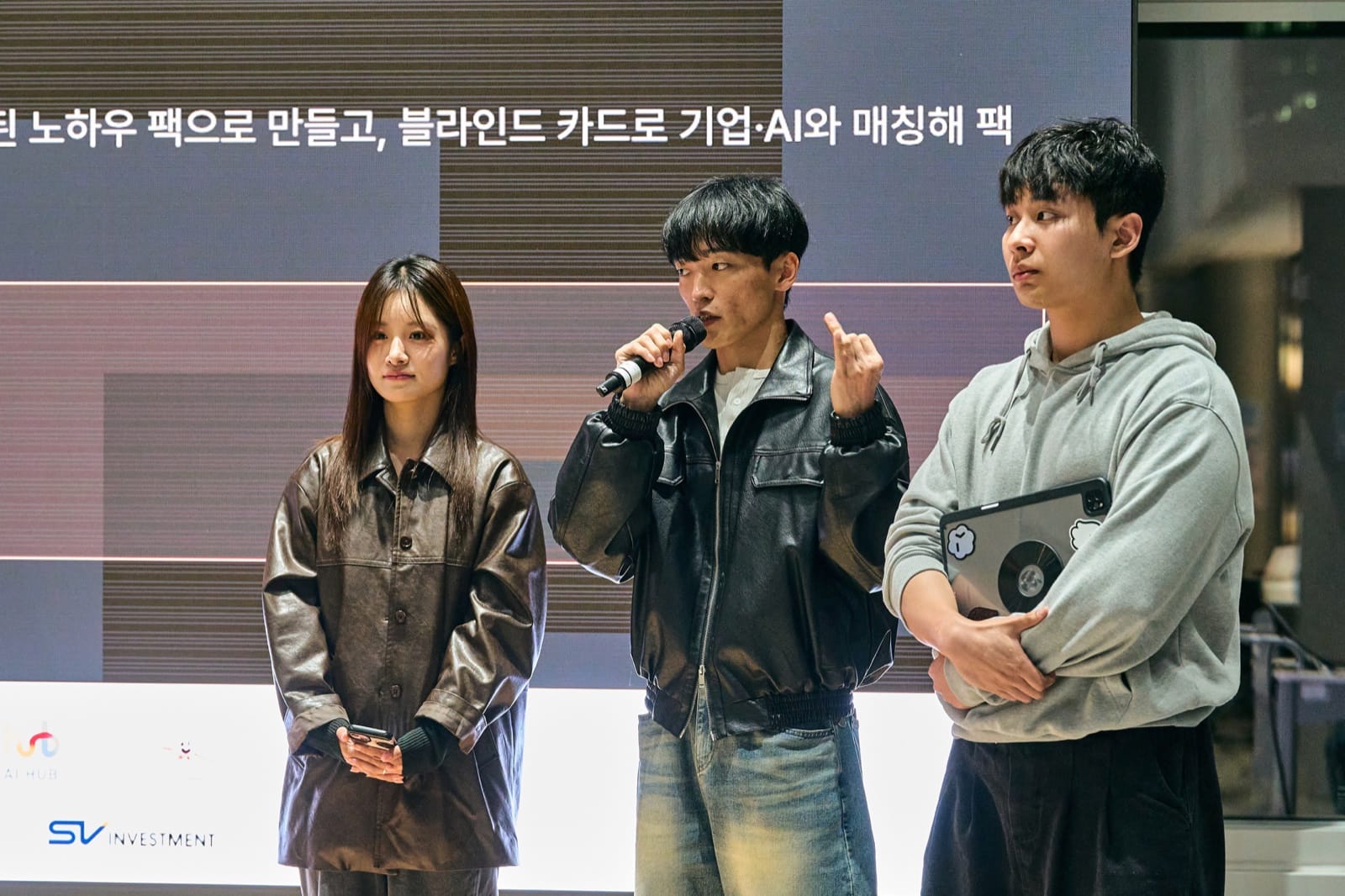
NERO is a team of three. Their submission says they built the whole flow in a fresh repo after 10 a.m.: the interview and Claude's follow-up questions, extraction and generalization, blind cards, demand matching, sealed Q&A, mock payment and access to the handover document, and a receipt showing what Claude did along the way. It came to 5 screens, 11 APIs, 4 Claude calls and 10 database tables.
The first page of their pitch deck read “Your job may end. Your judgment doesn't.” The second page was about pricing. Opening a full handover document costs $149. Each case connection costs $20, and 70% of that goes to the person who wrote it. If a connection leads to a hire, Handover takes 15%.
The deck also argued that the legal risk is small, since what goes up is the person's own judgment and never company data. The plan for the next 7 days was to open per-case connections and line up 10 sellers and 3 buyers in advance.
In the demo, Claude took the answers of an agent with 5 years at a Manila telecom, pressed with follow-up questions, and sealed the handover. Then a buyer described a problem their AI couldn't handle: roaming disputes from customers who'd switched plans partway through. Three cards came back as matches, each with the reason it fit. The buyer gets an answer to their question first, without opening the handover, and the full document only opens once they've paid.
The idea split the VCs from the first round of judging. One wrote, “A matching system built around know-how rather than jobs felt really fresh.” Another had doubts: “If a job is disappearing because of AI, there's a good chance AI has already replaced it. I'm not sure how much a know-how pack would help, or whether companies would pay for it.”
The Q&A ran from how the three recommended cases get picked for each company, to what separates this from existing data vendors, to who ends up paying. When a company types in a question, NERO's system sorts it into a category, AI scores the candidates, and the top three get recommended. The difference from data vendors, in NERO's view, is that the data is the agents' hands-on know-how, captured directly, and not data that AI has already processed.
Asked whether they'd recruit sellers or buyers first, NERO picked the know-how providers, with AI giving every provider answer a score and a rarity rating. Another question went to the team itself: this business requires knowing both sides well, so why is NERO the team to pull it off? The pitch didn't lead to a follow-up meeting that day.
Dongbyeongsangryeon's presenter has spent 25 years in shipping and logistics and built HubTrace with an engineer who has 25 years of their own. They introduced the team with one line: “So you're looking at the work of fifty years.” HubTrace is a real-time 3D control tower for freight networks. Shipment tracking, work orders and delivery reassignment all sit on one screen, so dispatchers and site managers look at the same view and can act on it right away.
The first market they chose is Japan. Since April 2024, truck drivers' overtime there has been capped at 960 hours a year, and 3PLs and carriers keep having to rework delivery plans while switching back and forth between their warehouse management and transportation management systems.
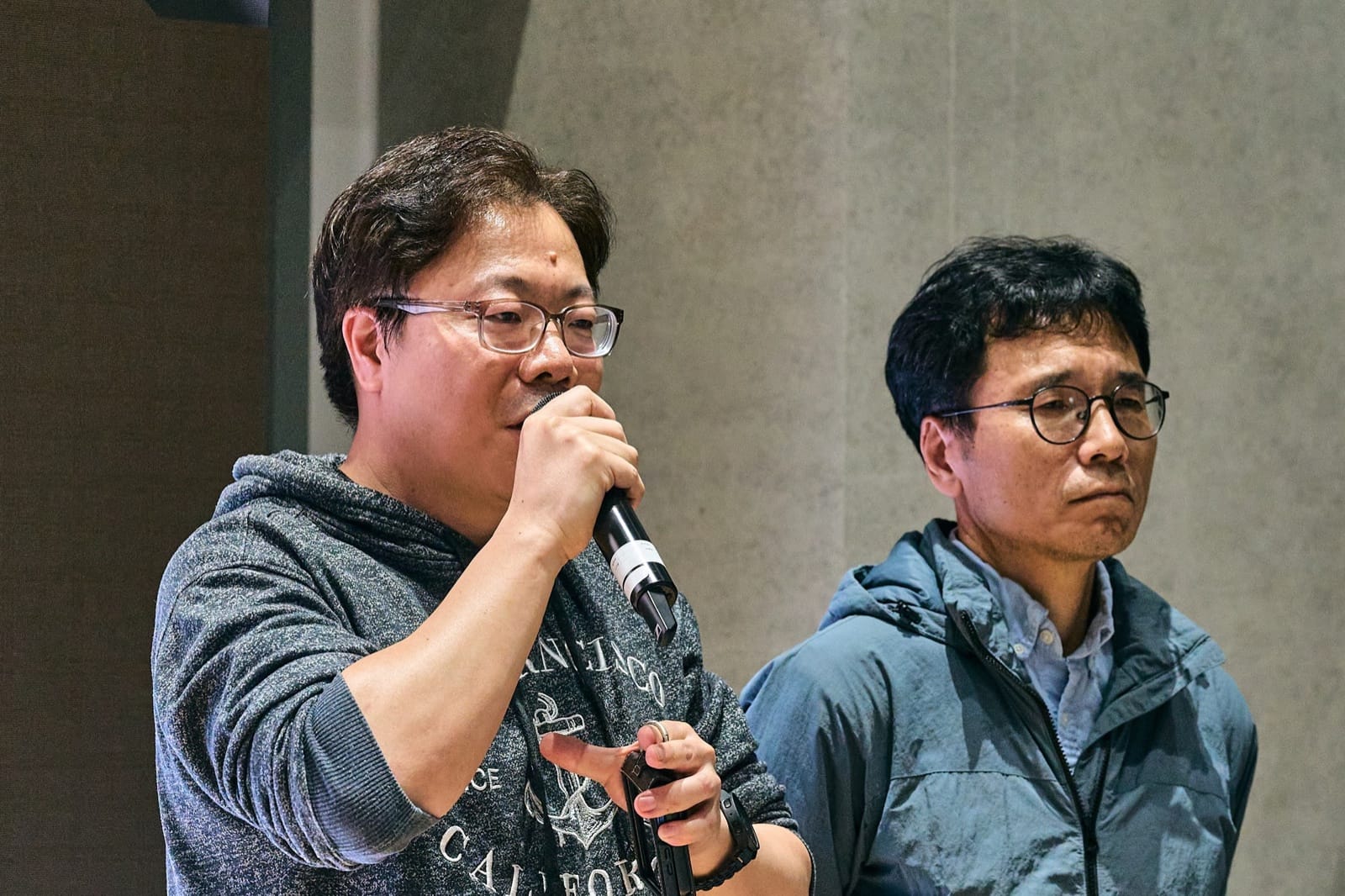
An AI logistics assistant sits on the right side of the screen. Ask it by voice or chat where your shipment is right now, and it checks the status and tells you. Request an urgent inspection, and it drafts a work order and waits for approval. Tell it to hand the remaining stops to another vehicle, and the route on the map changes as soon as you approve. Nothing runs until a human signs off. It's been through 14 live evals and 44 offline tests, and you can try it without logging in.
Dongbyeongsangryeon, a team of two, used part of their pitch deck to lay out how they use Claude. For every request, Claude Opus 5.5 returns a structured judgment made of choices, true/false flags and scores. The server validates that judgment and runs the lookups, then holds anything that would change data until someone approves it with a single tap. In fast mode, the median response time was around 5 seconds. Over the next 7 days they planned to add a Japanese interface and voice, connect real warehouse and transportation management data, and run a pilot at one 3PL site in Japan.
The Q&A started with why they'd picked Japan first, a market where 3PL systems are hard to integrate and sales cycles run long. On the point that Japan is conservative, the presenter conceded: “Honestly, it's exactly as you say.” Japan was only the model they'd built the simulation around, and the product could apply beyond Korea and Japan, across all of Asia.
Next came digital twins, a term everyone heard plenty of during the digital transformation wave. If you add AI to one, does it change enough for customers to actually feel it? The presenter has hit a wall on the ground every time they've started something new over 25 years, and they see this proposal and what they've built so far as a possible catalyst. Logistics and shipping are conservative, the barriers are high and the data is heavy, so everyone's afraid of change. Their way in is to start with small 3PL operators, and if policy backs it up, the shift should move faster.
On technical strengths, the engineer walked through the stack, Python crawlers and Three.js. Because the judgment model responds in roughly 70 to 500 milliseconds, an agent hooked up to CCTV or sensors could make an immediate call on a safety incident like a fire. In the first round, one comment read “Interactive 3D is so cool. It's a service that's a treat for the eyes.” The team also got some homework: “Future growth speed will depend on whether the solution is modular enough to supply as SaaS, or whether it needs SI optimization for each client.” They'd scraped into the finals 3 PASS to 2 FAIL, and they left the stage with a next meeting with AttentionX.
Team Sprint's Stepcast pitch began with a line printed on the cover of IKEA's newer manuals: “scan this to watch the video.” Even IKEA knows paper isn't enough. Customers who get stuck mid-assembly pick up the phone, and each of those calls costs $13.50. IKEA can afford videos and call centers. Small brands can't. With Stepcast, a brand uploads its PDF manual and Claude drafts a 3D assembly guide. Once the brand has reviewed it, customers just scan the QR code on the box and follow along, with no app to install.
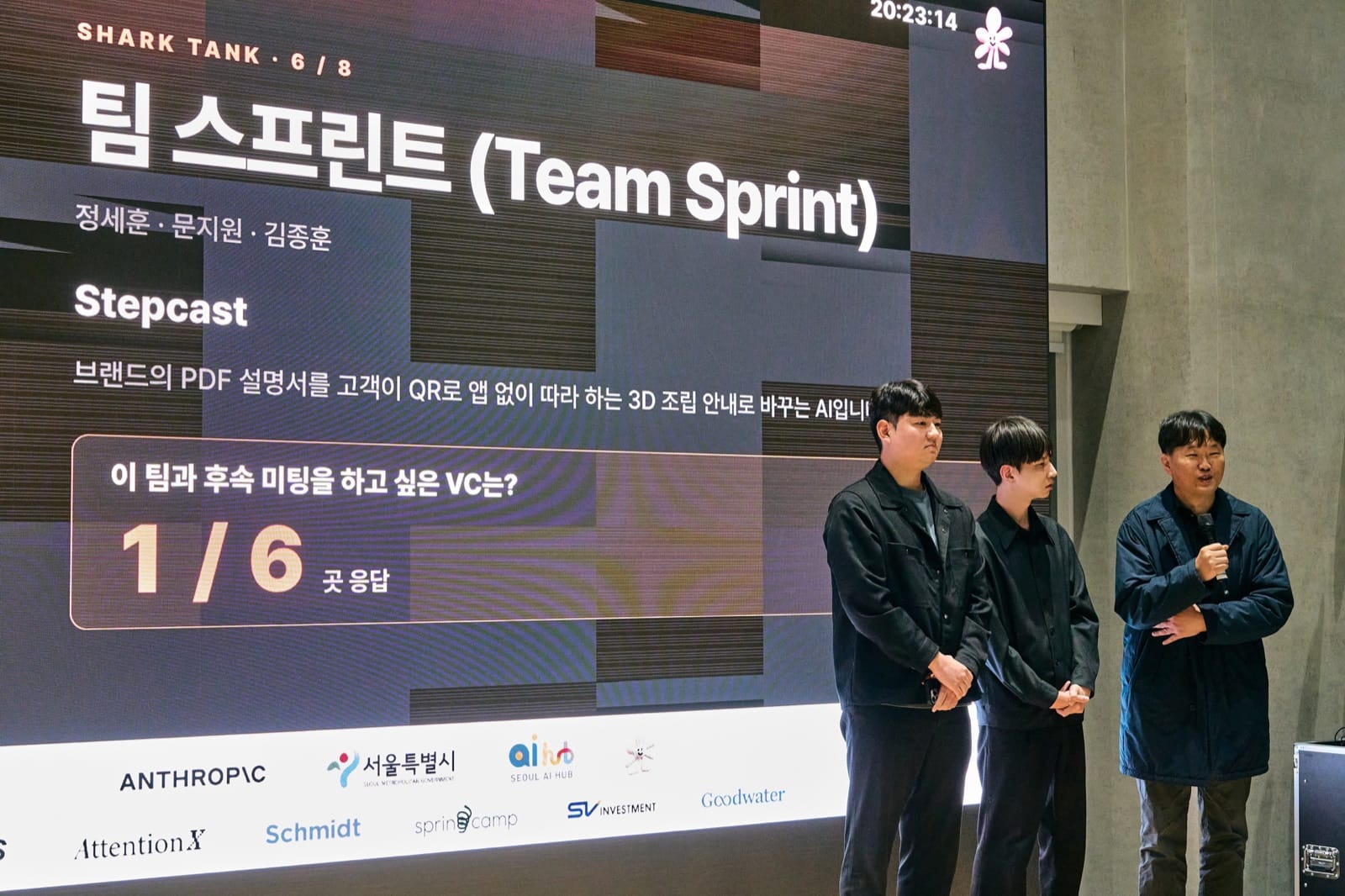
Team Sprint, a team of three, turned in a pitch deck that wasn't slides at all. It was two A4 pages of prose. According to those pages, the only input that day was the 24-page PDF manual for IKEA's KALLAX. Claude read it and pulled out 9 part types and 14 assembly steps. The panels are rendered in 3D with an oak texture, the screws and dowels keep their real shapes, and at each step the parts slot into place while the hex key and the hammer actually move.
The team also checked that the same method holds up on the manual for a much more complicated plastic model airplane kit. On the review screen, if you change the screw in step 3 from #1 to #2, the parts list and quantities for every later step update with it. AI writes the draft, and the brand, which knows the product better than anyone, is responsible for getting it right.
People already pay for this. Bilt, which builds 3D guides by hand, takes 3 to 6 days per product, and one of its clients saw support calls drop 30%. Wayfair alone has 20,000 suppliers, and most of them are small companies. The AI runs once per product, so there's no AI cost when a customer opens a guide, and the new Claude model cut that cost by 40%. The moat is data on the exact step where customers get stuck. When a brand fixes that step, the QR code stays the same, so there's nothing to reprint. The pitch ended on “Paper is not enough, not even for IKEA.”
Couldn't companies just make their own 3D with AI tools? Team Sprint agreed that Claude models are open to anyone and anyone can do 3D modeling. Where they differ is quality. They revised the first model they'd generated that day more than 20 times, checking it by eye the way the person actually responsible for the product would. For go-to-market, a prototype takes 2 to 3 weeks, so they'd start with CEOs of small and midsize companies that are legally required to include manuals. If the conversation in the room went well, they asked to be introduced to IKEA too. They'd find their way one step at a time.
In the first round, the team didn't get a single FAIL, and one VC wrote, “A fresh idea, with possible M&A down the line. That said, growth speed will be set by the technical barrier to entry and the AI token cost structure for 2D-to-3D conversion.” In the Shark Tank round, SpringCamp asked for a next meeting.
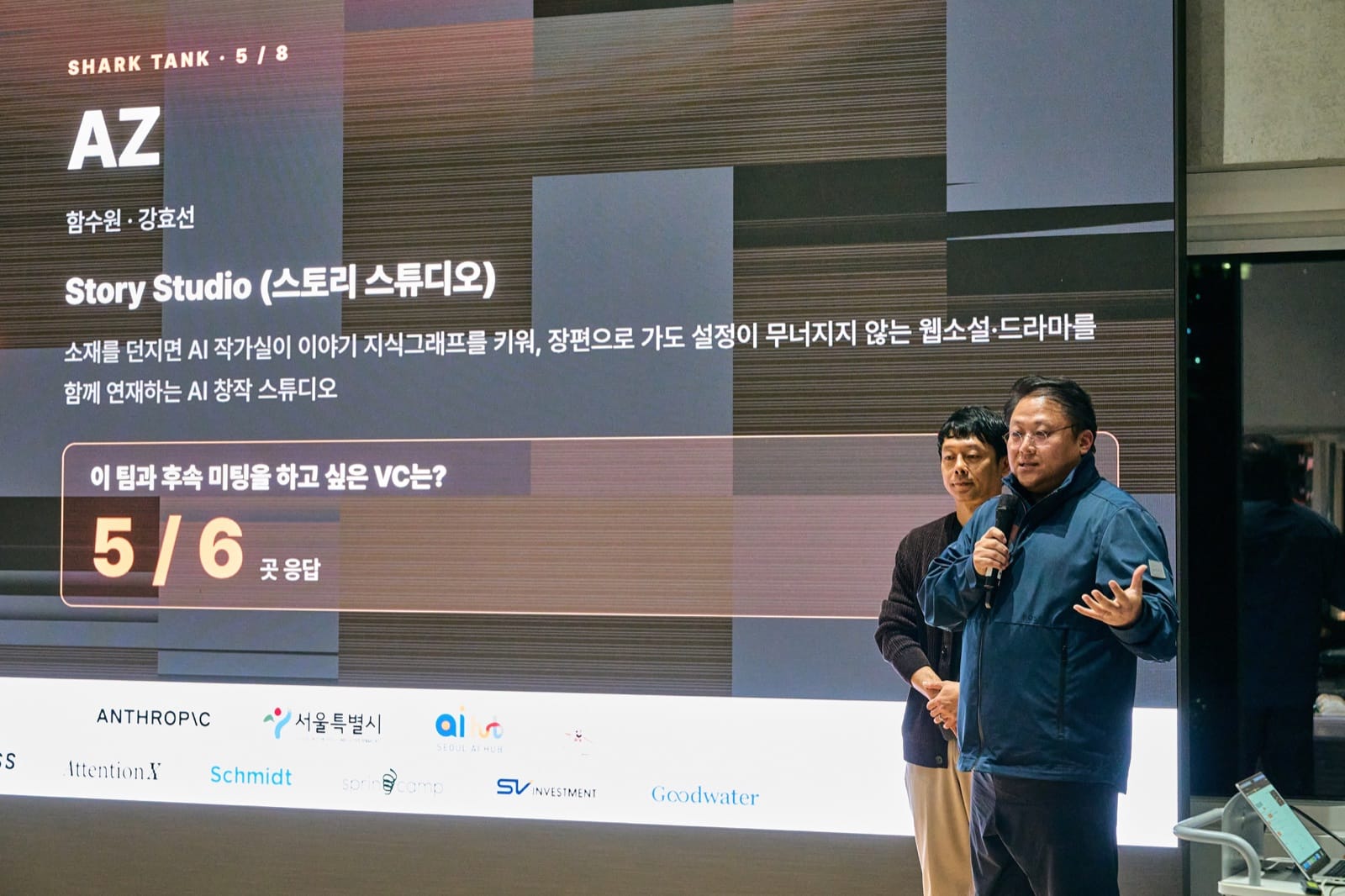
AZ's Story Studio took BASS Ventures' mission of 100 million users in a year and ran it through web novels, with the 100 million being readers, not writers. You drop in notes, photos, long posts or documents, and the AI interviews you while it grows a knowledge graph of your story. Agents playing planner, writer, editor, reader and cover designer use that graph as their memory to co-write web novels and drama scripts, so the worldbuilding doesn't fall apart even over a long series.
At each fork in the plot you choose a direction. The editor agent catches continuity errors, and the reader agent flags ahead of time where readers will get the satisfying payoff and where they'll sit through a frustrating stretch (Korean readers call them “cider” and “sweet potato”). Press publish, and Claude draws a cover and posts the story so anyone can read it free, like a blog. The target is people in the US who love web novels and short dramas but have never written anything themselves. In the first round, one VC left the team this comment:
Impressive angle: the problem isn't that people can't write, it's that they can't get it out
AZ, a team of two, set out its markets in the pitch deck. First come US and other English-language web novel writers serializing on Wattpad, Webnovel, Royal Road and Tapas, then Japan's Narou and Kakuyomu, then Southeast Asia. The problem they named is story collapse: when you post an episode every day, a few hundred episodes in, the characters, rules and foreshadowing start to come apart. Every agent runs only on Claude Opus, Sonnet and Haiku 5.5, and the product supports Korean and English interfaces as well as mobile.
The Q&A opened with whether AZ meant to recruit 100 million writers. The 100 million are readers, and AZ wants to be the platform. Someone pointed out that the interface makes it easy for anyone to start, yet the content seemed aimed at professional writers. AZ's goal is a platform where anyone can publish with AI's help and build their own brand as a writer. AI-made content is everywhere, which wears down the novelty, and web novel communities are wary of it, so how would AZ earn a place? They'd launch with writing support first, and at every fork in a story an editing manager would decide the direction together with the writer.
If a hit comes out of it, who owns the copyright? The writer does. The platform stays in a supporting role and earns subscription fees, with ads on free works and revenue sharing on paid ones. A similar service already exists in Taiwan, so why would AZ do better than that service, or than Claude itself? To bring writers in early, the team is considering lower usage fees and handing all paid revenue to writers, with no split taken.
Both members have been writing code for a long time. Now that the value of code doesn't belong to developers alone, they see making content as the next frontier for what AI can do. In the first round AZ had also drawn a critique: “Plenty of similar services have already launched. Beyond simply producing works, the key question is how tightly built the works it puts out can be.” The team didn't come away with a follow-up meeting that day.
What we heard most was how unusual the rules were
Once all 8 teams had pitched, the final results went up on the LED screen. Arakyn and Dongbyeongsangryeon got follow-up meetings with AttentionX, Klaro with Goodwater Capital, Team Sprint with SpringCamp, and HuhKimHyeonggunJunwoo with BASS Ventures. That's 5 of the 8 teams leaving with a next meeting set. AttentionX's two matches wouldn't have happened if we hadn't lifted the matching limit right before the stage opened. Match or no match, all 8 finalist teams get $5,000 in Claude credits each.
Looking at the results, the missions the VCs wrote and the teams they picked that evening didn't always line up. Only two pairs matched on a VC's own mission, BASS Ventures with HuhKimHyeonggunJunwoo and AttentionX with Arakyn. AttentionX also picked Dongbyeongsangryeon, which had taken on SV Investment's mission. SpringCamp picked Team Sprint, which worked on that same mission, and Goodwater Capital picked Klaro, which had answered AttentionX's mission. The missions were a starting point. When the VCs raised their hands that evening, it came down to the team and the product.
I thanked the six VC firms that stayed with us from the weekend afternoon into the night, Anthropic for being so generous with credits, and Seoul AI Hub for opening up its space. Then the VCs, the founding teams and every participant who'd stayed to the end gathered for a group photo and shouted the Korean cheer “Ambition for Korea, fighting!” Late that night, messages kept coming into the participant channel, like “Thanks for all the hard work~! The hackathon was so much fun~!” and “Great work, everyone!!”
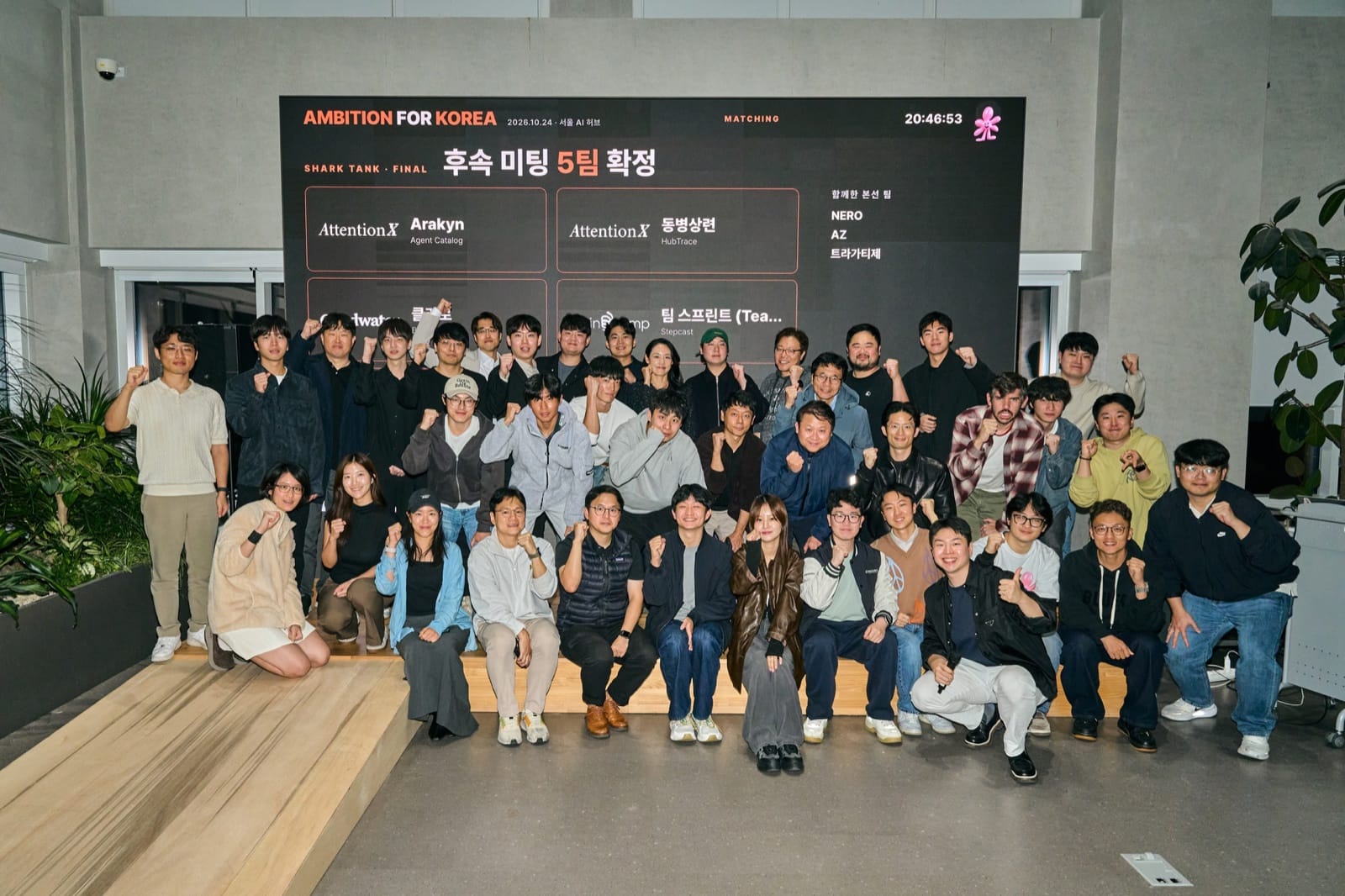
After the event, the thing I heard most was that the program and its rules were unusual. That's fair. All day, every team's commits piled up on the screen, a green or red dot appeared each time a VC voted, and the door shut the moment all 8 seats were filled. All 114 VC one-line comments, along with every team's demo, pitch deck and GitHub link, are collected in the archive, and you can also browse them by mission. We're connecting the five matched teams with their VCs directly.
The embarrassment I feel when I say “going global” didn't disappear in a day. But 105 people have now actually done it for a day, instead of only talking about it, and five of those teams are carrying the conversation forward with VCs. From here on, we're not going to wait.
Every service built that day
Here’s every service the 36 teams submitted. The eight finalists come first and the rest follow in submission order. Each one-liner is the team’s own wording, translated where it was written in Korean. The teams run their own demo and GitHub links, so some may go offline later. To see them grouped by VC mission, open the mission view in the archive.
- Arakyn · Agent Catalog (Finalist, follow-up meeting with AttentionX) Faster. 30× lighter. The search engine built for agents. Demo · GitHub · Deck
- NERO · Handover (Finalist) A marketplace where Claude turns the know-how of jobs AI will erase into sealed know-how packs, matches them to companies and AI through blind cards, and connects them to pack sales, per-question inquiries and hiring. Demo · GitHub · Deck
- Dongbyeongsangryeon · HubTrace (Finalist, follow-up meeting with AttentionX) A live 3D control tower for cargo networks, with an AI logistics assistant that looks up, plans and acts — only with human approval. Demo · GitHub · Deck
- Klaro · Bias (Finalist, follow-up meeting with Goodwater Capital) A companion travel agent for K-fans that lets you walk the path your bias walked, quest by quest. Demo · GitHub · Deck
- AZ · Story Studio (Finalist) Throw in your material and an AI writers’ room grows a story knowledge graph, so web novels and dramas you write together don’t fall apart even as they run long. An AI creative studio. Demo · GitHub · Deck
- Team Sprint · Stepcast (Finalist, follow-up meeting with SpringCamp) AI that turns a brand’s PDF manual into a 3D assembly guide customers follow from a QR code, no app needed. Demo · GitHub · Deck
- HuhKimHyeonggunJunwoo · Onehouse (Finalist, follow-up meeting with BASS Ventures) A new agentic social network that proactively connects you with strangers who fit you. Demo · GitHub · Deck
- Tragatize · Tragatize (Finalist) Your short-form video becomes a live stream that never ends, 24 hours a day. Demo · GitHub · Deck
- CHOAM · Nunchi An agent that reads the room and moves you (forward-looking, somewhat optimistic). Demo · GitHub · Deck
- Planetes · Quest The anonymous B2B marketplace for engineering work: hide who is asking, prove what was delivered. Demo · GitHub · Deck
- Keiailab · settlivo A global payroll platform that simplifies the tangled payroll process between overseas companies and remote workers, and uses blockchain to cut transfer time and fees. Demo · GitHub · Deck
- WJxEJ · Glowprint Before you pay for a K-beauty product or a Seoul clinic, see at a glance whether the seller can be trusted and whether it suits your ingredients. Demo · GitHub · Deck
- Kkyare · Weather Decision Gym Forecasts the weather and this year’s expected yield for every parcel of large US farms, then retrains on real harvest records each season to keep getting more accurate. Demo · GitHub · Deck
- JaeDragon · muselook Pick any makeup look you love, see it simulated on your own face, and shop the K-beauty products that match its colors, re-picked for your skin tone. Demo · GitHub · Deck
- Namui Jiwon · gigi gigi. uses AI to connect businesses with on-demand talent—and workers with continuous income and portable benefits. Demo · GitHub · Deck
- Magent · Magent A hyper-personalized consumer AI that remembers your judgment and optimizes your next purchase. Demo · GitHub · Deck
- unknown · Into the Unknown De-identification for mental health data that keeps its clinical meaning and data quality intact. Demo · GitHub · Deck
- Triple Hyun · WGS (worktree guild system) The Guild, a community where 10 million US IT workers find work and grow together. Demo · GitHub · Deck
- Bearing · Bearing AI that writes the customs paperwork for everything that goes onto a ship. Demo · GitHub · Deck
- Chilling Soft · Alter A personal agent that lives in the OS layer, not a chat window. It quietly learns you, helps before you ask, and grows more like you the more you use it. Demo · GitHub · Deck
- Team Kimbakgui · Dream Achieve Moments (DAMs) AI can replace your tasks, not your expertise. Dream Achieve Moments reads the life you've already lived, finds where your skills and your dream meet, and gets Demo · GitHub · Deck
- UJHS · SCENE A 3D messenger that turns a group chat into a round table. Friends who are reading sit up, friends who aren’t are slumped over, and your words arrive in your own voice. Demo · GitHub · Deck
- Naru · Frontier Lab Market A market that turns field experts’ tacit knowledge into rights-verified AI training and eval data, and into virtual companies for LLMs. Demo · GitHub · Deck
- Team Hoyeonjigi · Lumi An AI agent that gathers news about your favorite K-pop artist in one place and lets you buy their outfits, merch and favorite things from the US. Demo · GitHub · Deck
- SEVENFOLDER · PathPilot AI Legacy patch intelligence: even systems that can’t be upgraded can respond the same day. Demo · GitHub · Deck
- Return to the state · RLMask Persona-based de-identification that runs locally, with no risk of personal data leaking. Demo · GitHub · Deck
- Kim & Yang · YuiYumi A Live2D character AI assistant that lives on your screen, watches what you’re doing, speaks up first, and handles everything from email and calendars to building apps. Demo · GitHub · Deck
- Newtype · GhostReel A global short-form side-hustle channel. A twin creator shoots for you without showing a face, using viral short-form data and your own taste, while your Claude reads and rewrites it over MCP and keeps getting better. Demo · GitHub · Deck
- Team Choigobaekgu · Morrow - There’s More to Tomorrow. Your AI agent interviews with a company’s hiring agent first, and finds roles your résumé doesn’t show. Demo · GitHub · Deck
- GrabCreditTaoJayul · poin Chat answers what you say. poin answers what you don’t. Demo · GitHub · Deck
- Team Sparks · Jinseonmi An AI guide that shows foreigners and tourists local Korean information with sources, compares and recommends K-beauty and K-medical options, and builds the visit itinerary. Demo · GitHub · Deck
- Jongno 3-ga · Pibook An agent-first platform that picks and manages the best procedure, price and clinic purely through autonomous negotiation and automatic matching among foreigner, Korean and clinic agents (A2A). Sensitive procedure data and clinic quotes go through zero-knowledge proofs (ZK). Demo · GitHub · Deck
- Team BuleMoonDream · SIEVE_WHYBUY Now that the leading frontier companies have all moved into the agent market, SIEVE_WHYBUY links what consumers actually bought after an AI recommendation, and why they picked something else or gave up, giving consumers rewards for taking part and giving brands the purchase-decision data that comes after the recommendation. Demo · GitHub · Deck
- Super Agent · Meme Rush Every day, agents turn the world's hottest meme and hit game into a 30-second game and deliver it through SNS. Demo · GitHub · Deck
- TangibleIdea · Argos Vendor access to your data: attack-proven, set up by AI Demo · GitHub · Deck
- animalive · Companion Studio A Live2D companion you talk to, not type to. She answers in her own voice and reacts with her face, every turn. Demo · Deck
Keep reading
Join Bloom
Bloom builds offline rooms where people and technology meet. We run them in Seoul, and now beyond it.
- 💬 Discord community, where events are announced first
- ▶️ YouTube, full talks from past events
- 📸 Instagram, photos from our events
- 🎟️ Bloom app, upcoming events and Mixers