Inside the Anthropic AI Census of 81,000 Users

The largest, most multilingual qualitative study ever run
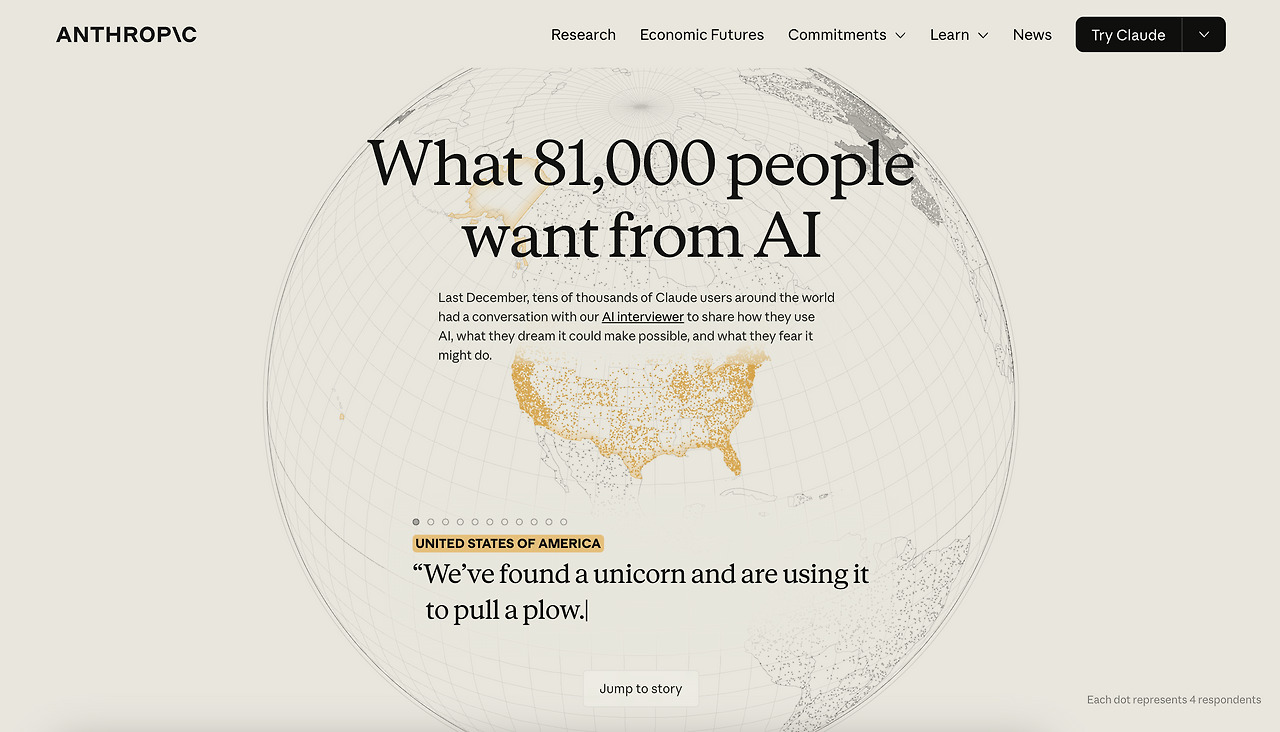
For one week, Anthropic had its own AI interview its users. Four questions: what did you recently use AI for, if you had a magic wand what would you want AI to do, has AI ever come close to that vision, and if AI developed in a direction against your values, what would that direction be. A total of 112,846 responses came in, and after filtering out low-effort answers, 80,508 were analyzed, across 159 countries and 70 languages. Anthropic introduced it as the largest and most multilingual qualitative study ever conducted.
The interesting part is that the interviews were run by AI, not people. According to the appendix, respondents were unexpectedly honest.
Respondents poured out stories of grief, mental health crises, financial anxiety, and failed relationships, content human researchers rarely encounter in traditional interviews.
The report explains why: when the counterpart is not human, the social cost of honesty nearly disappears. That one sentence already captures a slice of the AI era.
The richer the country, the scarier the AI
The first thing that jumped out was a paradox of wealth. Wealthy regions like Western Europe, North America, and Oceania showed the most negative feelings about AI, while Sub-Saharan Africa, Central Asia, and South Asia leaned positive. In Sub-Saharan Africa, 18 percent said they had no concerns about AI at all; in North America, only 8 percent said the same.
A founder from Cameroon, quoted in the report:
I live in a technologically disadvantaged country and cannot afford failure. But thanks to AI, I can now handle cybersecurity, UX design, marketing, and project management at a professional level, alone and at the same time. This is a tool that closes gaps.
Those who already have much fear losing it. Those who do not yet have it feel, first, that they finally can.
Fear comes to those who have used it
Read through the Claude Blue lens, it goes like this. First contact with AI brings an excitement phase: amazing, the world is changing, I should hurry and use this. Use it deeply and the next phase arrives: is this replacing my work, and what is my reason to exist? Users in developed countries have used AI deeply in larger numbers, so more of them have entered the next phase, while developing countries may still be in the excitement phase.
The appendix data supports this reading: the more directly people experienced the benefits, the more clearly they felt the harms at the same time.
Tension is discovered through use. People do not predict that the thing helping them will make them pay for it. They learn by experiencing it.
One more hypothesis fits here. The way developers work resembles the way LLMs work: a structured loop of hypothesis, verification, implementation. So AI penetrated developer work fastest and the threat was felt fastest. Non-developer work is messier, full of meeting people, negotiating, and reading context, so it takes longer to seep in. If that lag exists, then countries with high developer ratios and extreme adoption speed reach the fear phase first. Korea qualifies.
What people wish for reveals what their country worries about
The most interesting data came from the magic wand question, and the answers split completely by region. In Sub-Saharan Africa, South Asia, and Central Asia, the dominant wishes were starting a business and learning. In Central Asia, learning reached 14 percent, nearly double the global average of 8 percent, with South Asia at 13. The report reads entrepreneurship in these regions as a way to route around capital barriers.
The texture of fear also differed: Korea leaned toward loss of identity, while the US feared loss of control more, a mix of culture, economy, and history. What remains is a record of 80,000 people revealing their inner lives in front of the mirror called AI. It goes far beyond a user satisfaction survey.
Join Bloom
Bloom builds offline rooms where people and technology meet. We run them in Seoul, and now beyond it.
- 💬 Discord community, where events are announced first
- ▶️ YouTube, full talks from past events
- 📸 Instagram, photos from our events
- 🎟️ Upcoming events
This post summarizes the conversational interview report Anthropic ran with Claude users worldwide in December 2025.