Can AI Fix Politics That Ends at “The Other Side Is Bad”?
Dongin Choi on why every political message collapses into the other side is bad, and why he would build an AI native party rather than fix an old one.

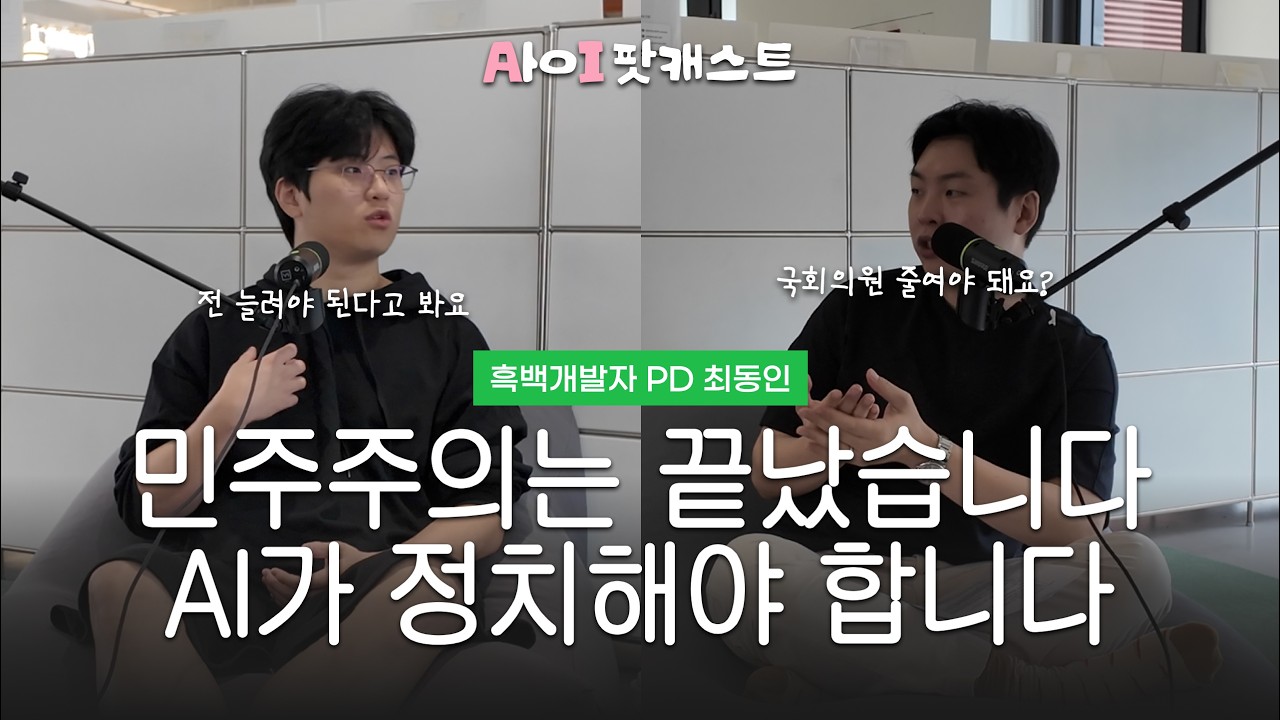
Dongin Choi of The Hackathon, who built the wildly viral Heukbaek Developer, joined the Bloom iPodcast as our third guest. Almost nobody around me can go deep on technology and politics at the same time, so the whole conversation was a genuine pleasure, and it wandered through society and culture and history in a way I enjoyed enormously. I am more curious how it lands for the people watching.
AI and politics both being hot at once made it land harder.
He is building the operating system that comes after democracy
I asked him to introduce himself and the answer came back as a single sentence.
What comes after democracy as an operating system for humanity? I am Dongin Choi, and I am building some of that.
When I asked why he took politics as his issue, he said it started from a single thought. This is far too important an area of society to leave without anyone holding the will and the momentum to change it as the times change. Working out how he could change it himself, in which area and in which direction and with whom, produced that one sentence.
Everything he read at home turned out to be a book about rulers
The root of the interest goes back a long way. His father studied law and his mother painted in the Eastern tradition, and the house leaned traditional enough that he finished the Thousand Character Classic and grew up reading the Four Books and Three Classics. Somewhere in there he noticed something.
I read the Four Books and Three Classics, and they are all books about how to rule.
They are about how to govern well, he said, whether the thing being governed is a body or a household or a country. He went to Hanil High School in Gongju, South Chungcheong, an environment controlled tightly enough that he had no mobile phone until he turned twenty and had to use a payphone, and he read through three years of self study. His teachers in the second and third years happened to love Marx, so that was when he read Das Kapital and social philosophy, and since his German was good he read them in the original too.
Full marks on every exam and still a D
Germany sits in the middle of all this. His father was posted abroad as a legal cooperation officer, and he spent a few years of primary school in Munich and Berlin, where he found children his own age arguing about Nietzsche and Heidegger and Wittgenstein. They were reading modern philosophy the way we read classical poetry.
The shock arrived on his report card, where full marks on every exam still produced a D.
Getting the exam questions right is not the point. You have to contribute to this class.
The standard was that a perfect score counted for nothing without questions or remarks that contributed to the lesson, and from then on he started thinking about what makes a good question. A good question turns out to be the work of finding a problem, so the frame became recognising a problem somewhere, sharpening it through his own lens, and carrying it as far as a proposed solution.
The other thing he saw in Germany was the density of political activity. There are many parties and they form coalitions with each other, and a youth parliament exists so that children take part young, saying which party seems right to them. When I brought up the glass dome on the Berlin Reichstag, he answered that a thing like that does not get built for no reason.
Where are the philosophers now
He wanted to study political science and diplomacy at Seoul National University and did not get in. The interview question was what kind of current the sharing economy of Uber and Airbnb represented, and he answered that it was a communist movement. Where the old picture had the working class rising to pull capitalists down, the flow was now shifting toward capitalising cars and houses, which used to be consumer goods, and opening a route for workers to become capitalists themselves.
The professor did not care for it and asked whether he had actually read the books. He laughed that he probably had not been trying to answer the way they wanted, since a contrarian streak was not entirely absent.
So he ended up in business administration and hit a wall, because he had wanted philosophy and cared about politics and had no interest in this particular discipline. Then a conversation with a friend from a long running philosophy reading group landed on something.
No proper philosopher has appeared in the modern era.
Digging into why led him to the conclusion that people like Elon Musk and Steve Jobs are the philosophers of this age, and that is where the founding started. He tried a great many things over two or three years, building and selling a health supplement brand, grabbing at a pile of ideas out of a wish to enlighten the world. Importing game IP from China and Japan and selling merchandise worked better than expected, and about a year in the question came back up.
Why did I start this? Can I do this for ten years?
He handed that business over at the end of 2023. He wanted to do something entirely new, and he judged that he now had the room to do what he actually wanted.
What he saw while helping with his father's campaign
Around then his father ran for the National Assembly and asked for help, and that was the first time he saw politics raw. Not as an abstract concept but as the actual board it plays out on, how voters and politicians talk to each other, and whether politicians are in fact bad people, all of it arriving at once. He campaigned in a Spider-Man suit, calling himself your friendly neighbourhood Spider-Man.
What he took from it was one line, that the means of communication are terrible. Mass texts and banners and broadcasts and debates all run one way, so you end up saying the same thing to everyone. Saying the same words to a teenage boy and a woman in her nineties means the words reach nobody. Policy for teenagers has no pull with the grandmother, and policy for the grandmother has none with the teenager.
The only message that reaches everyone is that the other side is bad
When I asked what survives that, the answer was short.
What actually reaches everyone? Simply that the other side are bad people.
There is nothing left to say except that someone has a moral problem, because that works on teenagers and on people in their nineties alike. Setting a clear enemy and talking as though removing that enemy solves every social problem is easier to be held to and easier to execute. The structure of promising to pull someone down in exchange for support has a very clear price attached.
The trouble goes a layer deeper. He started from the hypothesis that politics would improve if you changed the media and the means of communication. About a year of grinding showed him the underlying structure was tangled far more tightly than that. Media and speaker were never separated, and the people involved were running that play deliberately, which took him time to see.
You can pull hundreds of millions of views and nothing changes in the end. It only gets worse.
The message stayed the same, and the skeleton of that person is no good and I am better and if you back me I will pull them down does not change however much you change the form.
He likes an underdog
The politech startup he founded at the end of 2024 was called Chamchi Sangsa. Plenty of people remember it or mistake it for a company that sells tuna. Chamchi means both true politics and participatory politics, and he added the tip that he says participatory politics to politicians on the left and true politics to politicians on the right.
Right after the martial law episode he went to rallies on both sides selling T-shirts and caps, because he wanted to see for himself what kind of people turn up. What he saw there was that a structure capable of mobilising hundreds of thousands exists, and that relationships of give and take run inside it. Politics comes down to groups contesting their interests against other groups, a contest over whose numbers are larger and who persuaded more people. The conversation carried that all the way to the office politics people talk about inside a company having the same structure.
During the presidential campaign he helped with publicity for the Lee Jun-seok, Kim Moon-soo and Kwon Young-guk camps. He made things like a campus food tour, a one to many format called Joonstock, and Minsaeng Necut as a twist on the photo booth strips, borrowing heavily from the grammar of celebrity fandoms. When I asked whether helping candidates whose leanings did not match his own felt dissonant, the answer was that party is not his criterion.
What changes the world is always a revolt of underdogs, and the world changes as they gain strength, which is what I believe.
It might be someone from the Democratic Party running in Daegu, or someone doing hard work in a third party from the start, so he thought about how a person in the underdog position could become better known regardless of party. He said he particularly likes people who have kept living out their words through their own lives rather than repeating what others say. When I asked for his favourite underdog, he said he had listened to a speech by the late President Roh Moo-hyun the day before. Roh proved himself over a trajectory of ten and twenty years, was the reason.
If AI could be Plato's philosopher king
When I asked where he means to attach the technology, he said he wanted to make people's thinking a little more complicated. Instead of running to this one is kind so I will vote for them and that one is bad so I will not, he wants people to weigh what a policy means for them, given their sex and age and region and occupation and family. No individual can cross reference all of that, and technology enters there.
Plato came up at this point, because after watching Socrates put to death by majority vote Plato proposed rule by philosophers as the system after democracy, and the description of the philosopher king reads closer to a slave than to an elite.
No possessions, no wife, a being that has escaped its own interests
And at the same time a being that understands every mechanic of social structure and system. Nobody like that has ever existed, so Plato's design stayed an ideal, and Plato himself failed at every attempt to tour small states and educate their kings. What struck Dongin Choi there was that AI might be able to do it.
I said AI also belongs to someone in the end, and asked whether a single company's model running the whole legislature might instead concentrate power in a few hands. His answer was to compare it against humans. People do not explain why they reached a decision and find it hard to do so, while a model can be controlled and trained and improved, and its data and algorithms can be published.
I mentioned that I enjoy watching hearing footage. The fun is in the scenes where someone shouts about being addressed too casually, so I asked whether any of that fun survives when AIs argue with each other, and we agreed that enjoyment comes from identification and identification needs the same species. So what we will be watching for a while, he said, is a contest between politicians augmented by AI and politicians who are not.
He carried it into a practical picture as well. The right move, he argued, is to increase the number of legislators and cut their staff, with AI taking some portion of the three hundred seats to fact check and to hold people back from crossing lines. Political use of AI today sits at the level of a chatbot standing in for search, and parties are more conservative than traditional companies, which makes AX hard, so the conclusion came out this way.
Building an AI native party beats trying to AX an existing one.
He also pinned down why third parties struggle. They run on individuals, which makes a vision hard to set, and the whole thing collapses when something happens to the individual. The Democratic Party and the People Power Party keep their vision and their line even through name changes, and simply swap people. So he said what is needed is a vision, a community of people who share that vision, and media to carry it outward. Heukbaek Developer was his attempt at building the media himself.
The real reason he made Heukbaek Developer
So I asked what the single vision of such a party would be, since AI doing politics is a means and there has to be a world it is meant to build. The answer was a country with more people living happily in a state of absorption, and he sees Korea as a particularly severe case. The economy turns and work life balance roughly holds, so it is bearable now, but a point arrives where that balance breaks once AI and robots start replacing labour. Education would have to change starting now, and it keeps repeating the same line.
First get into a good university, first get good grades, first get into a large company. There is only ever first.
It is a system that mass produces people with no taste, no thought and nothing to be absorbed in. During industrialisation it was the engine that made growth fast, and he sees it as entirely wrong now.
The intent behind Heukbaek Developer came into focus there. Testing the reach of media and gaining a community and a network were part of it. The larger aim was to spread word that an era has arrived where you can build a product with AI and earn real money, and that you can now go and find your own work. He estimates that only about a million people know this, around two percent of the population, and he wants to push that number to ten million and fifty million.
That is also why his target runs younger than Bloom. He wants teenagers to try things freely without risk and notice what they like, which does not mean everyone has to start a company. Doctor or lawyer or office worker or factory worker, the point is to at least explore what you like before going out into society, and the ten years from middle school through university are the window where a safety net exists. His reason for recommending that people found something once was the same. What you want to work on, how you approach it and what strategy you use all reveal your disposition, which makes the result a compressed version of the trajectory of your life.
I closed with someone I know who works at xAI, where the colleagues are all high school students with several papers already published, and a community runs on X for finding people to write papers with. The line about degrees no longer mattering is already old news, and the instinct to rank people by age collapsed over there some time ago. We ended on the thought that society and politics might move up a level if more people like that appear in Korea too.
Keep reading
Join Bloom
Bloom builds offline rooms where people and technology meet. We run them in Seoul, and now beyond it.
- 💬 Discord community, where events are announced first
- ▶️ YouTube, full talks from past events
- 📸 Instagram, photos from our events
- 🎟️ Upcoming events