Just Move to San Francisco
One founder clears the path for companies entering the US and UK. The other is building personalized cancer vaccines. Their advice to a room of Korean builders was not hedged.

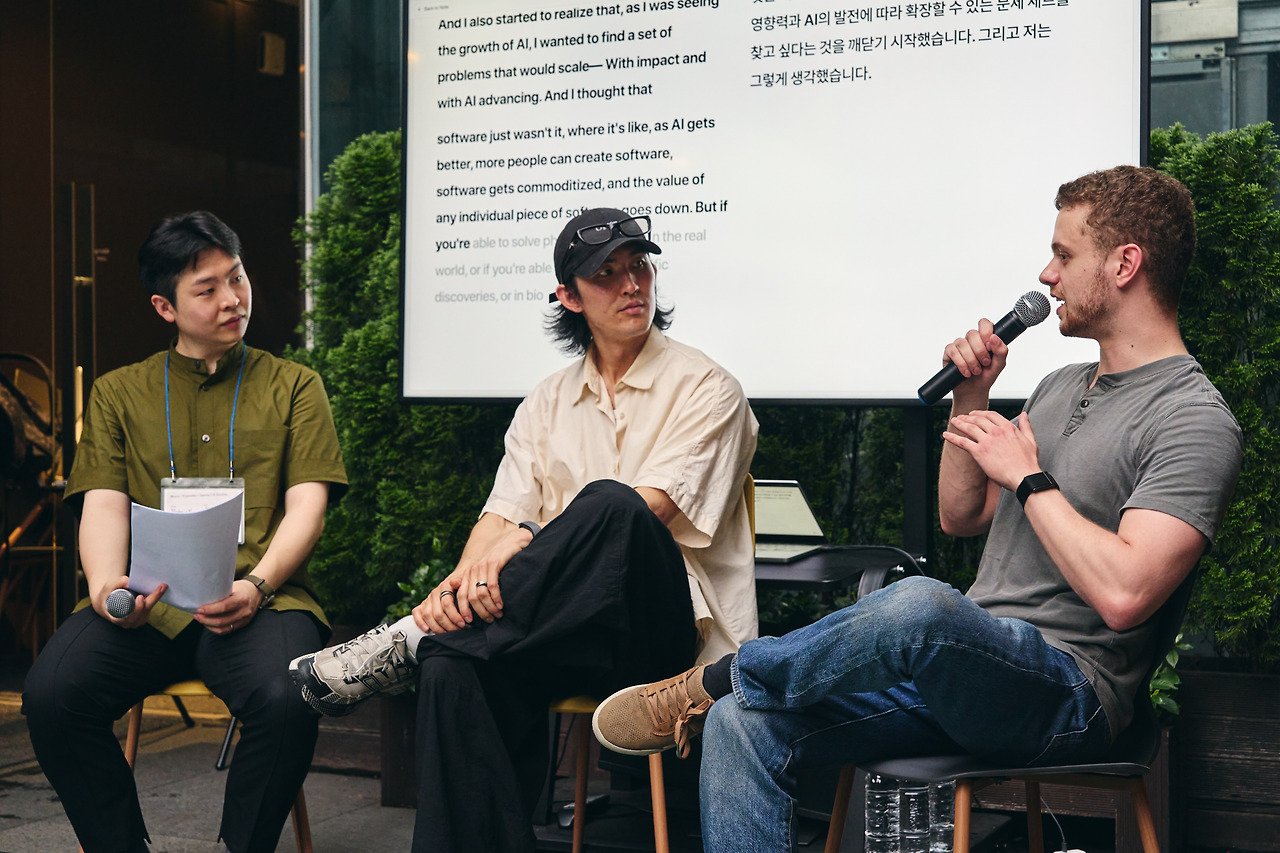
If you are dreaming of going global, book a 2-week ticket to San Francisco and stop debating it, because every connection starts from the nerve to speak to a stranger first. That was the message of the night.
The better AI gets, the less any single piece of software is worth, but in areas that handle real-world problems, biology among them, the influence grows at the same rate AI does.
What matters in founding a company is not a certificate or a domain career, but whether you lived the problem yourself and whether you can draw the big picture of the solution. That is intellectual honesty.
This post is based on talks given at a Bloom event by Leeho Lim, cofounder of Expedite, and Elian Belot of Serova.
📅 7 July 2026 | 🤝 Bloom × Expedite × Serova × K Auction
🎤 Leeho Lim (Expedite) · Elian Belot (Serova)
🎟️ See the event page
The agentic law firm built by the person who had the problem
We brought two speakers in from abroad to line up with ICML week. One of them clears the path for founders entering the United States and the United Kingdom, and the other builds personalized cancer vaccines, which is one of the hardest startups anyone can attempt. Leeho Lim, cofounder of Expedite, has put up two companies that went through YC and is now building his third. He told us he has never treated company building itself as a mission, though he is clear that he likes the process of working a hard problem out.
His first company, Encord, started from how hard it is to train machine learning models on messy data. A doctor inside the NHS, the British public health service, became the first customer and introduced others, and the company went on to win a Royal Navy contract that Amazon had bid for as well, which left it with solid references in healthcare and defense. The second company taught him something painful. He was fixated on finding a cofounder before anything else, started with someone he did not know well, and the two of them split before the first year was out. Starting a company with someone you do not know well is a genuinely bad choice, he said.
He did not rush the third one. Angel investments in around forty companies showed a pattern: founders who had started in the UK or Canada hit the same administrative wall entering the US, over immigration, corporate structure and equity for staff abroad. The decisive moment was hearing what one founder paid a lawyer to flip a UK entity into a US one, after a 20 million dollar Series A and a move to San Francisco. If somebody sells a poor service at a high price, he would rather build something 10 times better, which is where the agentic law firm Expedite began. That is the original shape of a startup: the person who lived the problem solves it.
When software loses its value, walk into biology
Elian Belot came at it from the opposite direction. He grew up in France, met AI in high school and sensed that the technology would decide the next few decades, and he studied computer science and machine learning in Canada. After graduating he worked as an AI engineer at a software startup in San Francisco, and about a year in he began to notice that something was off. Building products with an LLM was closer to software engineering than to AI research, and as AI improved and anybody could build software, the value of each individual piece of software went down rather than up.

He wanted a problem whose impact grew as AI advanced. In the physical world, in scientific discovery, in biology, discovery and influence swell in step with AI, and software runs the other way. What settled it was that LLMs had made learning an unfamiliar field far easier. Biology, with its vast and complicated unstructured data, is where AI is most useful. He quit, went deep into biology, met founders at Oxford who had just started a personalized cancer vaccine company, joined as their first technical hire and moved to London. The team had raised 8 million dollars in a preseed. He is now Leeho's customer too, because Expedite is handling his O-1 visa for the move to San Francisco.
The US, the UK and San Francisco, and the difference a community makes
Both of them have moved between countries, so we asked what changes from market to market and culture to culture. Elian said the European mood avoids risk and does not encourage standing out, which made it obvious to him that anyone who wanted to found a company would end up going to the US. He put the UK in the middle, with a mindset closer to Europe, a language that works with the US, and enough overlap that whatever happens on the internet applies there right away.
Leeho pointed at community as the core of San Francisco's founder culture. The city runs on a Pay it forward instinct and a tight sense of community, so a founder you meet there puts a hand out at once, curious about what you are doing. London was the reverse, because for all its unicorns the community kept thinning and people to build alongside got harder to find. Elian nodded and said it feels as though everyone builds alone in their own room, even with the best universities and companies right there. The strength of an ecosystem comes from a culture of connecting and helping first, not from the density of capital and talent alone.
Book a 2-week ticket to San Francisco
So where should a Korean founder go? Leeho named the US as the first market. Selling into the UK carries a lot of cultural nuance and unwritten rules, which makes it awkward in much the same way Korea is, while American companies are curious, run short sales cycles and stay open to startups. The method he gave was simple. Book a 2-week flight to San Francisco and ask anybody you have any contact with for an introduction. Being briefly in an unfamiliar city is itself a good reason to ask for one, and one meeting produces another meeting until the introductions snowball.
What Elian pressed hardest on is what Koreans rarely do, speaking to a stranger first. San Francisco is a small city of 100,000, but the density of talent and contacts is high enough that one link opens the network. If the table next to you in a cafe is talking about their startup, walking over to say hello starts the connection. The order Leeho laid out was clear. Think of everyone you know in San Francisco and contact them, go in person to events on Luma or Partiful that catch your eye, and message the people you want to meet on LinkedIn: you are in town for a few days to see the ecosystem and want a coffee.
YC, visas and some blunt practical advice
Leeho got through YC twice, and he said plainly that a VC or an incubator exists to grow somebody else's money, so you have to show a signal that turns into money. The first signal is the traction you already have, and for B2B SaaS nothing lands harder than real revenue and a market that is big enough. The second is validation, talking honestly with several hundred customers and showing that this is a real need rather than a solution bolted onto one. He said YC had rejected him several times as well, and that good incubators like Entrepreneur First, South Park Commons and HF0 keep appearing, so these communities earn their keep for anyone without connections.
Visas came up too, and his company has handled more than 400 O-1 cases at a 100% success rate. The trick is who they turn away. Selling a visa to someone who does not qualify is no different from selling a bad product, so they decline even when it pays. What separates an O-1 case is visibility, a record the government notices: hackathon judging, a little funding, press coverage, bylined articles, a talk at a conference like ICML. Asked whether aiming at the US means physically moving, he said that for top-down enterprise sales or lab-based biology, the first meeting is worth far more in person than over Zoom, and the relationship can carry on over Zoom afterwards.
What Korean founders are good at, and cancer as an information problem
What Elian sees in Korean founders is hunger and fast execution. They are also diligent enough to weigh up direction carefully, and he said that matters more than people assume, because the better AI gets the more the quality of a decision is multiplied. Americans move fast without chewing over direction to the same degree, and Koreans are good at that slower choice of what to work on. The trend he pointed to ran the same way. Silicon Valley is in a slight panic right now, because everyone can code, the value of software is falling, differentiation is hard without a footing in reality, and people are turning toward the physical world.

The cancer part stayed with me. Elian said cancer is still not conquered even though it is an enormous and universal market, because it keeps evolving past the defenses of our own bodies. What makes AI shine there is that it can process vast unstructured data that no human eye can read. Train a transformer on DNA and the sequences that come out are not interpretable by people, yet enormous signal can be pulled out of that latent space. There is no reason cancer has to be an incurable disease, he is convinced, because it is fundamentally an information problem and AI is very good at information.
Someone asked what a person without a domain does in an era when the value of software is falling, and Leeho answered with intellectual honesty. He was never a lawyer, yet he knew in his body where legal problems hurt, and whether he held a certificate did not matter. Claude now drafts a contract easily and a lawyer tidies it lightly, which has cut away a large part of legal work, and what counts is whether you lived the problem yourself and whether you can draw the big picture of the solution.
What a company can take from this
Put into working language, the night leaves four things behind.
- Start from the place where you felt the problem. The original shape of founding a company is not a certificate or a domain career, it is whether you took the pain of that problem yourself and can draw the big picture of the solution.
- Going global starts on foot. If overseas expansion is the goal, book a 2-week ticket to San Francisco, walk into the community in person, and speak to strangers first so that the connections snowball.
- Bet on the side AI amplifies. As the marginal value of software falls, the opportunity sits in areas like biology and the physical world, where influence grows as AI grows.
- Treat careful direction setting as a weapon. The more AI takes over execution, the more the quality of the decision about what to do decides the outcome, and that can be a strength of Korean founders.
Frequently asked questions (FAQ)
Q. Where and how should you start going global?
- The US was recommended as the first market, with short sales cycles and companies that stay open to startups. The method is to book a 2-week ticket to San Francisco, contact the people you already know, attend events on Luma and Partiful, and reach out on LinkedIn to the people you want to meet.
Q. Why is the founder culture in San Francisco so strong?
- Because of more than the density of capital and talent. There is a Pay it forward instinct and a tight community, so even a founder you have just met shows curiosity and puts a hand out, and connections expand quickly.
Q. Is software founding really worth less in the AI era?
- As anyone can code, it gets harder for any single piece of software to stand apart. Problems in biology or the physical world run the other way, because discovery and influence grow as AI advances, and people are turning in that direction.
Q. Can you found a company without domain expertise or a degree?
- You can. What matters is not a certificate but whether you took the pain of the problem yourself and can draw the big picture of the solution. Specialists can be hired, and an LLM lets you learn an unfamiliar field quickly.
Q. What does an incubator like YC actually look for?
- A signal that turns into money, which means the traction you already have, real revenue in a large market, and validation, real demand confirmed in conversations with several hundred customers. If you are rejected, other good communities such as South Park Commons and HF0 are alternatives.
Watch it again
Keep reading
Join Bloom
Bloom builds offline rooms where people and technology meet. We run them in Seoul, and now beyond it.
- 💬 Discord community, where events are announced first
- ▶️ YouTube, full talks from past events
- 📸 Instagram, photos from the floor
- 🎟️ Upcoming events