An AI Engineer Said He Felt Like a New Grad Again
An AI engineer, a culture critic, a philosophy YouTuber, and a media studies professor in one room in Seoul, talking about what the models are doing to the people who use them most.

"It feels like being a job applicant again." Years of accumulated expertise going flat in months.
The night
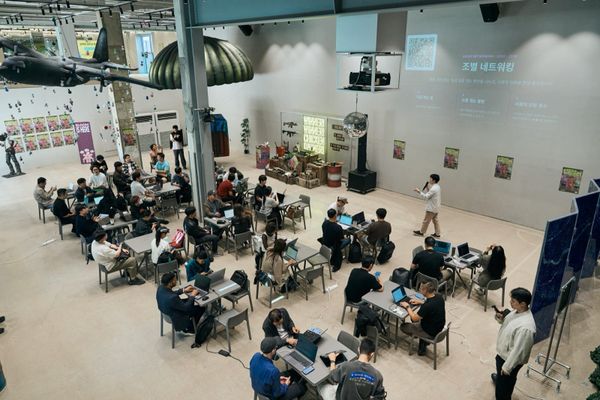
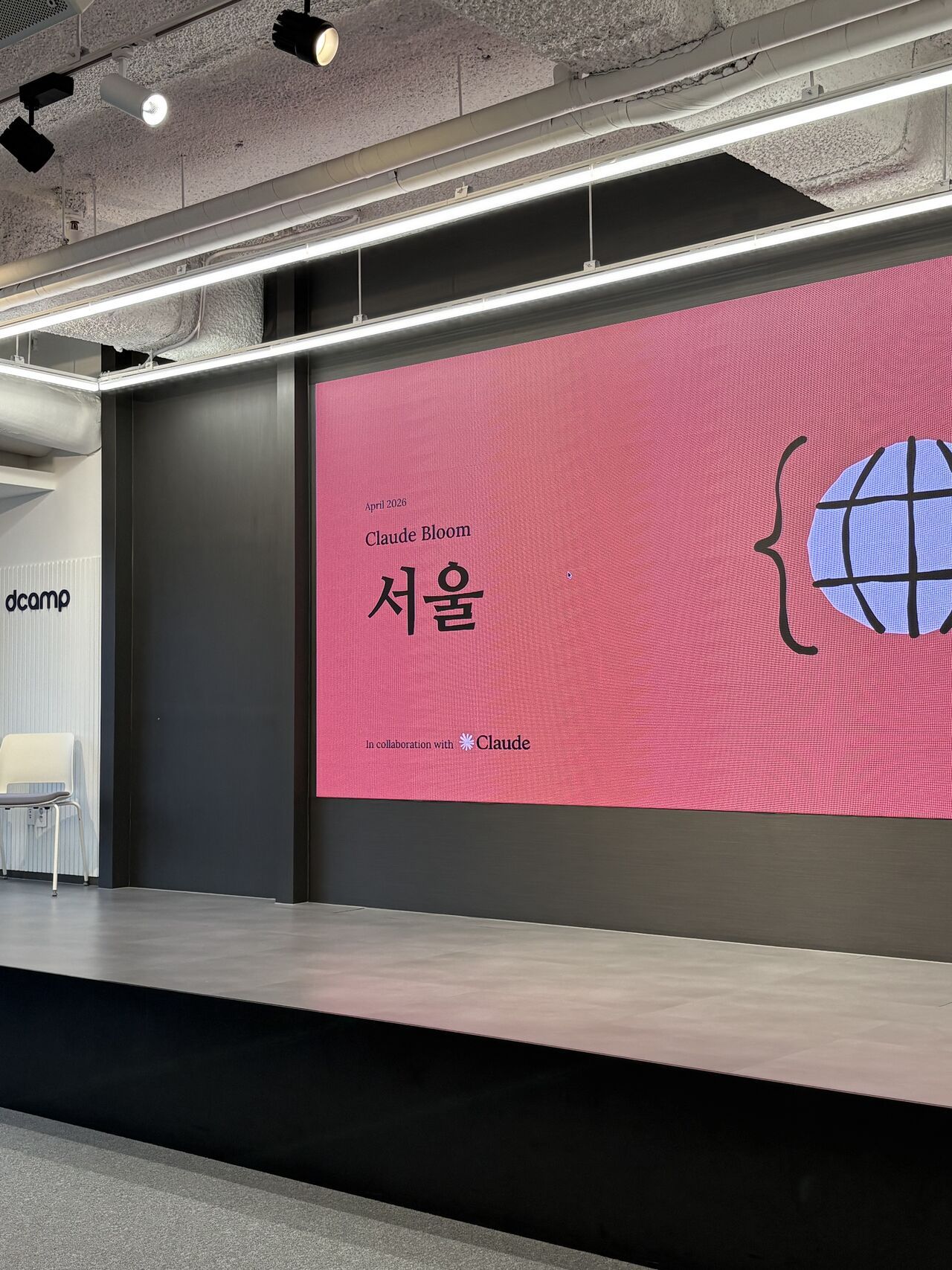
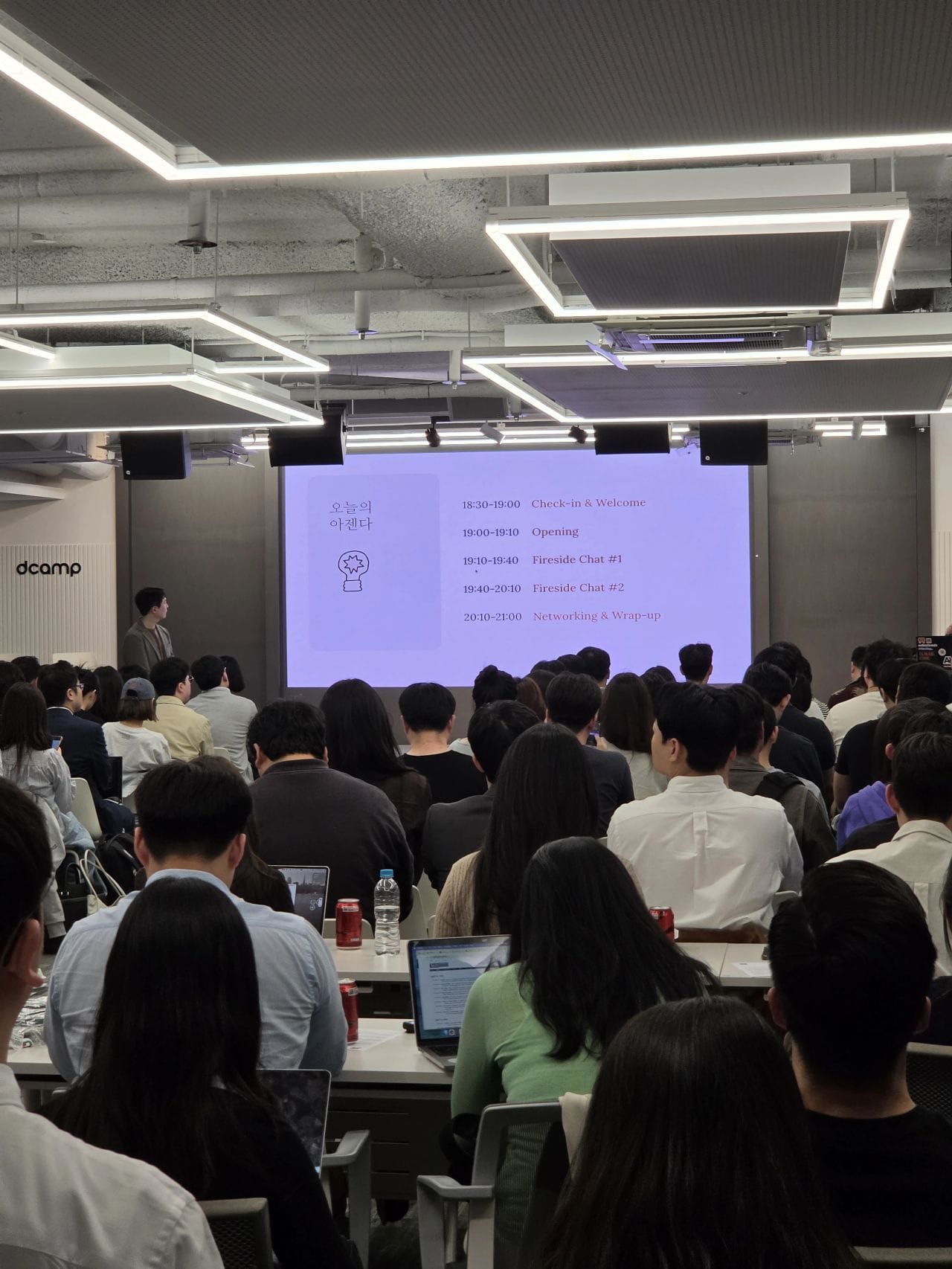
This was Bloom's first event, and the goal was to put Claude Blue and Bloom on the table as an agenda through the Claude community.
More than two thousand applications arrived within days of opening, and the room held one hundred seventy. Almost nobody no-showed, most stayed to the end, and people kept arguing outside the building until the venue closed at eleven.
The clearest finding of the night was this: the more unverifiable information floods the internet, the more people want real conversation and human connection.
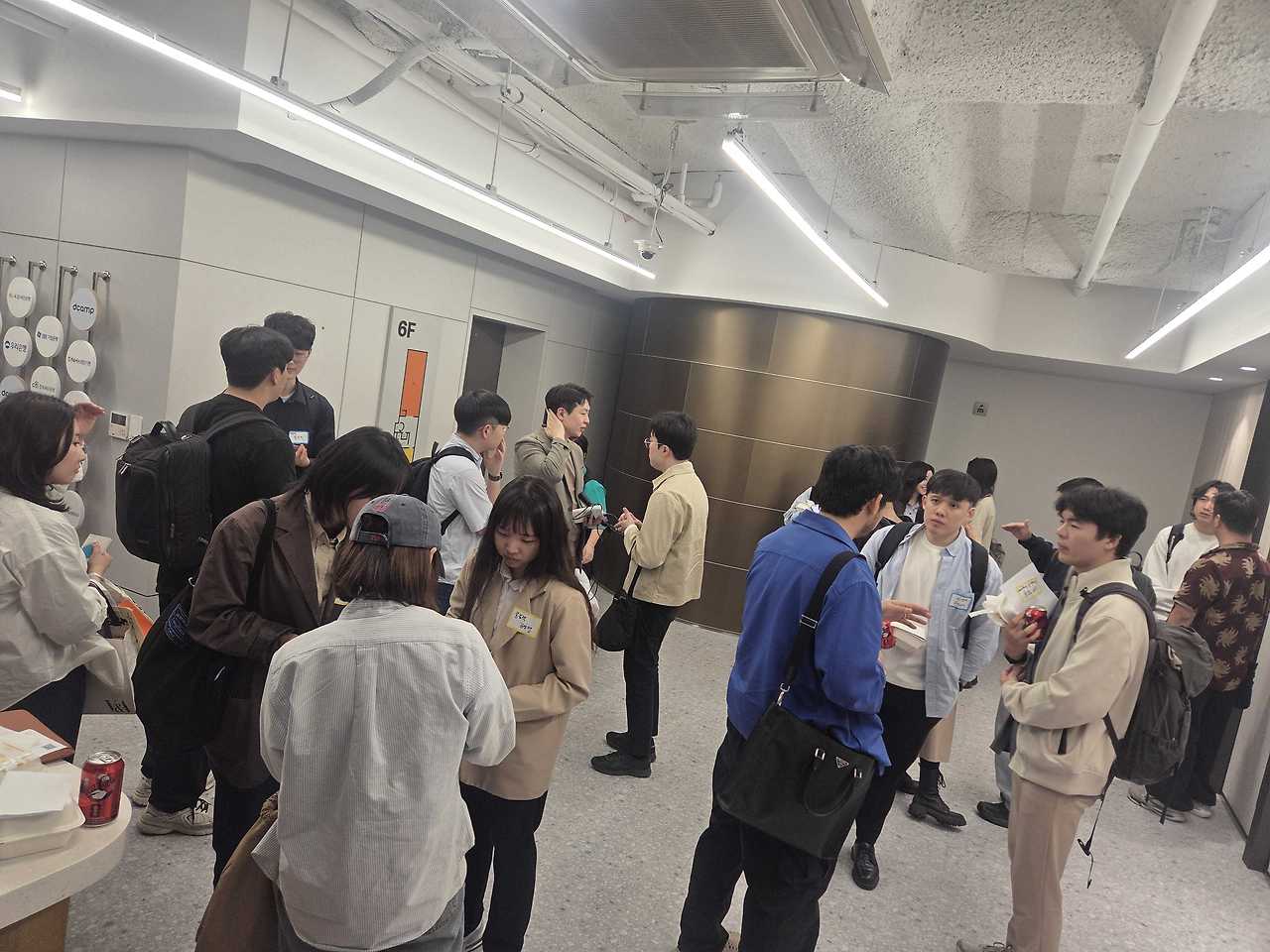
One note worth making: this was not an Anthropic event. Bloom organized it and Anthropic supported as a partner, and that independence is what made the conversation honest.
The anxiety of the top 0.04 percent
The opening framed the night with data: Anthropic had surveyed 81,000 users across 150 countries, the largest multilingual qualitative study of its kind.
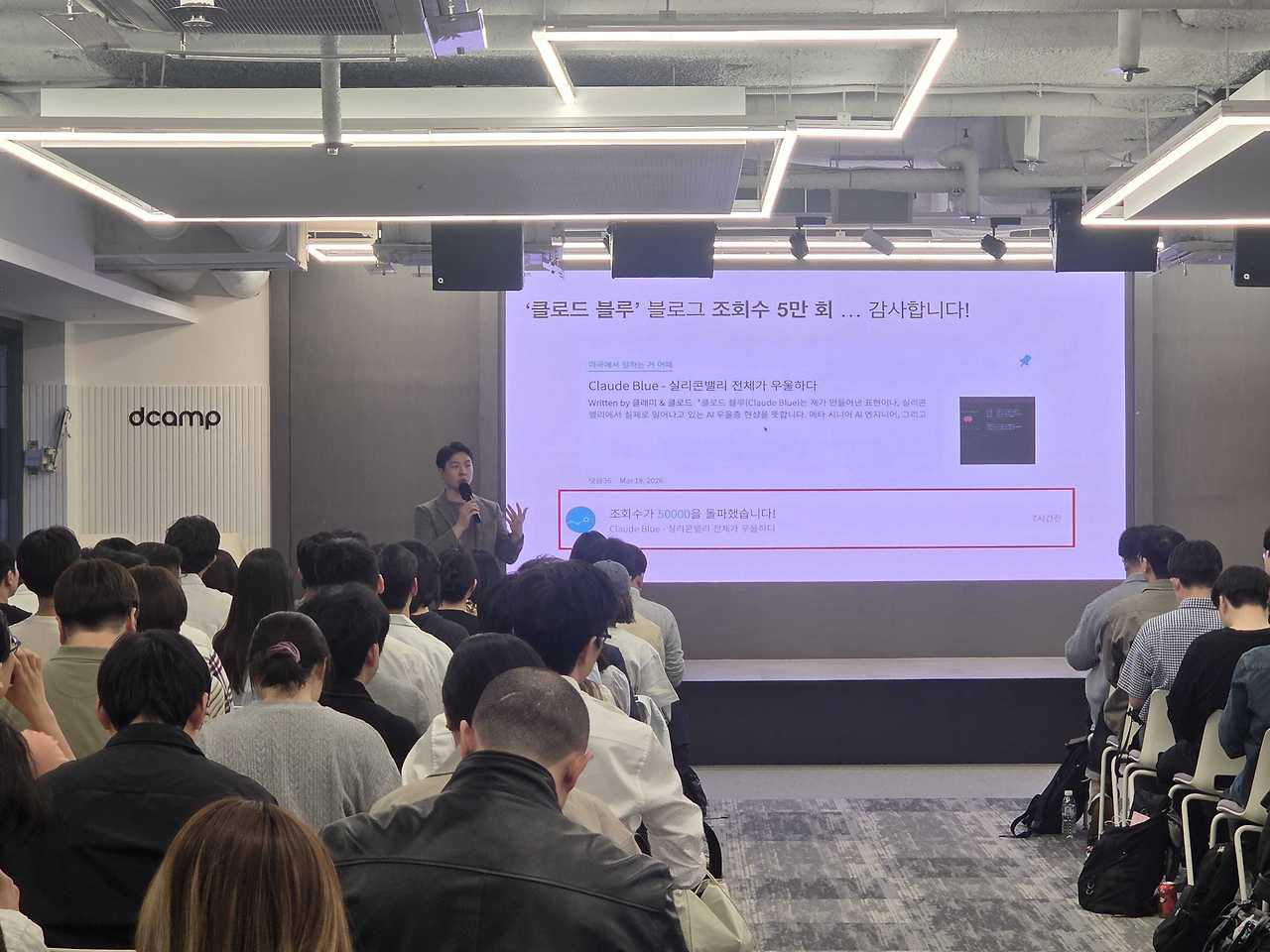
Eighty four percent of the world has never used AI, and the share of people using it for coding is 0.04 percent. Anyone who has vibe coded even once is already in the top fraction of a percent.
Yet anxiety runs high among exactly those people, and East Asia stood out. Two fears dominated: losing the capacity to think independently, and losing a sense of meaning as a species.
"It feels like being a job applicant again"
The first guest was an AI engineer who introduced himself as an ordinary developer, there not because of an extraordinary career but because he wanted to give shape to what he was feeling.
"It feels like being a job applicant again."
As of last summer the framing was that AI helped him write code, and now it is inverted: AI writes the code and he assists the AI. In the cycle of planning, design, execution, and verification, execution has effectively moved, and he estimated that more than ninety percent of software developers are in the same position.
It did not stay at work either, with wedding planning, property research, and data gathering. Anywhere information is involved, the model moves first and the person judges the result.
Chosen change is growth. Forced change is loss.
The sharpest diagnosis of the night was about agency.
Engineering careers have a natural arc from building to managing, and a manager who no longer writes code has not lost agency, because that shift was chosen.
"The core of the blue is that this is something I did not want."
Being told that design is what remains for humans is easy to accept intellectually, but the feeling does not follow, because the transition was not voluntary.
The vibe coding illusion
The second guest was a culture critic who has published a newsletter for five years and worked across a major portal and several startups. He commented on the original Claude Blue post on LinkedIn, which is how he ended up on stage.
He dated his own turn precisely to mid-February, when something was changing and it was not moving at his direction.
Over a six day holiday he went full time with AI, coding until seven in the morning, sleeping three hours, starting again, until at four one morning it broke. Output existed, but understanding what a commit was and how version control actually worked had taken a long time, and he ran straight into his own limits.
"Once vibe coding became normal, there was this sense that anyone could code. I thought so too at first."
It stops being true quickly, because more sophisticated work appears, and matching it requires actual knowledge.
"I spent a fortune on coding classes, and what I got was not coding skill. It was learning how to talk to engineers."
He did not become good at coding, but he learned what language engineers think in, and that turned out to be decisive for giving models precise instructions.
The engineer added the technical version, that approaches like domain driven and test driven development are closer to philosophy than technique, and if you set them up early the codebase has a skeleton to build on. A non-engineer vibe coding starts with no skeleton, so it works at first, then it starts creaking, and in the worst case produces something nobody can collaborate on.
Korea is a risk society
"Korea is a risk society. Make one wrong move and you fall out."
That was his read on the structural FOMO here, and because the cost of failure is so high, addiction to speed is close to rational.
It starts in education, where missing a particular school derails your life and missing a particular company derails it again. Introduce AI into that structure and anxiety multiplies, because the whole path can be invalidated.
He used the 1997 financial crisis as an analogy, a catastrophe at the time which some people recognized a decade later as an enormous opening. That learning cycle has compressed to three to five years, so recognizing opportunity got faster, and so did the pressure.
He added a limit though, that only around ten percent of the population feels this acutely, concentrated among the tech-adjacent and achievement-oriented, and the competition inside that group is what is intensifying.
Making raw data instead of searching it
He was running more than twelve projects at once: newsletter research, entertainment analysis, community automation, and a fully automated global entertainment briefing system covering the US, China, and Japan, where the model handles everything from commits to deployment.
His framing had shifted too, since through February he saw AI as an evolved search engine, and by April he was somewhere else: what if you generate raw data instead?
Give an agent a specific identity, say a person living in Hong Kong in the early twentieth century, train it on ten thousand hours of context, then analyze the data that agent produces, not retrieving existing data but generating a simulated reality. If that much movement happened in two months, forecasting three months out is not meaningful.
"If we all die anyway, why live"
The second session paired a philosophy YouTuber and author with a professor researching AI ethics.
Both used AI heavily, with one spending most of his AI time on translation and using image generation enough to consider dropping his stock photo subscription, while the professor spends five to six hours a day with it.
What was interesting is that both drew a line, since the author refuses to automate content creation, because that part is tied to his identity. The professor shared a costly error: a model wrote the sixteenth where it should have written the seventeenth, and her department lost real money.
In that context he described a question he had put to a model: if we all die anyway, why live. The first answer was standard philosophy, and pushing further produced something stranger, an argument that since you already exist, maximizing pleasure while you do is what serves you.
The professor added the more useful frame.
"The question will not be which questions are fresh and which are obvious. It will be how we interpret and receive the answers."
Pride is not the problem, money is
"People here feel blue partly because AI is smarter and that stings. But underneath it, I think it's economic."
His argument was direct, that inequality will widen. He brought in Habermas, who described this state as political powerlessness: once society organizes entirely around economics, people stop believing politics can change economic outcomes at all. The root of the helplessness people feel toward large technology companies is not that the models are smart.
The professor added a concrete case, where a game company executive told students that entry level hiring had dropped because AI now covers that work, and she watched the light go out of their faces.
He kept historical perspective though, since nuclear weapons did not end humanity, and inequality widened after the internet while most people still built lives. He expected the same here, not optimism, just realism.
Thinking less, and the reshuffling of hierarchy
The deepest stretch was about thinking less, and everything around us is packed: get a job, buy a home, the next step, then the next, with no gap left to stop and think in.
What he meant by transcendence was not religious, but what a person feels facing an infinite universe, or a question about meaning. Humans drift there whenever a gap opens, and modern life has sealed the gaps, so if AI can reopen them, that is a possibility worth taking seriously.
The professor grounded it: in a society where roughly eighty percent of a cohort attends university, practicing thinking less is not simple.
On the question of human standing:
"The question is not whether humans lose the position of the superior being. It is how we move forward alongside these models in line with the values we consider worth holding."
He brought in religious history, where Christianity has God and angels and Buddhism has many tiers, and humans always sat somewhere in the middle of a hierarchy. The idea that humans are the pinnacle is relatively recent, and AI may reshuffle it toward something more horizontal.
Then she raised her six year old daughter, who speaks to voice assistants however she likes, and the deeper issue is that first generation assistants were given female names and female voices. Children growing up with that learn that entities with those names and voices perform supporting work, and how we treat AI is already inside the next generation's daily life, entangled with how they read gender.
The winter of AI ethics
An audience question about model bias drew the sharpest answer of the night. The bias in the models we use accumulated broadly over a long period, so it will not be solved in one pass, and it requires sustained cross-disciplinary work and incremental change.
"Looking at the history of AI ethics, we are in its winter."
The field is expanding while attention and funding contract.
Keep reading
Join Bloom
Bloom builds offline rooms where people and technology meet. We run them in Seoul, and now beyond it.
- 💬 Discord community, where events are announced first
- ▶️ YouTube, full talks from past events
- 📸 Instagram, photos from the floor
- 🎟️ Upcoming events