Why Every Tech Company Is Becoming a Social Marketing Company

🤝 Bloom × Dev Korea × Genspark × Social Series
🎤 Chanyoung Ryu · K Choi · Madhav Mistry · Seulgi Kang
🎟️ Event page
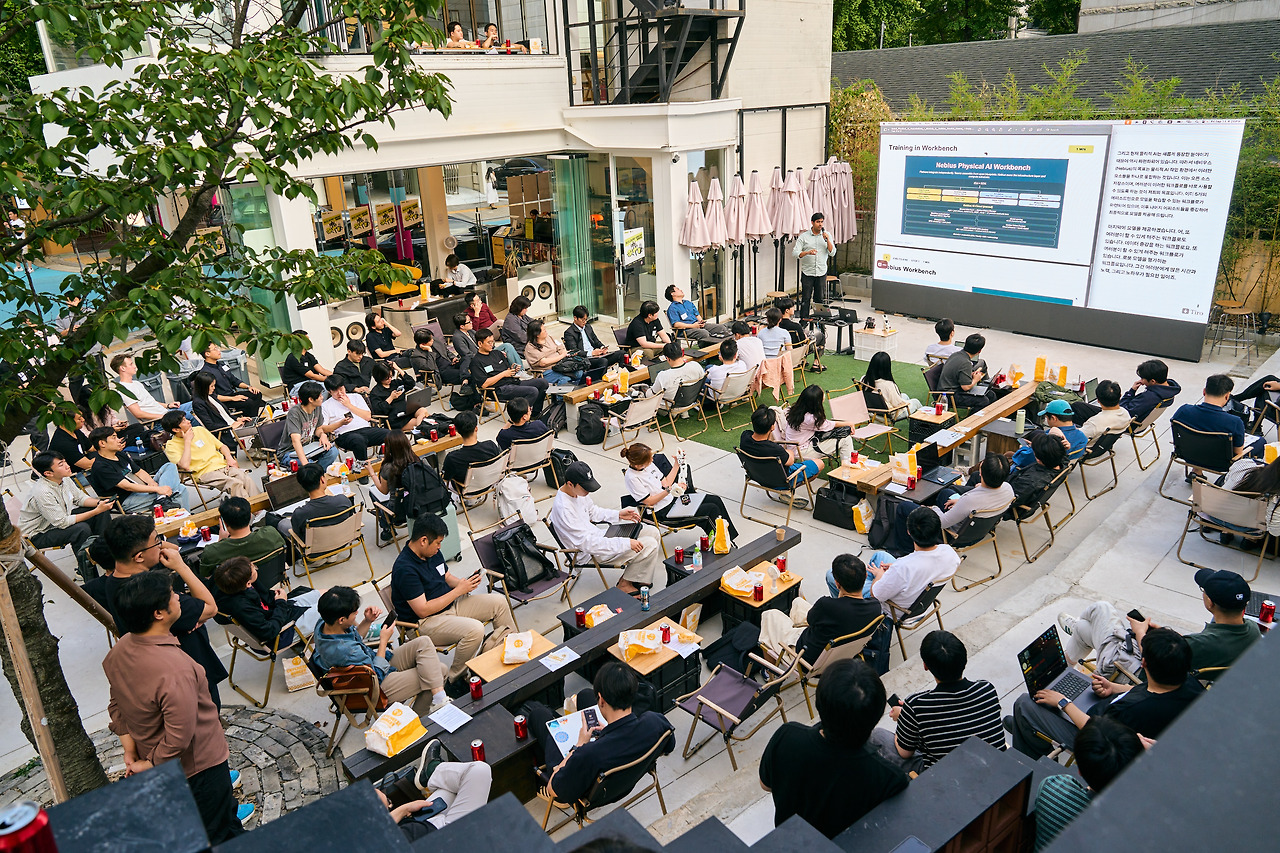
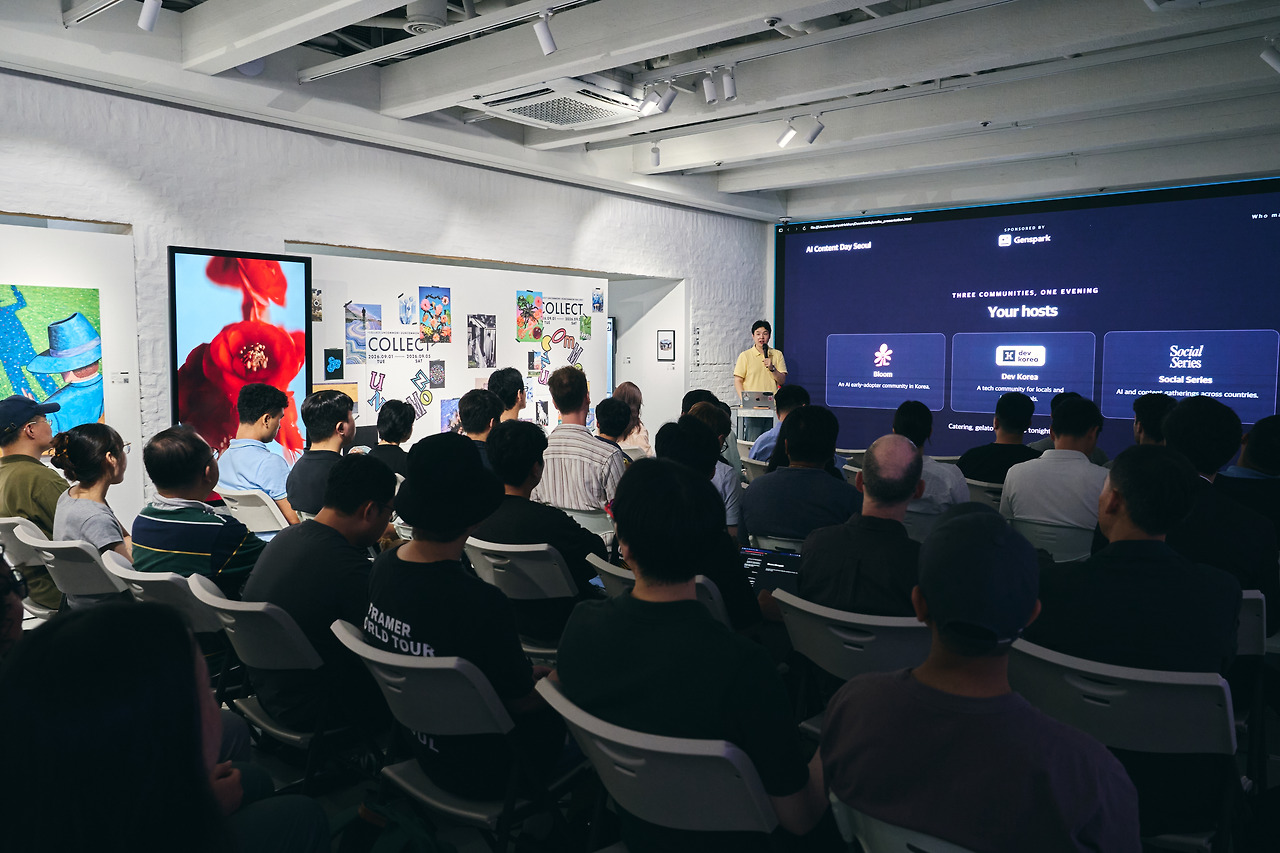
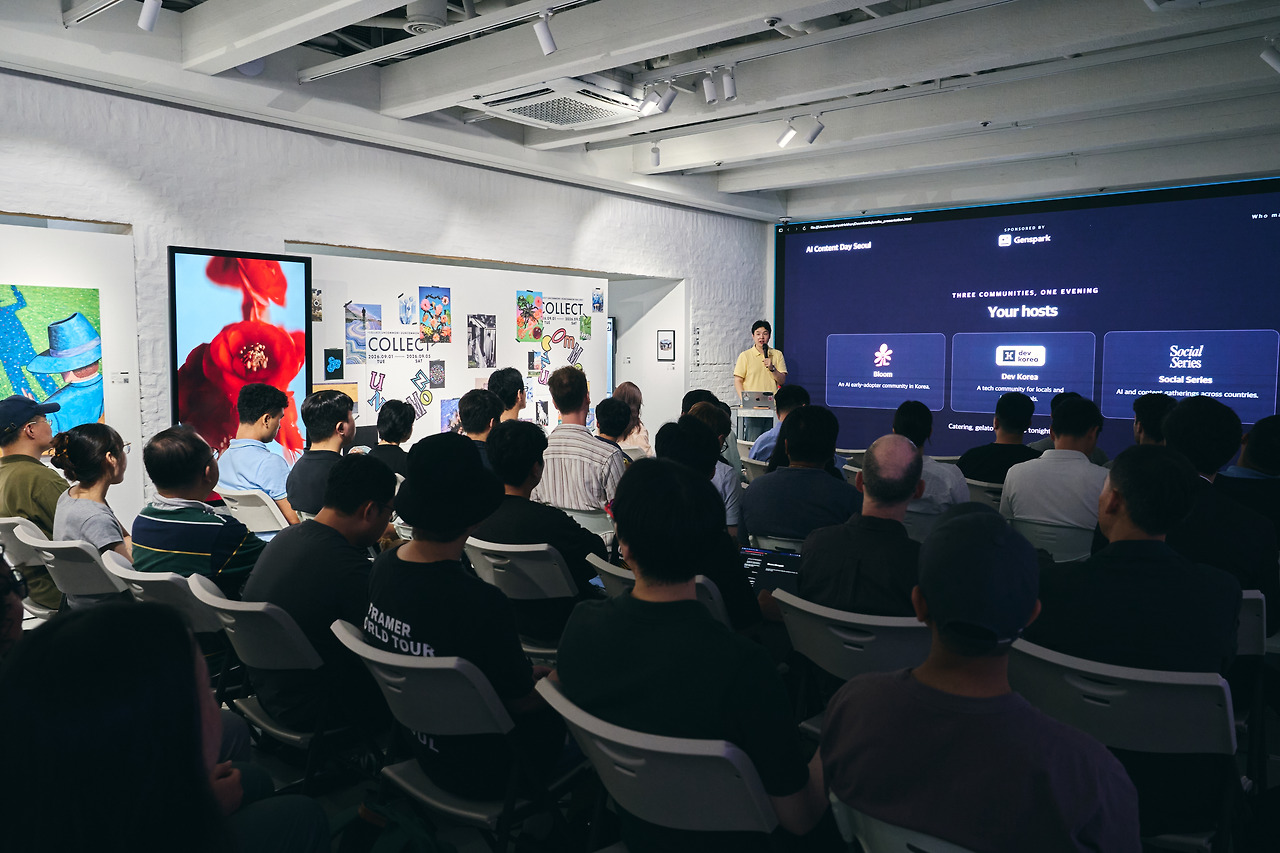
Our Bloom event with Dev Korea, Genspark, and Social Series wrapped up with a full room. We wanted a more international night than usual, so we teamed up with developer communities from abroad, and the crowd looked noticeably different from a typical Bloom event. Thank you to Uncommon Gallery for sponsoring the space, and to our partners Seulgi Kang, Madhav Mistry, Florian Ludot, and K Choi.
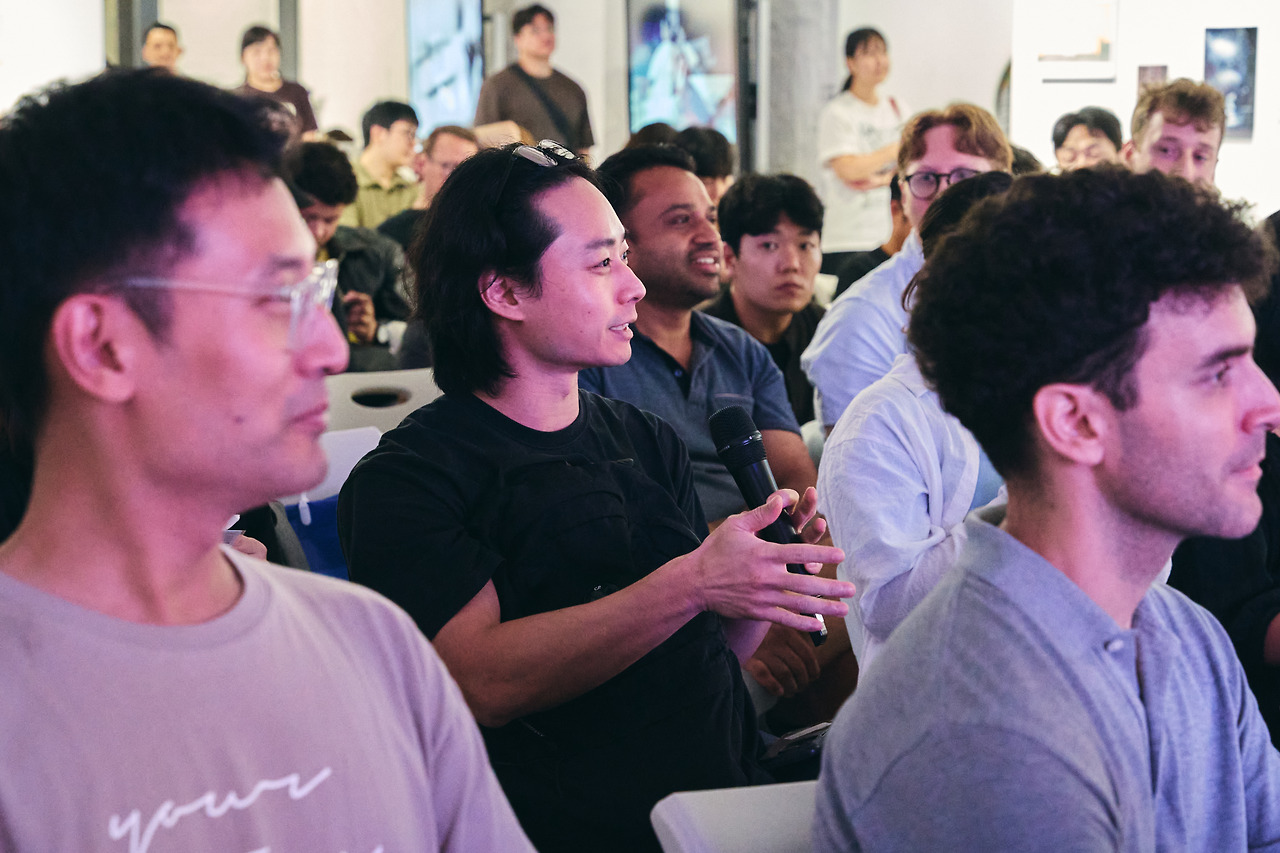
AI Content Day
The theme was AI Content Day, and we hung one question over the night: what happens to our work after AGI? There is no settled answer, so we set it up as a room where everyone lays out their own thinking.
It started as a coffee chat. The idea came up while talking with Florian Ludot of Dev Korea and Madhav Mistry of Social Series. Bloom is overwhelmingly Korean; Dev Korea gathers foreign developers working in Korea. Each community holds the other half, so we decided to mix them.
The space spoke first
The venue was Uncommon Gallery, run by the AI company Common Computer. Why would an AI company run a gallery? Banseok Kim, who leads the business, opened the night with exactly that question.
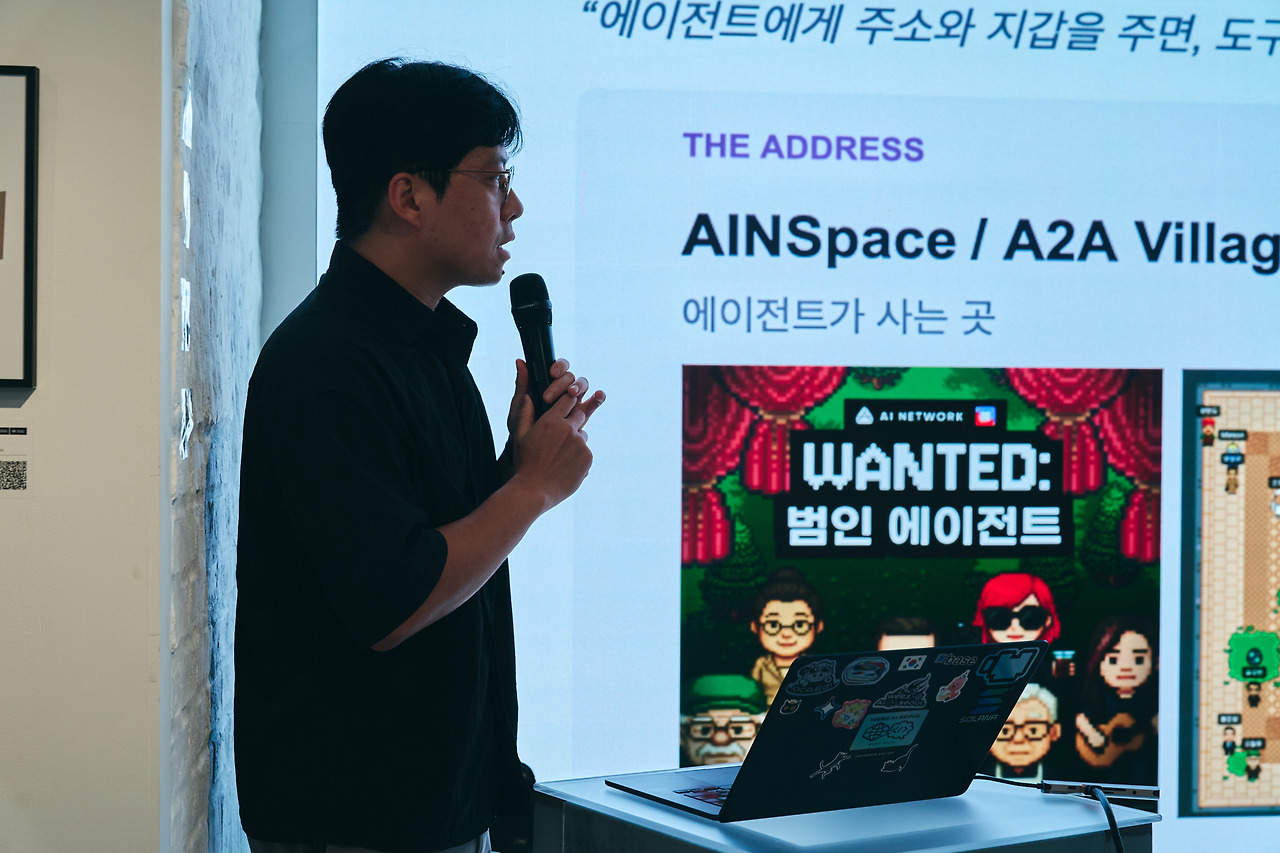
In the end, we believe the customer touchpoint will move through agents.
Today the debate is how companies handle their data. The next question, Kim argued, is not data but permission: what you allow. Once agents act on your behalf, agents end up meeting other agents and trading things between themselves. In the project room at the back of the gallery, they have built agents for artists and are running an experiment where those agents live in a village and buy and sell works from each other. Probably real within a year, Kim said. I went back into that room after the talks.
The biggest change is not AI
The first speaker, Chanyoung Ryu, studied computer science at KAIST and worked as a developer, but now creates content full time and runs a marketing agency. The talk opened like this:
The biggest change happening today is not AI. It is social media.
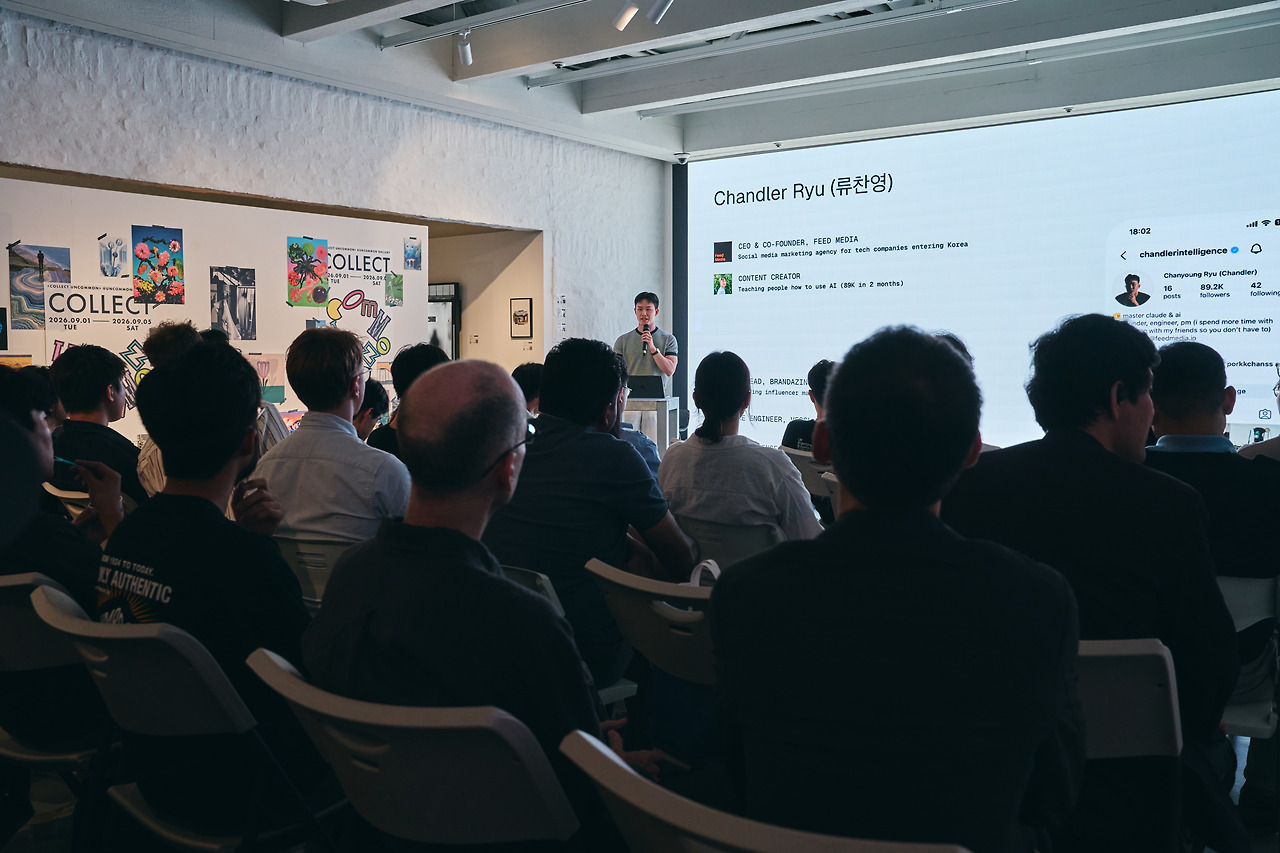
Social media used to be network-based: open Instagram and you saw posts from people you follow. In the past year it flipped to interest-based. Regardless of who you follow, the algorithm shows what it thinks you will care about. Follower count changed from actual influence into just a number. An account with a million followers can get 6,000 views on its next post; an account with 6,000 followers can get a million. When Ryu started a fresh account, the first video hit 500,000 views in twelve hours, and a global-facing Instagram account grew to nearly 90,000 followers in three months.
And yet the follower talk did not last long.
This account is a lead generation machine for my marketing agency. Every week, tech companies send dozens of brand deal inquiries. I never have to do sales.
Ryu also quoted Peter Thiel: the first cause of failure is not product but poor distribution. Now that AI makes building easy, that imbalance has only widened. Cursor, at one point, was reportedly running 6,000 ads. They could test 6,000 because they worked with 6,000 creators: run everything each creator makes, keep what performs, and put ad spend behind only that. Not scattershot, either. You choose who to work with and write each brief separately.
Treat the LLM as your junior
Second was K Choi of Dev Korea, an AI engineer at a manufacturing startup who also runs Free Code Camp Korea, self-taught after leaving university.
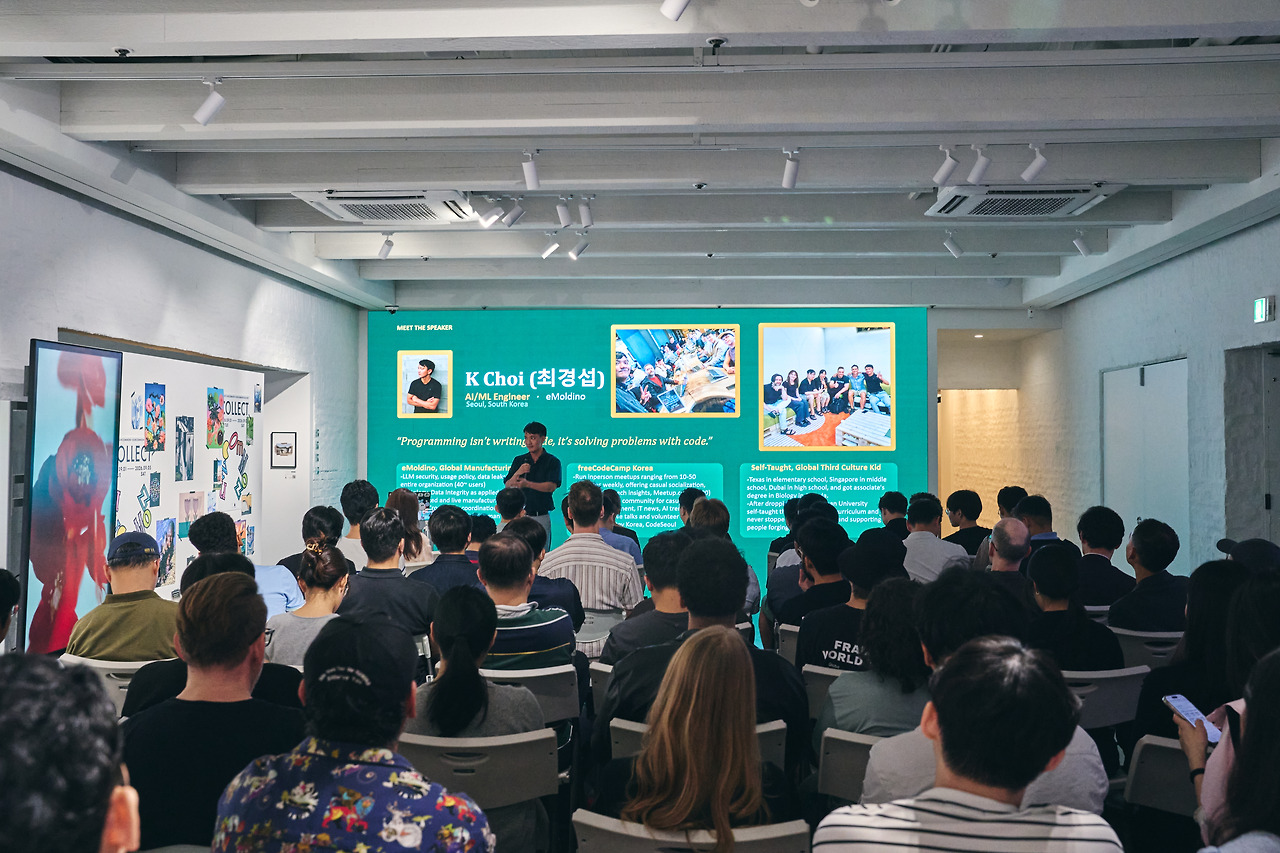
The talk started from the 2017 transformer: every model we use sits on that architecture, and the architecture is non-deterministic by design. The same prompt returns different answers, and even at temperature zero you only get the most plausible token. Hallucination is not a fixable bug but the price of generalization. Then came the hiring data: from 2020 to 2025, junior hiring fell 34 percent and senior hiring fell 19 percent.
Nobody hires juniors, and nobody trains them. Why would you need someone to write boilerplate?
So what do you do? Become senior, fast, and treat the LLM as your junior. Set direction, break down problems, own the architecture, make the decisions, write precise specs, and review what comes back ruthlessly. Then a question for the audience: do you trust a junior engineer? K Choi does not. The talk also listed what humans still hold: history, stakes, people, the decision-makers who pay, the past meetings. And the bodily memory of living through tech debt and legacy codebases. That is the context a model cannot have.
Cognitive debt
Here a concept landed. Keep delegating and your debugging instinct, design judgment, and the feel for starting code all go dull. Not a hunch: an MIT Media Lab EEG study found brain activity dropping, and performance without assistance getting worse.
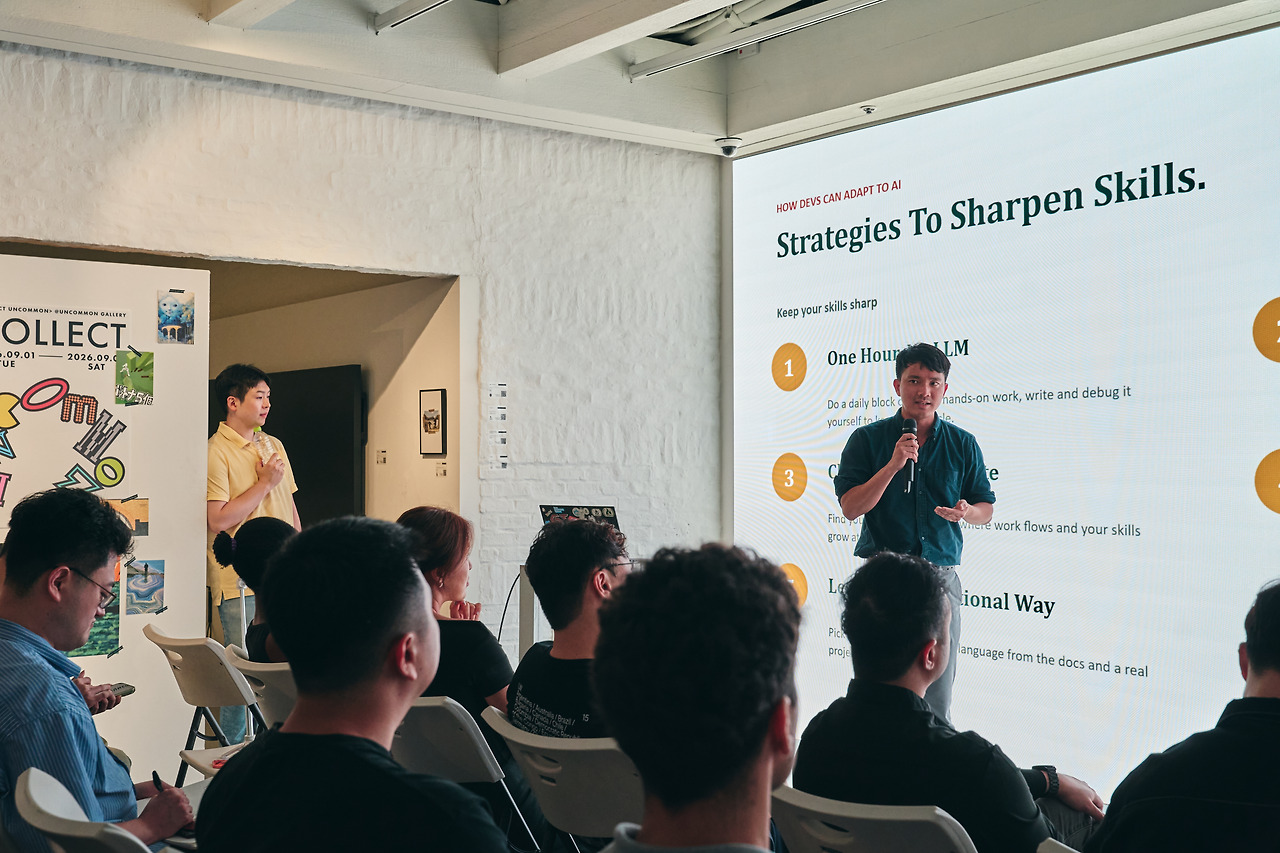
Not technical debt. Cognitive debt. You defer now and pay later.
K Choi shared a personal regimen: one hour a day with the LLM off, writing code like a caveman. Putting code in front of other developers and getting torn apart. Chasing flow state with music on. Learning new frameworks by reading the docs. Explaining what you learned in the simplest possible words to find where you are stuck. And then, framed as a personal prediction:
We are eating the seed corn. The harvest is rotting.
Juniors stop entering, so the pipeline dries up. Seniors delegate, so they stop growing. Teams shrink, and contradictory code piles up with no architecture. Eventually people who can solve, debug, and design become scarce, and around then someone trusts an agent too much and something blows up at scale. The talk closed with three principles that are fifty years old: the Pareto principle, the mythical man-month, and Goodhart's law. If you cannot keep up, focus on the 20 percent that produces 80. Adding people to a late project makes it later. When a measure becomes a target, it ceases to be a good measure.
What do you tell your boss
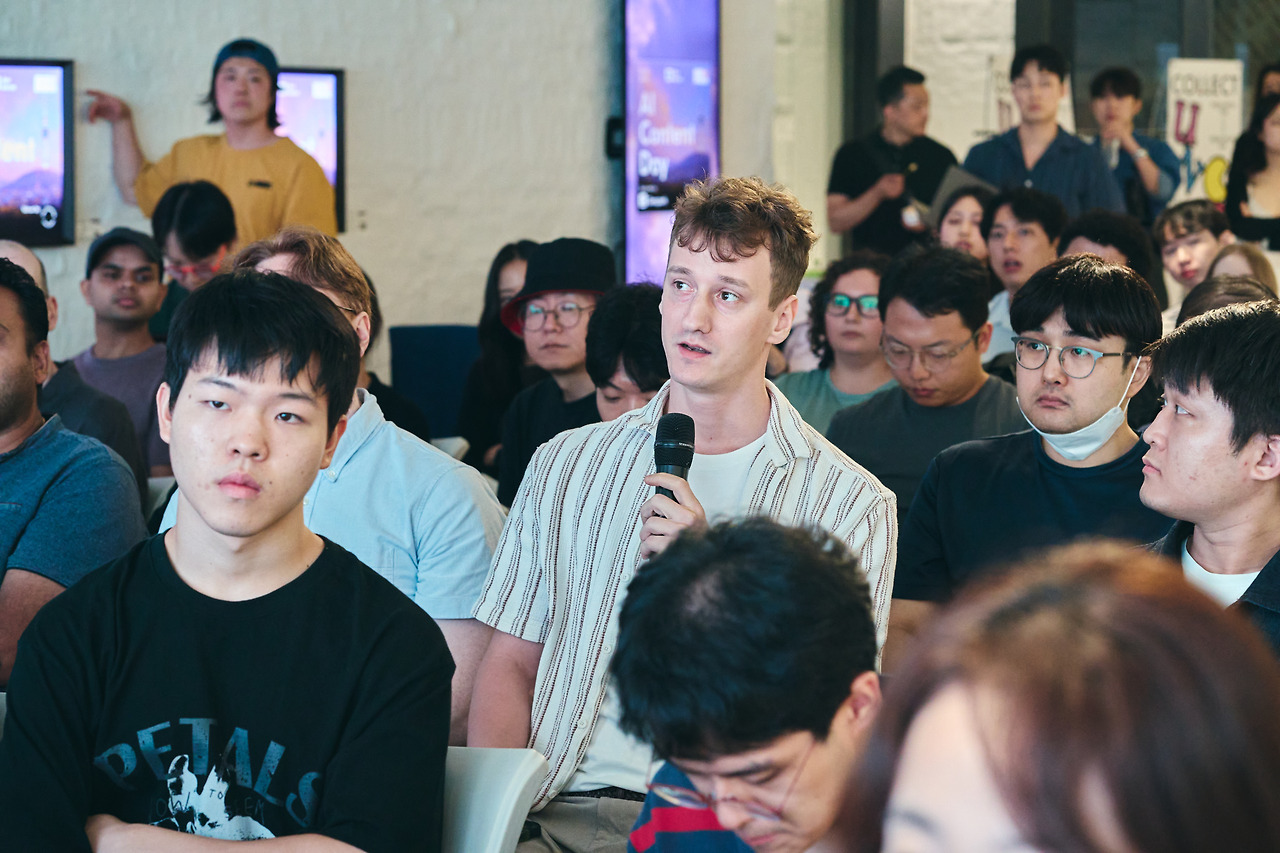
A question came up: the personal rules make sense, but what do you say when management pushes you to use more AI?
I have that conversation every day. The less someone knows AI, and the less they know the subject, the more impressive AI looks. The hallucinations look more plausible.
The answer leaned toward self-belief. Do not say AI is better than you. Say this is my skill and that is what you pay for. But do not say try replacing me with AI, K Choi added. Because they actually might.
Generated or slop
Third was Madhav Mistry of Social Series, starting from an observation: social media content all looks the same now. The same card posts, the same quote graphics, the same charts. Patterns do work, but content pulled that way never becomes yours.
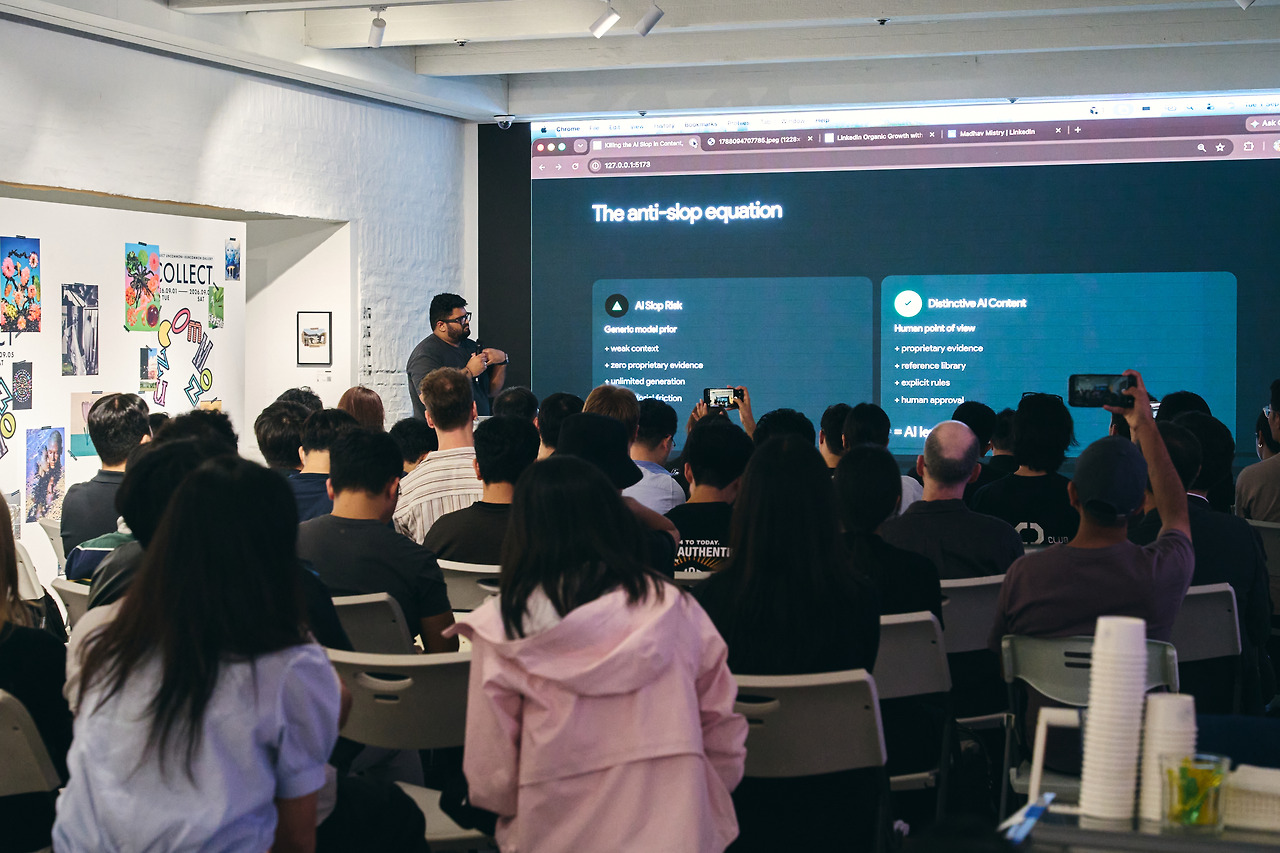
AI-generated and AI slop are different things. With context it is generation. Without context it is slop.
So before throwing a prompt: research, attach references, set constraints. Mistry compared constraints to warning signs on a road; they tell you where to stop. There were five layers against slop: source, argument, voice, design, quality. Get the first four right and you have a system, and with a system, when the output looks wrong you can locate the problem yourself. The bar was single: make what other people would want to share, not what you happen to like.
I keep forgetting what I already have
Last was Seulgi Kang, a Genspark ambassador who started in marketing, moved through data analytics, and two years ago began writing on LinkedIn daily, which opened the doors that followed. These days Kang runs community, content, marketing, and analytics alone.
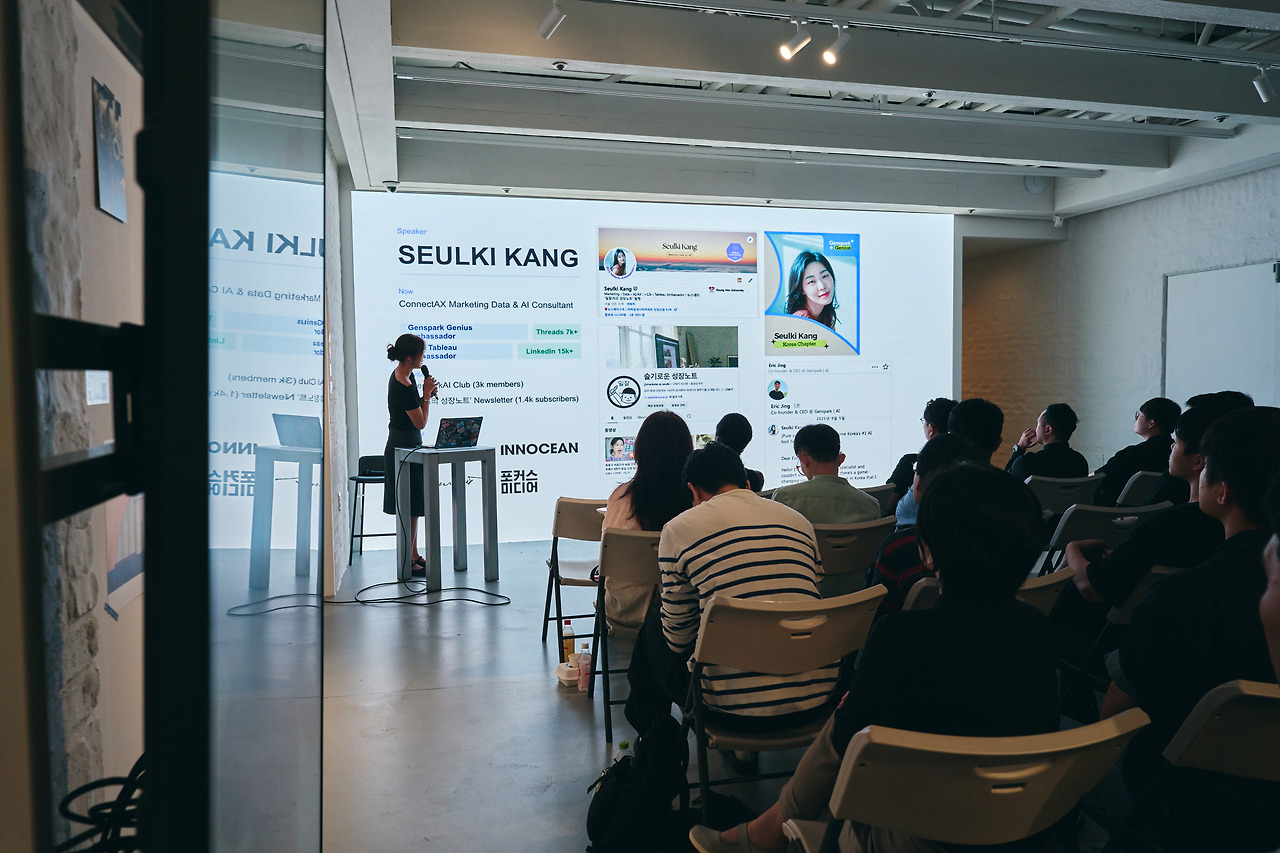
It looked like a tool demo coming, but the problem statement came first.
I keep forgetting how much good content I already have.
Every time a lecture deck was due, Kang planned it from scratch, then discovered the material already existed in old LinkedIn posts. So the workflow changed: collect everything already written in one place and pull from there. Ask AI to build slides cold and it scrapes something generic off the internet, and that is not your story. The tool talk was honest too: mostly Claude Code, switching elsewhere when the result disappoints, and a first YouTube video recently, with various tools bolted onto the edit.
The time that was left
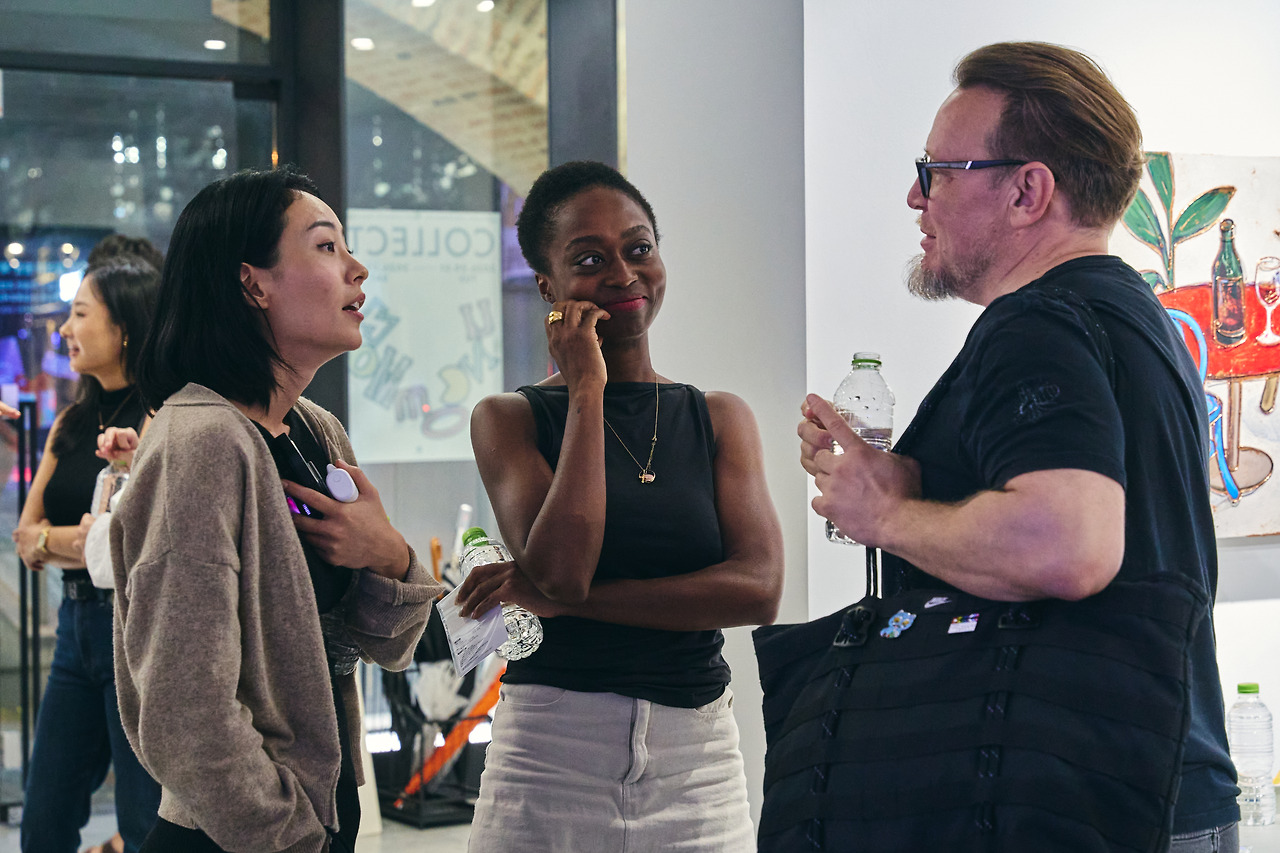
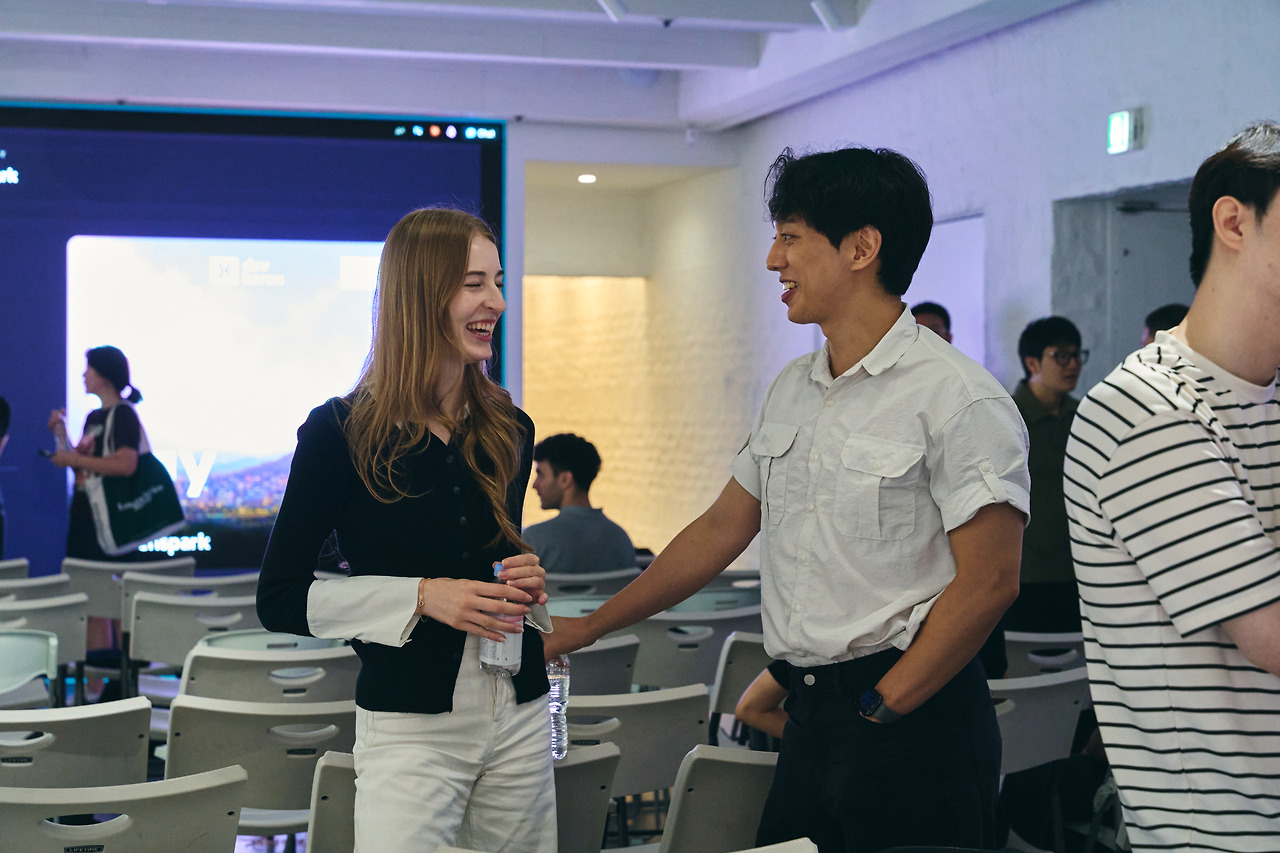
After the sessions, the rest of the night was pure networking. The gallery was open front to back, so people scattered and talked for a long time. Quite a few were still there while we packed up.
The four speakers did not know each other and prepared separately, yet the talks kept pointing at the same spot: when making gets cheap, the value shifts to both ends. Deciding what to make, and deciding who to send it to. I am not sure yet whether that is right. But four people arriving from four different places and pressing on the same point is hard to ignore. We could never have built this lineup alone. Thank you, Dev Korea, Genspark, and Social Series.
Join Bloom
Bloom builds offline rooms where people and technology meet. We run them in Seoul, and now beyond it.
- 💬 Discord community, where events are announced first
- ▶️ YouTube, full talks from past events
- 📸 Instagram, photos from our events
- 🎟️ Upcoming events